




Our daily Field Notes email is just the kind of jumpstart you need. A fast read. Maybe less than a minute. Because sometimes it just takes one insight to change the trajectory of the day.
Search Field Notes
-
If You Must Punish, Design Punishments That Make People Better
If You Must Punish, Design Punishments That Make People Better. When it comes to dissuading negative behaviors, penalties (losing something you already have) are better than punishments (requiring people to do something they don’t want to). This works because penalties remind people what the standards and rules are and why they can’t be violated. Nonetheless,…
-
Penalty Is Better Than Punishment
Penalties and punishments are different ideas that share a similar zip code. Leaders often use the two words and ideas interchangeably without much thought. While they may sound the same, they are distinctly different in expression and effect. A penalty requires you to lose something you already have, whereas a punishment makes you engage in…
-
A Handful of Great Decisions Drown Out All of the Bad Ones
Legendary investor Warren Buffett claims that investment decisions at his firm Berkshire Hathaway have been no better than so-so over nearly six decades, but that about a dozen truly good decisions have made their results sparkle in a way no one else has matched. That’s the way it works with decisions. We all make more…
-
Sharing Best Practices Across Teams
The best team leaders are not bashful about good ideas. They don’t care where a best practice originates. They see their role as finding the best solution or process from anywhere, even those used by competitors. Leaders then incorporate such practices into the everyday approaches of their own teams. Good leaders believe introducing a best…
-
Leaders Are Great Students of Cause and Effect
Now, take a step back and discuss the many possibilities with one or more trusted colleagues. The likelihood is that somewhere within the fishbone diagram lies the root cause that serves as the catalyst for the effect. Talk it out with others using as much empirical and anecdotal evidence as you have. Usually, a strong…
-
Where Else Would You Like to Be?
When he was nearing 80 years old, legendary Chicago Bears football coach George Halas was asked how much longer he intended to work and coach. He replied, “It is only work if you would rather be somewhere else.” When the passion to get to work starts from the first minute of the morning and lasts…
-
Small Signs of Respect Tell People You Honor Relationships
Small signs of respect between people go a long way in establishing a positive and mutually influential relationship. This is especially true in new relationships where the values and character of the other party are largely unknown. Giving respect through small gestures says more about who we are to others than just about any other…
-
Going Last Increases Your Luck
Going Last Increases Your Luck. People not only remember more accurately what happened recently, but in the face of competing information or when choosing between alternatives, those who judge have a distinct bias for the last performance. This is especially true if the last presentation or performance has distinct qualities. Comparison between competitors makes the…
-
Encouraging Others to View Critical Feedback as a Reward
Encouraging Others to View Critical Feedback as a Reward. Those team members fixated on improving actively seek feedback and view it as a reward. The more specific and critical the feedback is, the more they relish it. But that’s not true for most people. Encouraging those less inclined to request feedback to view it positively…
-
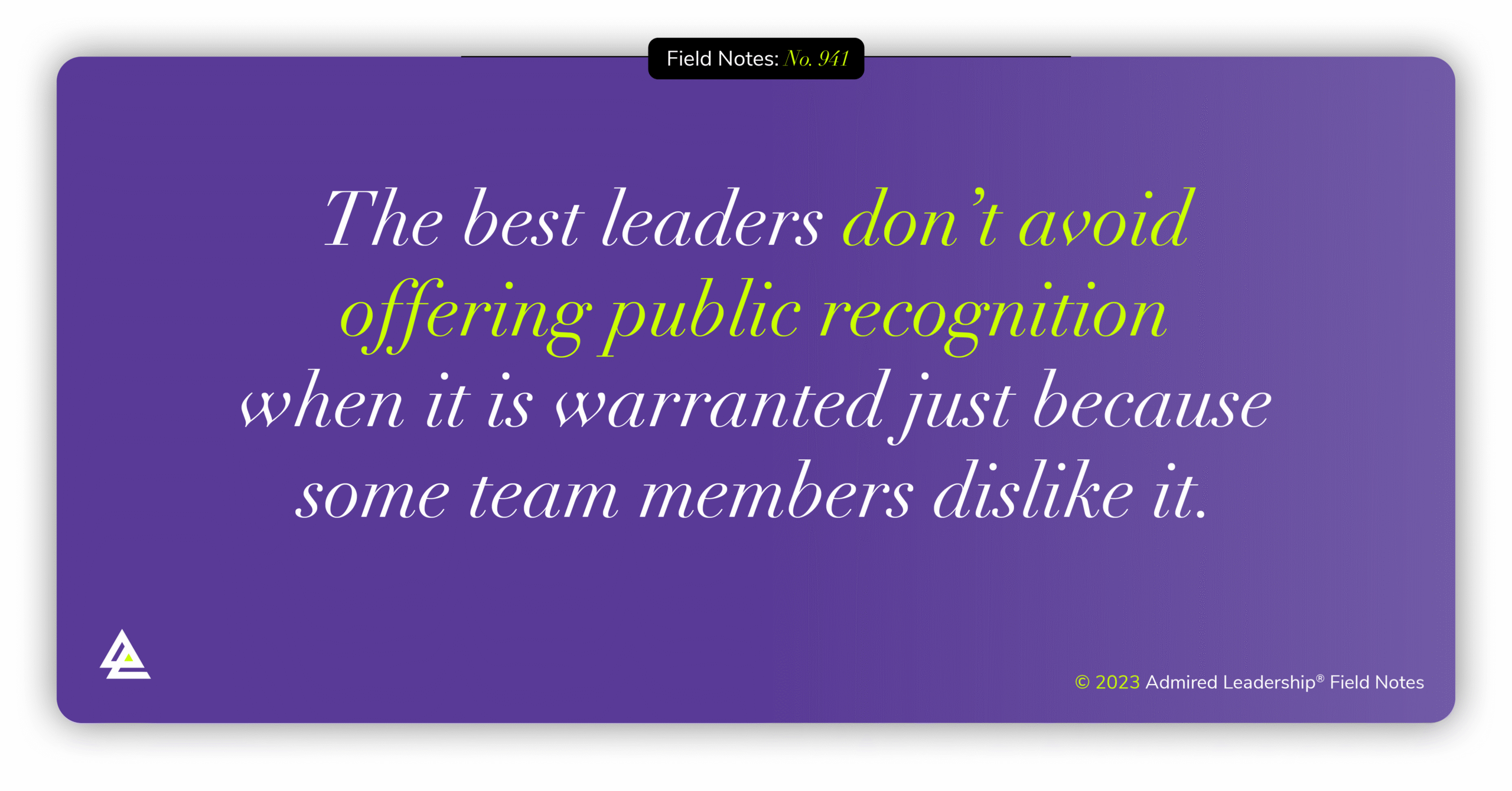
Why Some People Don’t Like Public Recognition
The best leaders don’t avoid offering public recognition when it is warranted just because some team members dislike it. Instead, they insist on confirming that everyone on the team believes a single peer deserves such an accolade. Better yet, they occasionally let the peers offer the recognition. It always takes excellence to recognize excellence.