

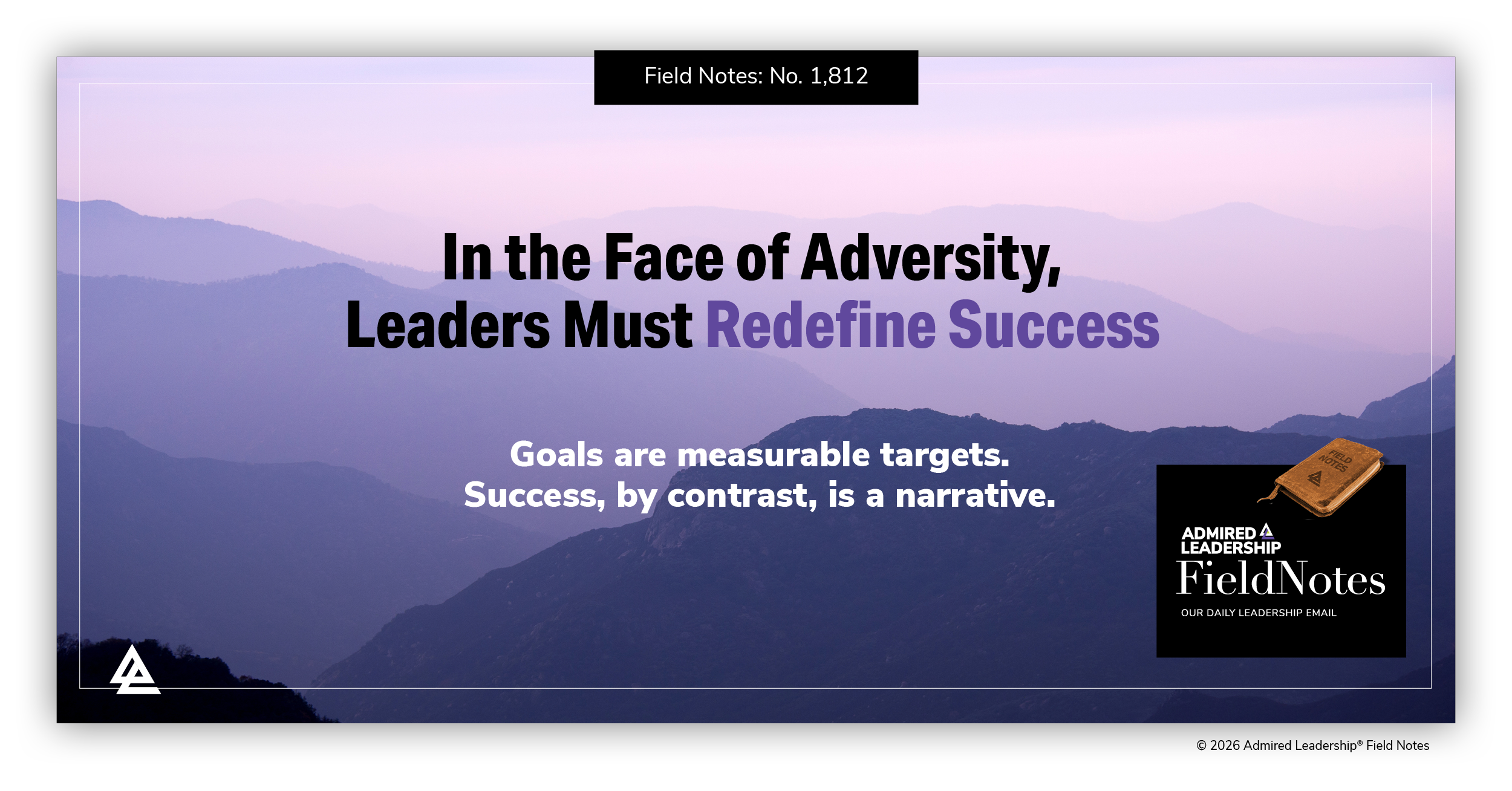
When the headwinds are strong and the organization’s goals can no longer be met, leaders must remember to redefine success for the team.
It is not enough to simply lower the bar or to set new and achievable goals.
Team members need more to maintain their commitment and engagement in the face of adversity. They need to know what now constitutes success and what it looks like in the current environment.
Setting new goals does not replace the need to redefine success. It’s easy for leaders to miss this.
Goals are measurable targets. Success, by contrast, is a narrative. It answers the question that every team member is quietly asking: Does what I’m doing still matter?
When adversity disrupts the original mission, people need more than a revised scorecard. They need a compelling story about why the work in front of them is still worthy of their best effort. Without that story, the new goals feel like a retreat, not a rallying cry.
Before crafting a new narrative of success, leaders must first acknowledge the setback and the reason for a shift to a new direction. They must get honest and admit their disappointment. This means describing why conditions have changed or what forces have arisen that make the original vision and goal set unachievable.
Good leaders don’t redefine success by packaging disappointment as opportunity. Teams can quickly sniff out the “spin” of simple reframing. They don’t want a consolation prize. They desire a new and compelling challenge.
Consider a sales team that has lost its largest client and missed its annual revenue target. Telling them to “focus on the learning” or “use this as a reset” signals a leader who has run out of real answers.
A new definition of success will typically focus on what is within the team’s control and why it matters. The pivot is not just directional.
Success is now defined by what the team must do to prove itself, regardless of the outcome that adversity has taken off the table.
In the sales team example, the new vision might sound like this:
- “I want to be direct with you. Losing our biggest client was a significant blow, and I’m not going to pretend otherwise. They represented 30% of our revenue and a relationship we had built for over a decade. Missing our annual target as a result is a real disappointment—for me, and I suspect for you. So, let me be clear about where we stand and what success looks like from here.
- “We’re not going to hit the number we set out to hit. That goal is gone, and it would be dishonest of me to replace it with a smaller version of the same ambition and call it a win. What I’m asking instead is something much harder and more important.
- “Between now and year-end, success means building a pipeline that ensures no single client ever holds that kind of leverage over us again. It means that each of you identifies and advances three relationships that could, over time, become the kind of partnership our big client once was. It means we leave this year having learned what made us vulnerable and having done something about it.”
Ultimately, how a leader defines success during adversity reveals what they truly believe about the team and the people they lead. If they simply lower expectations and wait for conditions to improve, they signal that the team’s value is conditional and dependent on favorable circumstances.
But leaders who invest the effort to articulate a new, meaningful, honest, and achievable vision of success send a far more powerful message — that the team’s character, adaptability, and commitment matter more than any single outcome.
Teams with new goals and a new redefinition of success commonly emerge stronger from adversity. And when the headwinds finally ease, they carry with them the hard-won confidence and attitude that no perfect set of circumstances can manufacture on its own.