
To guide an audience’s reasoning about an issue, leaders sometimes ask and answer their own questions.
The ancient Greeks coined the term hypophora to describe the device speakers and writers use to ask a question and then immediately answer it themselves.
Some examples: “Why do we need to change? Because if we don’t, our competitors will continue to steal our customers.” “Can we afford to wait? No.” “What do we need right now? Discipline and focus.”
Hypophora is commonly used in political speeches, sermons, classroom teaching, courtroom arguments, motivational speaking, advertising, and sales presentations.
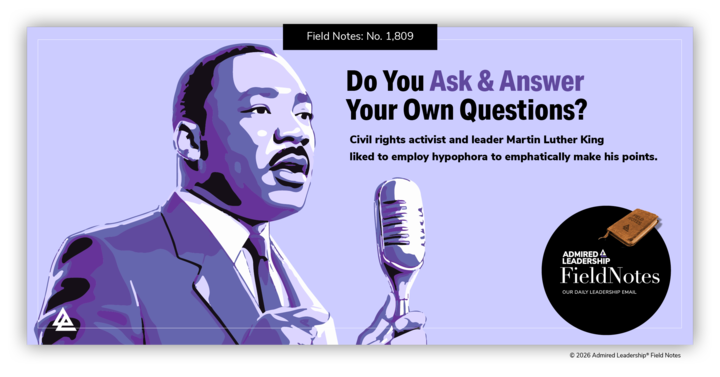
Civil rights leader Martin Luther King Jr. liked to employ hypophora to emphatically make his points: “When will you be satisfied? We can never be satisfied.”
One of history’s greatest orators, King used hypophora to anticipate the criticisms of his detractors: “How does one determine whether a law is just or unjust? A just law is a man-made code that squares with the moral law…an unjust law is a code that is out of harmony with the moral law.”
The question creates curiosity while the answer allows the speaker to deliver the opinion they want the audience to embrace.
Leaders often use the device to emphasize a key point, to counter an objection, to create a conversational tone, or to influence how others think about an issue.
Unlike a rhetorical question, where the speaker leaves the obvious reply unanswered to make a point, hypophora supplies the answer to frame the “correct” response.
It can make communication feel interactive and project confidence and clarity that forestalls competing interpretations. The emphasis and rhythm of the hypophora also make ideas more memorable.
When applied sparingly, it can project confidence and feel engaging and clarifying. For leaders, it can keep the attention of an audience focused on how they want them to view an issue.
But when used too frequently, especially within a single presentation or conversation, it can come across as condescending, arrogant, manipulative, or scripted.
Highly confident leaders, sure of their conclusions, are often unaware that they use hypophora. It’s a valuable speaking device if it isn’t overused.
Now that it’s on your radar, listen for it. Catch yourself and others using hypophora to make a strong point.
Be careful not to go overboard. Answering your own questions has its limits.