



Key Quote:
“Unconscious biases are important to understand because they leak into behaviors and microaggressions that have real world consequences” (p. 50).
Key Points and Concepts
Claiming an Identity
We look to other people to grant us our identity, and when we don’t receive that affirmation, we enter an exhausting pattern of feeling threatened and consequently becoming less of the “good people” we mean to be.
• “When we are unsure of whether an important identity has been granted by others. our craving for affirmation becomes more intense and urgent” (p. 4).
Chugh separates self-identified “good people” into two categories: believers and builders.
• Believers are passive individuals who want to do good but don’t necessarily pursue such actions. They embrace diversity and inclusion theoretically but may not always live out these ideals.
• Builders see and utilize their ordinary privilege—privilege that blends in with the norms around us and are subsequently easily dismissed or overlooked. They’ve activated a growth mindset and therefore act upon their beliefs to do good.
Similar to birds in a V-formation, one person cannot lead all the time. Multiple people must step up to claim their identity as a leader at different times and in various situations to confront society’s pressing issues for all to experience true change.
Moving from Believer to Builder
There are four critical steps believers need to do to become builders (p. 19):
• Activate a growth mindset (vs. a fixed mindset). This includes realizing you are a “good-ish” work-in-progress, rather than a premade good person.
• See your ordinary privilege and use it to help others. Ordinary privilege is an opportunity to stand up for those who have different advantages than you.
• Move to willful awareness and become comfortable with having your beliefs challenged, instead of being content with ignorance.
• Engage people and systems around you so you can hear the perspectives of others and thereby diversify your own beliefs in the process.
When people feel the psychological safety of asking questions and making mistakes, growth mindsets and performance typically flourish (p. 30).
When people express anger over injustice, consider listening to it despite your discomfort, with the intent to grow (p. 33).
“The difference between a fixed mindset and a growth mindset lies in whether we believe we have blind spots” (p. 34).
• In a growth mindset, it’s possible to make “good mistakes,” given that you learn from them and making mistakes is less likely in the future.
• “I’m sorry, I was wrong,” (growth) vs. “I’m sorry you were offended” (fixed) (p. 43).
Exposing yourself to different people stretches your views and helps you become a builder.
Examining Your Unconscious Biases
Unconscious biases are important to understand because they leak into behaviors and microaggressions that have real world consequences (p. 50).
It’s a good habit to “check your privilege” often, examining the ways you may have relative advantage related to your identity (p. 62).
Bounded awareness is our tendency not to perceive readily perceivable information due to our biases. In the face of evidence that challenges our beliefs, we sometimes are unable to see it because it doesn’t match our expectations (p. 97).
We are naturally drawn toward information consistent with what we already believe.
Confirmation bias — We like to think “our mind is like an impartial judge in search of the truth, but it is more like an attorney searching for evidence to support her case” (p. 97).
Intersectionality considers the multiple identities that each person carries.
Do not forfeit an opportunity to learn by getting caught in an argument where you want your opinion to be heard loudest.
Headwinds / Tailwinds
Headwinds are the challenges that make life harder for some people. Tailwinds are the circumstances that make life easier for some people.
These situations can be big, small, visible, and invisible, but they exist in each life and “our failure to see systemic headwinds and tailwinds in the world around us leads us to blame the people facing the headwinds” (p. 65).
When we ignore these, we cannot see the problems others face and subsequently cannot be part of any systemic solution.
In an organization, leaders typically ask the same people to take the lead on certain issues. Instead, we should learn from how a flock of bird flies: In a V-formation, the lead bird flies into the headwind, literally, “cutting the wind so that the other birds can coast in the jet stream. The key to the flock’s success is that the lead bird is not permanent. The lead rotates backward, allowing another bird to step into the role”
(p. 125).
Keeping Your Eyes Open Anyway
In every situation and conversation, you have the choice to either look away or look anyway.
When our values are in tension with one another, we have a tendency to look away. For example, if you care a lot about human trafficking in the clothing industry but love the cheap prices at H&M, you are especially unlikely to check on the manufacturing procedures of your clothing producers.
The more we care about something, the less we want to know.
When we dehumanize or otherize people, casting them outside of our circle because they don’t look or act like us, it’s psychologically easier to inflict pain on them and we are less likely to be bothered by it (p. 149).
It’s especially easy to revert to savior mode when we consider others less fortunate than us. Fight the urge to save; instead, try to advocate. Be a voice but not the voice.
Sympathy vs. Empathy
• Sympathy is when we feel sorry for someone, but we do not try to feel what they are feeling.
• Contrarily, when we express empathy, our attention is centered on the feelings of others, rather than our own.
We also have a tendency to typecast others and throw perceived stereotypes on individuals to our own expectations, even if they are positive. However, this is also dangerous. One might stereotype Asian Americans as smart and hardworking; when academic orientation is assumed, athletic potential is often missed (p. 159).
Steering the Conversation
Those who are more included will likely have greater confirmation bias since everyone feels included.
• This in turn allows them to perpetuate that belief, sometimes unknowingly.
Media narratives are mirrors. Everything we consume, from the music we listen to, to the movies we watch, shapes our minds in micro-ways. Over time they have macro-effects. To become a better person, we have to carefully filter the media we
consume (pp. 191-192).
When psychologists asked children for an explanation
of why the first 43 presidents were white, 26% said they believed it was illegal for a black person to be president (p. 193).
• People create their own narratives in the absence of one, so intentionally create the messages you want others to hear and believe.
If you do not talk about issues within your own community and engage in difficult conversations,
you are also part of the problem through your complicit silence (p. 196).
• Not acting or speaking up due to fear is another act of privilege (p. 199).
You can question many workplace narratives that normally go unnoticed because it’s regarded as “the culture.” When we ask polite questions to gain understanding rather than confronting an issue in an accusatory way, “we gently force people to make the case for the narrative or to adjust it” (p. 204).
Leaning on the Personal Relationship
You can take more risks in confronting others if the relationship is already there; utilize this and start with those closest to you (p. 221).
• When “steering the conversation” and confronting others, ensure the conversation is a private one and make the focus about educating the other on your beliefs, not addressing norms.
“If there is no right way, then each of us can find our own way to be builders and to support builders. The only wrong way is to settle for only being believers” (p. 241).
The 20/60/20 Rule
• 20% of people lack motivation to control their own prejudice. They are not believers and don’t desire to be (the stuck 20).
• Another 20% of people are eager and willing to engage in difficult conversations, and work toward becoming builders (the easy 20).
• The 60% is “best characterized by passivity and silence, the people we are least likely to notice. This is the group most susceptible to influence, from either of the 20% groups” (the middle 60)
(p. 210). These people are influenced by social norms and they are consequently the ones we should try hardest to have conversations with.
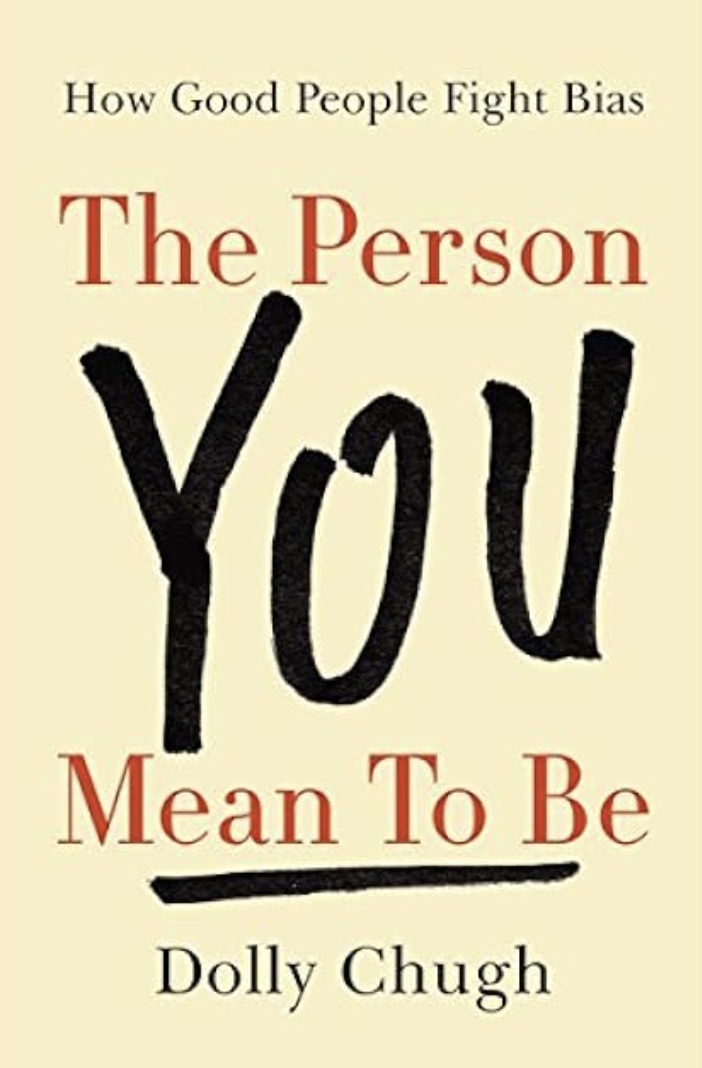
Chugh, D. (2018). The Person You Mean To Be: How Good People Fight Bias. HarperCollins Publishers.

“Prioritize what needs to be done and then assess how much time each task will take in terms of relativity, rather than time estimates, for instance, use the Fibonacci sequence to assign which tasks will have more weight in terms of time and effort.”
“[…] personal concerns are raised first by fellow team members talking with one another. They may bring in others to consult. It may result in feedback, a harsh corrective move, or even dismissal. But it’s a team decision.”
“The Scrum process depends on continuous improvement where you plan, do, check, and act (“act means to change your way of working based on real results and real environmental input.”