



Key Quote:
“Transcendent leaders are acutely aware of their limitations, which makes them humble… they become stewards of principles that foster alignment, collaboration, and use of knowledge to further the organizational mission” — Fred Kofman
Key Points and Concepts
Why Transcendent Leaders are Essential
Transcendent leaders reconcile the need for purpose and significance in their followers: “I believe the most deep-seated, unspoken, and universal anxiety in all of us is the fear that our life is being wasted away” (p. 17).
Kofman argues that organizations win through ‘transcendent leadership’: “Connecting people to their highest purpose at work solves the biggest, hardest problem there is for those who work for organizations” (p. 19).
A true determination to succeed cannot be forced through material incentives alone, but through leaders using higher motives: a feeling of belonging, a sense of achievement, a noble purpose, and ethical principles (p. 13).
What separates humans from animals is a deep search for meaning, derived from helping people or society. Great leaders should cultivate an environment which fosters emotional, spiritual, and psychological fulfillment, to attract top talent and encourage organizational success (pp. 20-21).
Transcendent leaders are already enthusiastic for their cause, which allows them to understand the visceral needs of others: “they understand that if you want to make accountability and cooperation occur at the same time, you need to inspire people and create a culture of commitment and connection to a larger purpose” (p. 18).
Problems in Current Leadership Practices
Disengagement: Failure to understand the human side of workers, which results in a lack of connection between work and the value employees bring to the company, leading to declining commitment to organizational goals and a mentality called “learned helplessness”: a deep-rooted mindset of giving up due to constant negative setbacks or disengagement practices in the past (p. 44).
Disorganization: “KPIs and local incentives [individual goals] encourage people to not recognize each other as teammates” (p. 61). This results in stunted progress towards the global [overall company] goals.
Disinformation: People having different, inconsistent information due to a narrow understanding of their role in the global context, thus struggling to reach unanimous decisions on strategy or problem solving (p. 74).
Disillusion: the significant discrepancy between a leader’s words and his or her actions, which results in mixed messages and behaviors, a lack of trust, and an overall decline in employee satisfaction (p. 95).
The Problem with Monetary Incentives
Intrinsically uninspiring: Money has historically been a conditional motivational force (as acknowledged in Adam Smith’s Wealth of Nations) for employers to control the behaviors of employees, but “Monetary incentives can’t inspire people to care, to work for a common goal, or to support intelligent decision making” (p. 122).
Destroys natural motivation: “Adding financial incentives to situations in which people are motivated to work hard and well without them seems to undermine rather than enhance the motives people already have” – Psychologist Bryan Schwartz (p. 123).
Drives out positive engagement: A leader who relies on financial rewards disturbs the natural drive or choice to work for reasons of integrity, since “financial incentives can never drive people to do good work because they want to, because they care, and because it is the right thing to do” (p. 124).
Limited: Unlike non-material incentives which have no bounds, monetary incentives have limits (p. 35).
The Price of Disengagement
Case Study – Marissa Mayer: Yahoo was sold to Verizon just four years after Marissa Mayer became CEO in 2012. This was largely blamed on her inconsistent, temperamental management style. Employee surveys showed declining morale and leadership trust, communication between vice-presidents turned vicious, and problems were left unsolved. “Mayer’s biggest mistake as a CEO was perhaps what Forbes contributor Mike Mayatt identified as a failure to understand Yahoo’s culture, which he claims grew toxic under her leadership” (p. 34). Upon entering Yahoo, Mayer neglected to understand the company culture and employee values. She implemented her own management vision without regard to the emotional needs of her employees, leading to disengagement and failure (pp. 34-35).
Case Study – Martin Winterkorn: Under the leadership of CEO Martin Winterkorn, known for his highly critical and demanding management style, a major emissions test scandal surfaced at Volkswagen in September 2015. The controversy left Winterkorn apologetic and shocked, but ultimately reluctant to take any responsibility. He blamed his workers in the United States before eventually resigning. Not only did the emissions scandal cause serious financial damage to the company, but Volkswagen also faced scrutiny for potential health effects in Europe due to the pollution from illegal levels of nitrogen oxide. Although Winterkorn may not have done anything directly to contribute to the emissions fraud, he is a clear example of how bad leadership can indirectly escalate problems. “He was a disengaging, controlling, and arrogant leader who promoted, and likely abetted, behaviors that drove VW over the cliff. He wound off resigning under an avalanche of criticism and accusations, leaving his company to face billions of dollars in fines and criminal investigations” (p. 92).
Balancing Power and Leadership
Power naturally manifests itself through trust and commitment from others, but paradoxically the power earned can in turn make leaders seem untrustworthy (p. 104).
Power can lead to selfishness: “Power encourages people to act on their own whims, desires, and impulses” (p. 104).
Integrity is the only way to balance the corrosive side of power within leadership, motivating the leader to remain committed to doing what is right at the expense of his or her selfish interests (p. 107).
The Meaning Revolution: Solutions to Organizational Problems
Employees need intrinsic motivation to stay engaged at work. This is built from a sense of purpose, ethical work practices and policies, a feeling of belonging to the company and the world at large, while also having a level of autonomy over one’s work (p. 121).
Taking the time to define organizational culture is vital for executing strategy. This “elicits their [employees] internal commitment and provides a sense of individual and collective identity” (p. 146).
Challenges are inevitable, and transcendent leaders need to take responsibility for these challenges regardless of their contribution to the problem, which positively impacts others’ responses. “Instead of seeing and presenting yourself as a victim of forces beyond your control, you must see and present yourself as a player responding to a challenge” (p. 168).
Leaders must establish principles of integrity in the culture of their organization so that everyone understands the relationship between their work and the purpose of their work. But leaders must also understand the value of commitment from employees: they must ask rather than demand (p. 221).
To prevent miscommunication, Kofman advocates that organizations use “escalating collaboration” (see below) which means working together to understand the best way to reach the common objective without pinning people against each other (p. 195).
On ‘Escalating Collaboration’ in Organizations
Escalating collaboration involves both disagreeing parties working together to establish a mutual solution instead of individually seeking approval or biased direction from a third party (often managers), which typically escalates the conflict (pp. 194-198).
Both parties must ask each other, and attentively listen during the following questions: what do you want? What do you plan to achieve with that? How will that further the organization’s mission and why? What do you think we should do? (p. 197).
The goal is not to win the argument, but for both parties to understand the opposing point of view.
After both parties understand each other they can ideally work towards a creative solution that satisfies their main concern while also respecting the other’s needs (p. 197).
If a solution or compromise cannot be made, “the participants explore how relaxing some constraints might dissolve the conflict or help them reach a compromise” (p. 197).
If necessary, both individuals will raise the issue to management together to elicit help, request a judgement call, or seek an alternative perspective to resolve the issue (p. 198).
Mastering Appreciative Listening in Conflict Management
When facing confrontation or conflicts, leaders must validate the speaker’s view and seek to truly understand their feelings to find a solution (p. 198).
Attentive listening and undivided attention without interrupting are essential for mutual respect and cooperation (p. 199).
After listening to a counterpart’s perspective, a leader must summarize his or her understanding of the speaker’s points and allow the speaker to modify the summary for greater understanding (p. 199).
Asking questions are essential to good understanding, particularly open-ended questions which allow the speaker more autonomy over his or her response (p. 199).
“Frame the issue collaboratively, building a narrative that finds a mutually beneficial outcome for the conversation” (p. 202).
“By identifying the interests that motivate both of you, you can come up with creative solutions that integrate everyone’s needs” (p. 203).
Businesses that Prioritize Engagement and Cultural Values
Case Study – IBM: In 2003, 50,000 employees participated in a project to update IBM’s mission. This process revealed intense disconnect and frustration, but uncovered values shared by all employees: a commitment to every client, entrepreneurial thinking beyond the company, and honesty and accountability among co-workers and shareholders. A new mission statement was created, encouraging employees to strive for greatness. To support the company’s new values, management compensation was based on client evaluations; practical changes were made to pricing; IBM began assisting social causes like health care; and managers were awarded annual funds to propel creative business initiatives for the company (p. 153). IBM’s redefinition project shows the beneficial changes a business can undergo when leaders strive to engage employees in company strategy.
Case Study – LinkedIn: In response to delays in fixing problems and various conflict management issues, LinkedIn established a company rule called “Five-day alignment” to encourage good conflict management practices. Any two individuals in conflict have five days to sort out differences and reach a mutually agreed solution. If a resolution is not achieved after five days, they must meet together with a manager for mediation, which consistently resolves issues in less than an hour. “It’s understood throughout the organization that refusing to escalate jointly when two people have failed to reach alignment after five days goes counter to our cultural norms” (p. 205).
Becoming a Transcendent Leader
Letting go of ego: A transcendent leader prioritizes commitment to a higher purpose or goal rather than protecting his or her social identity (p. 238).
Love: Having compassion for others is essential to allow engagement, honesty, acceptance, and sensitivity, all of which encourage good relationships (p. 241).
Self-Awareness: “Transcendent leadership demands that we have the ability to look deeply inward—beginning with recognizing our own inevitable mortality—and the self-discipline to embody the principles that inspire others to passionate commitment” (p. 19).
Humility: “Transcendent leaders are acutely aware of their limitations, which makes them humble…they become stewards of principles that foster alignment, collaboration, and use of knowledge to further the organizational mission” (p. 133).
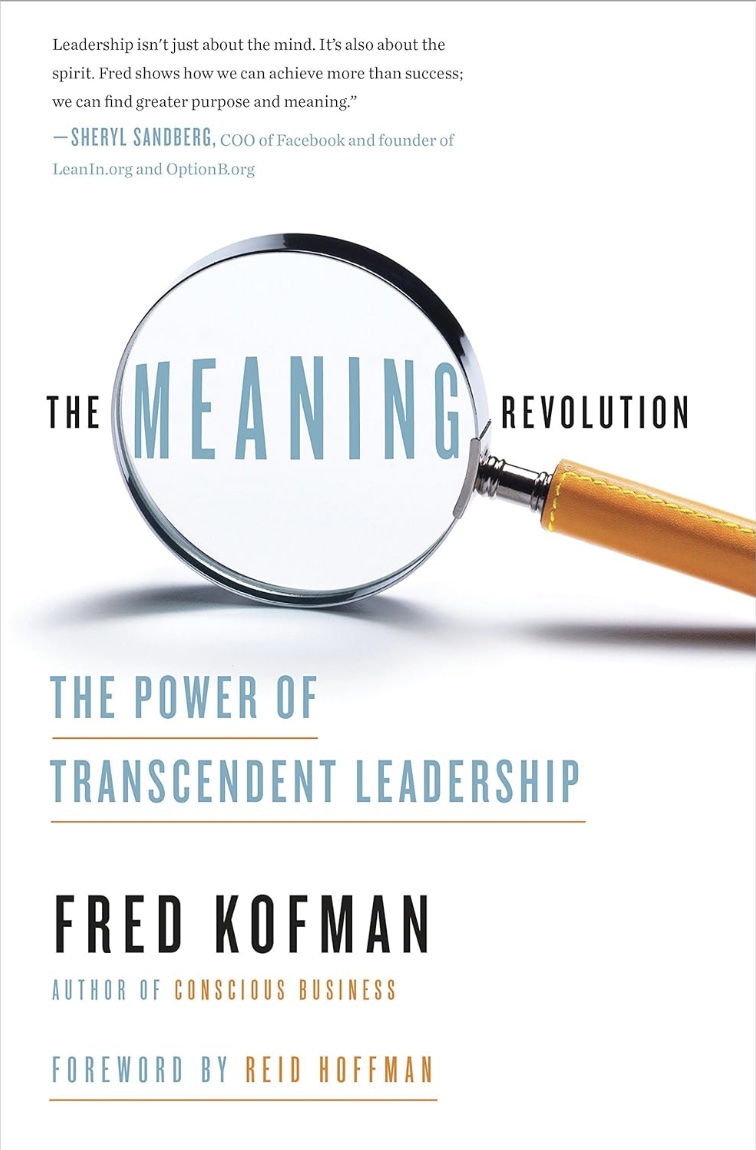
Kofman, F. (2018). The Meaning Revolution: The Power of Transcendent Leadership. New York: Currency Publishers.

Transcendent leaders reconcile the need for purpose and significance in their followers: “I believe the most deep-seated, unspoken, and universal anxiety in all of us is the fear that our life is being wasted away.”
Employees need intrinsic motivation to stay engaged at work. This is built from a sense of purpose, ethical work practices and policies, a feeling of belonging to the company and the world at large, while also having a level of autonomy over one’s work.
Humility: “Transcendent leaders are acutely aware of their limitations, which makes them humble… they become stewards of principles that foster alignment, collaboration, and use of knowledge to further the organizational mission.”