



Key Quote:
In a subscription model, fluidity feels cohesive and “it’s also a much happier business. Why? Because subscriptions are the only model that is entirely based on the happiness of your customers” (p. 208).
Key Points and Concepts
Products Alone are No Longer Profitable
Major manufacturers like IBM, GE, and Xerox, thrive today due to their ability to transition from generating revenue from products, to generating revenue through services. They were able to redirect their focus “on achieving outcomes for their clients rather than just selling equipment” (p. 12). These industry giants have built success and remain on the Fortune 500 list since its inception in 1955 while over half of the companies on the initial 1955 list were already gone in the year 2000 (pp. 11-12).
More recent companies like Amazon, Google, Facebook, Apple, and Netflix were quick entrants onto the Fortune 500 list and are already household names, innately familiar in the fabric of our day-to-day life. They never had to switch from product to service. They built their businesses on “direct digital relationships with their customers” and are forcing more established companies to catch up (pp. 13-14).
Customers Lead in a Subscription Based Model
Customers today are looking to be unburdened by physical products. They desire the outcome without the hassle of acquiring and maintaining material things. Big box retail stores missed this, and large segments have gone out of business. Customers “want to be happily surprised on a regular basis. And if you don’t meet those expectations, you get dropped, not to mention trashed on social media. It’s that simple” (p. 17).
The old business model distributed products through sales channels, and thus, a product made its way to the customer; the relationship stopped there. Companies didn’t really know, or care to know, their customers as individuals. In the new business model, the individual customer (subscriber) is the central component seeking experiences. Successful companies today “recognize that customers spend their time across many channels, and wherever those customers are, that’s where they should be meeting their customer’s needs” (p. 20).
How the Subscription Model is Changing Every Sector of the Economy
Retail (it’s thriving): With all the focus on e-commerce and service lines, there is a misconception that brick and mortar stores are becoming a relic of the past. This is false. “Over 85 percent of all US retail sales still happen in physical stores, representing more than $5 trillion in total sales” (p. 23). The purpose and intent of the physical store is just changing to meet the demands of the customer base.
• Companies which have solely operated online in the past are opening lots of new stores every day. Instead of packing a building full of things to move products, the already existing digital relationship is driving traffic to the store (pp. 22-27).
Customer IDs have changed the traditional retail subscription service by allowing companies to personalize the experience and engage one on one with the subscriber. In the old model a customer signed up for a book of the month or CD of the month and got stuck. The subscriber was burdened with a bunch of content they probably didn’t like and locked into the subscription due to cunning billing practices and hard to navigate cancellation policies. Focusing on the relationship with the subscriber instead of on product sale, creates longevity and increases revenue as the relationship continues (pp. 28-30).
Fender is an excellent example of how to move toward a subscription-based model with a larger ticket luxury item. Fender has been “making amazing electric guitars for more than seventy years. But sales of electric guitars industry wide have fallen by about a third in the last decade” (p. 30). Fender identified the drop off was due to people forsaking the guitar after buying one because it was too hard to learn. So, they created an online service to tune and teach guitar, keeping customers engaged and loyal (pp. 30-32).
Retail prospers when the strategy to remain focused on the customer is executed. There doesn’t have to be a separation from physical and online retail. Brick and Mortar stores are changing their physical design to mirror the natural way a customer might browse online. For example, Amazon is arranging its book display faced out instead of the less approachable horizontal stack seen in libraries. Online data is used to guide store set up tailored to the customer experience (pp. 32-34).
Husqvarna doesn’t require ownership of their product – they have a tool rental library. A producer of machines for lawn and garden maintenance, construction, and other machinery, Husqvarna created a subscription model for use of its product. Instead of a customer having to purchase tools they may use only seasonally, they pay a flat monthly fee and enjoy use of whatever tool is needed in the moment (pp. 35-36).
Media: The revenue base is still present. Customers are just demanding different digital services. While the entertainment industry was wringing over revenue loss from online piracy, some companies were listening to the customer base and began legal streaming services based on a subscription model. Netflix dominates the market using a portfolio effect creating original content among its already existent content based on the data it gathers from users (pp. 39-41).
Transportation: Hyundai, Porsche, Cadillac, and Volvo are already moving to a subscription-based service – not to be confused with a traditional lease. When a customer purchases a lease, it’s the product (vehicle) they are connected to. Under the new approach, when a customer purchases a subscription, they’re beginning an ongoing relationship with the company (pp. 51-52).
Uber, Lyft, and the ride-share economy are successfully disrupting the transportation industry. Customers want the outcome – getting from point A to point B, and not the product itself – the vehicle.
“A lot of Silicon Valley executives think that legacy car companies look a lot like IBM did in 1985” (p. 56). IBM lost its hold on the market by forfeiting the user experience to Microsoft “and the same thing is going to happen to the legacy car companies when they inevitably hand over their dashboard intelligence to Apple, Google, and Facebook” (p. 56). Car companies have a clear advantage in the structure as production already exists on a mass scale (pp. 56-61).
SNCF, the state-owned railway in France reclaimed the market at an astonishing pace by utilizing cloud based systems and identifying the correct market for unlimited subscriptions, hitting its annual growth target ahead of schedule (pp. 61-64).
Print: Music streaming created the framework for print media in the subscription model. Without having to rely on ads for revenue, the subscription model focuses all the value on the readers. There is no disconnect between print and digital. Consumers were and still are after the content (pp. 65-71).
The “Fish”, Courage in Leadership and Communicating Through Perceived Risk
It is challenging for boards, investors, and employees of companies to transition from an asset purchase model to a subscription model as they experience their company’s business results going from black to red. “In their excellent book Technology-as-a-Service Playbook: How to Grow a Profitable Subscription Business, Thomas Lah and J. B. Wood refer to this transition as “swallowing the fish” as the revenue curve temporarily dips below the operating expense curve before climbing back upward again” (p. 85).
“Adobe’s CFO, Mark Garrett, told dozens of Wall Street analysts that he was going to try as hard as he could to make his company’s revenue earnings fall as quickly as possible” (p. 80). The executive committee agreed to pursue the model because they recognized that companies with a stream of recurring revenue fared better during the recession (pp. 80-87).
Adobe led through the transition by executing a tight communication plan internally and externally. They directly addressed employees’ concerns and used humor to diffuse tension. A financial model for subscriptions did not exist at the time. To deal with the uncertainty, Adobe was overly transparent, sharing “much more financial information than it had in the past, as well as a clear set of target “markers” of future subscriber and annual recurring revenue (ARR) growth numbers”, to help Wall Street grasp the new metrics (p. 88). They announced the change to customers and allowed considerable time to adjust to the new model. Adobe conducted face to face meetings with over fifty thousand customers, educating on the new system, still providing the security of the old model, with an option to subscribe to the new (pp. 86-88).
Companies such as Cisco and Parametric Technology Corporation mirrored Adobe’s success by communicating their transition publicly and over communicating financial information while sticking to their timelines (pp. 89-96).
Thinking in Value Instead of Outcomes
“Once customers can get the outcome they want, without having to worry about owning the physical assets, that’s where the demand goes, and that’s where new revenue streams are created” (p. 121).
The “Internet of Things” or IOT, is the culmination of years’ worth of data from sensors retrofitted on existing items and embedded into newly produced items. All that data is sent back to centralized servers. This allows “companies to view their products as whole systems, as opposed to individual units…” (p. 106). Mapping this interconnectivity and applying big data analytics means the ability to reach an optimal end state. This allows companies to think in terms of outcome production and added value (pp. 101-108).
Owning the knowledge of how a company’s items interact with the world around them is an invaluable asset. “The data inherent in a connected device means you can sell the same information to several distinct kinds of customers: consumers, advertisers, resellers, industry groups, etc. Multiple beneficiaries give you lots more flexibility in terms of pricing and packaging” (pp. 109-113).
How to Measure Growth in a Subscription Based Model
Beta is the new state of being in the subscription model. To continue offering exciting experiences and meet the ever-changing needs of your subscription base, constant change is a necessity. Gmail pioneered this concept when it released its software in a “beta” state, but not to a select target group. They released it to everyone and by doing so enlisted their customers as a partner in development. Kanye West, in the release of The Life of Pablo, placed a beta album into the hands of his fans. “Kanye put out the first SaaS album” (p. 136). Graze, a factory from London launched in the US and instead of spending resources on market research, they used the existing customer base, and a digital feedback system, to tailor the product to the needs of the consumer. Gmail, Kanye, and Graze all understood that agility allows for constant development and engagement with the consumer (pp. 133-138).
When product becomes service, how you approach placement, price, and promotion, changes along with it.
• Place: Don’t abandon channels. Educate resellers about the benefits of a deeper understanding of customers to increase revenue through already existing channels.
• Promotion: Create a meaningful narrative about the purpose of your product. Answer the “why” question.
• Pricing and packaging: Achieving the proper balance between cost of services and usage is vital. Too much or too little leaves money on the table. This process is never finished and must be constantly revisited (pp. 146-154).
To be successful, find the right customers. They will define the business. Reduce churn rate. “If you’re losing more customers than you’re taking in, it doesn’t matter if you’ve got a great sales team” (p. 162). Expand your sales team. Don’t relegate yourself to one single model. Increase value through upsells and cross-sells. A ready customer base exists, and they are already engaged in your product. As subscribers they are more invested in expanding the relationship than any prospect would be. Launch into a new segment and continue building the company’s relationships. Go International. We are no longer bound by geography in this digital age. Maximize acquisition growth opportunities. If you’ve picked up a majority of the market share, fold in the competition. Optimize your pricing and packaging “…your subscription service could be sitting on vast amounts of unrealized value, simply because it hasn’t taken the time to test the market with new pricing strategies” (pp. 156-172).
Transitioning Operation Models to Work in a Subscription Culture
A traditional net income model won’t work in the subscription economy because the formula needs to begin with starting revenue instead of past revenue. Annual recurring revenue (ARR) is the measure for understanding profit and loss in the subscription model. Factoring in churn, recurring costs, recurring profit, and new ARR in addition to the traditional model is how to understand profit margins (pp. 176-182).
Many subscription companies seem unprofitable by looking at the raw numbers, but growth needs to be considered when measuring profitability. “Here’s the key takeaway – it is perfectly rational for subscription businesses to spend all their profits on growth, so long as their bucket doesn’t leak” (p. 183). At any moment in the company’s life if ARR is growing faster than recurring expenses, you can spend the difference on growth. The rewards are deferred but consistently greater than a product-based model (pp. 183-184).
This new system requires a new structure internally beginning with IT. Linear and siloed structures increase efficiency in a product system and IT departments have spent years streamlining these systems for efficacy. Now suddenly that model needs a different flow. It’s non-linear and it will create chaos. It was intended to account for material moving in one direction, not for revolving channels with random starts and stops around an individual customer. “And what should the new architecture look like? …It should look circular not linear” (p. 197) and the subscriber ID is in the center of it all (pp. 190-197).
To work efficiently in this new system, organizations must develop thinking around customers.
• PADRE, which is an acronym for: Pipeline – building demand in the market. Acquire – a way to track the buyer’s journey. Deploy – helping the customer use the product well and quickly. Run – how long and often the customers are using the service. And Expand – how else can you connect with the customer? (pp. 200-204).
In a subscription model, fluidity feels cohesive and “it’s also a much happier business. Why? Because subscriptions are the only model that is entirely based on the happiness of your customers” (p. 208).
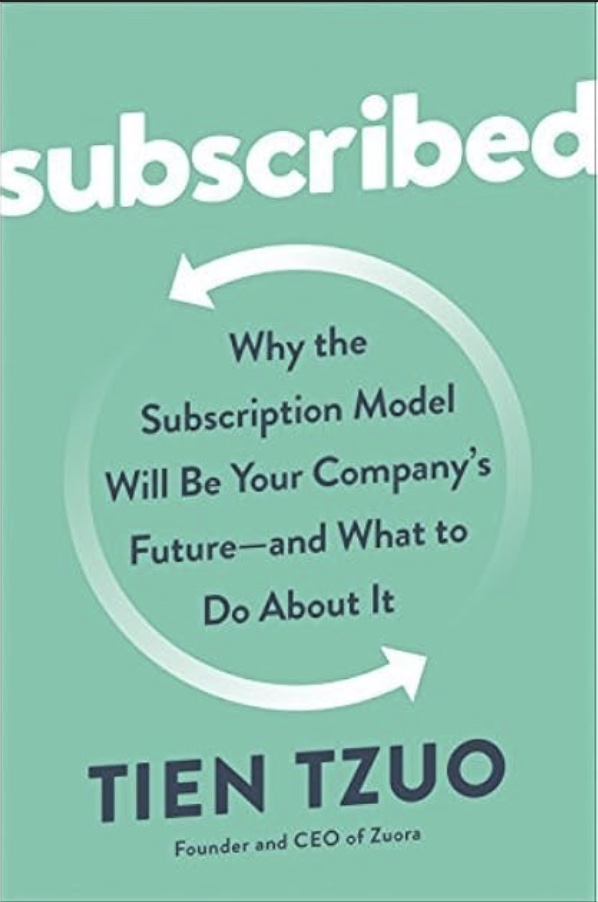
Tzuo, T. & Weisert, G. (2018). Subscribed: Why the Subscription Model Will Be Your Company’s Future – and What to Do About It. New York: Portfolio/Penguin, an imprint of Penguin Random House LLC.

“Customers today are looking to be unburdened by physical products. They desire the outcome without the hassle of acquiring and maintaining material things. Big box retail stores missed this, and large segments have gone out of business. Customers “want to be happily surprised on a regular basis. And if you don’t meet those expectations, you get dropped, not to mention trashed on social media. It’s that simple.”
“Once customers can get the outcome they want, without having to worry about owning the physical assets, that’s where the demand goes, and that’s where new revenue streams are created.”
“Beta is the new state of being in the subscription model. To continue offering exciting experiences and meet the ever-changing needs of your subscription base, constant change is a necessity. Gmail pioneered this concept when it released its software in a “beta” state, but not to a select target group. They released it to everyone.”
“In a subscription model, fluidity feels cohesive and “it’s also a much happier business. Why?
Because subscriptions are the only model that is entirely based on the happiness of your customers.”