
Great teams have routines and habits that separate them from the merely good.
One of those habits is the ability to have open and honest conversations. Often called “psychological safety,” this is the climate where people on the team feel comfortable taking conversational risk.
When they feel psychologically safe, team members believe they can speak up, ask questions, admit mistakes, challenge ideas, and offer unpopular opinions without being punished, embarrassed, or ignored.
Quality decisions, top performance, and continuous learning in teams all depend on this feeling of safety.
This is why the best leaders work hard to normalize candid conversations and make silence the risky thing.
One particularly effective way of doing so is to create a ritual that gives people permission to take conversational risk.
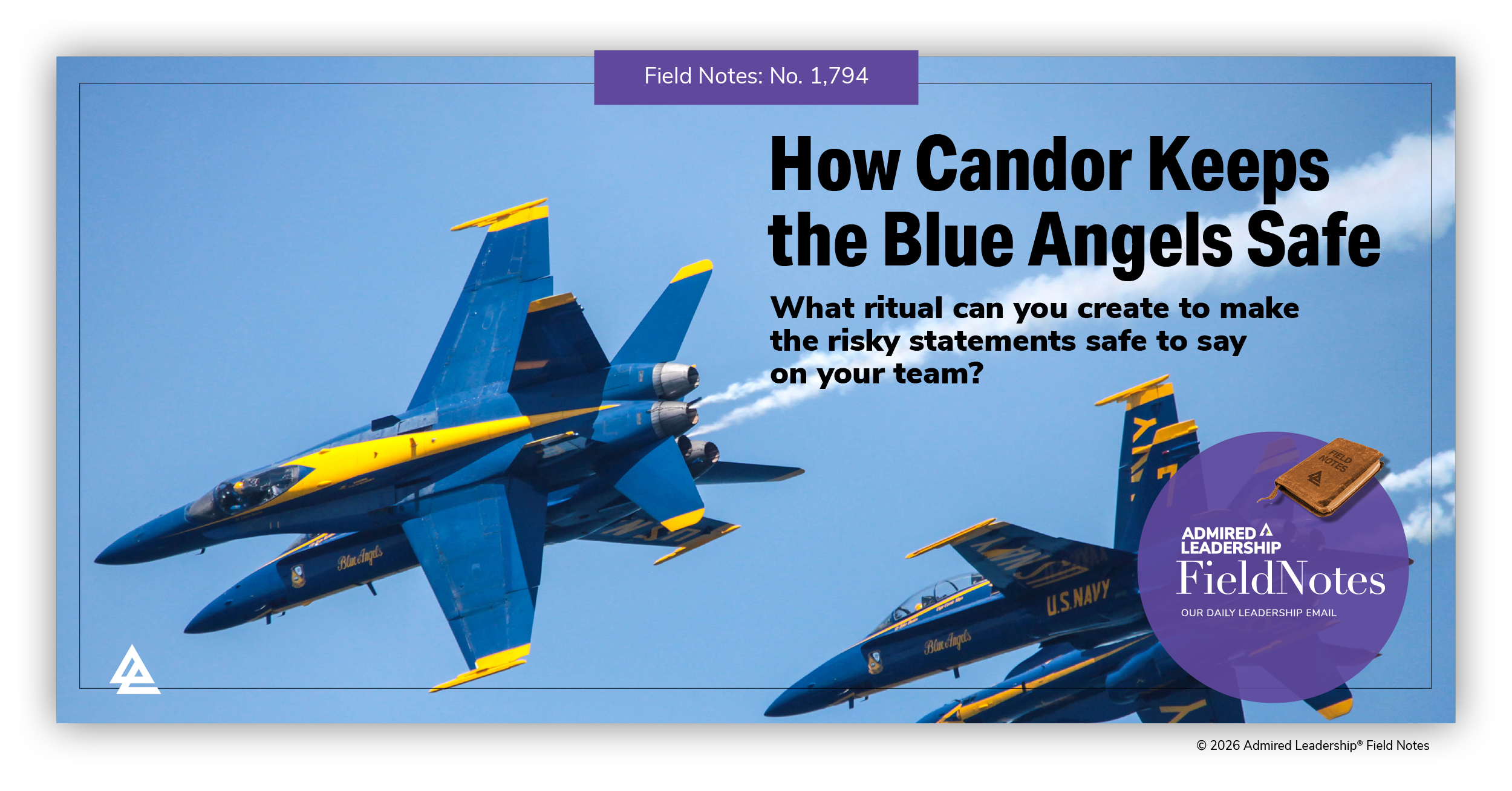
An example is the “Calling a Safety” ritual practiced by the Blue Angels, the US Navy Flight Demonstration Squadron.
With up to six F/A-18 Super Hornets performing flight maneuvers 18 inches apart at 250 knots, few teams in the world depend on trust the way the Blue Angels do. Their lives literally depend on being able to have honest conversations about their performance.
This is where the “Calling a Safety” ritual comes in. After every flight, the team conducts a video review in which every pilot self-declares their mistakes.
For each error, the pilot announces they are “Calling a Safety.” The pattern is always the same: take the safety, commit to fixing it, and express gratitude for being on the team.
“I’m calling a safety. I was 20 feet too high on the base turn. I’ll fix my safety, and I’m just happy to be here.”
And that pattern repeats. For every pilot, for every safety, for hours.
For the Blue Angels, the risky thing is to NOT take a safety. Expressing a contrarian view, a new idea, a critique, or a mistake isn’t just normal — it’s expected. And everyone is safer, literally and psychologically, as a result.
“Calling a safety,” “Holding the truth stick,” “Wearing the honesty hat,” “Using the cone of candor” — all make it safe to express what the team must hear.
What ritual can you create to make the risky statements safe to say on your team?