



Key Quote:
“Public speaking is about being authentic, not perfect; connecting with your audience and building trust, building allies around your ideas, and exercising leadership with your voice” (p. 207).
Key Points and Concepts
You’re Always Public Speaking
Public speaking is related to leadership in many ways. When giving a speech, you must “stand up on behalf of your ideas, your vision, your organization, or your community—and [persuade] others to join you to achieve a shared goal” (p. 8).
Many people who hate public speaking say it’s because they don’t enjoy being the center of attention; however, if you change your mindset to believe that the attention is on the subject, rather than you, it dissolves your nerves. The messenger isn’t the main focus. The message is.
To give a moving speech, determine who needs to hear what you have to say, then take action based on your ideas (p. 8).
Think About Public Speaking Strategically
“A powerful speech should feel like a conversation between you and every single person in the audience, no matter the size” (p. 15).
• The best speeches are typically eighteen minutes or less (the duration of an adult attention span), utilize personal stories to drive emotion, and are conversational (p. 23).
These three questions help form not only the structure, but the strategy of your speech (p. 27):
1. Who is your audience?
2. What is your goal?
3. Why you? / What gives you authority to present this speech?
Use language that your audience can relate to. Be specific when necessary. For example, “if you use the word ‘development,’ will your audience know if it’s about real estate, international aid, fundraising, or software?” (p. 28).
People like clarity and conciseness, which is different than dumbing down research. See how you can clear away “the excess descriptions that are clouding up your speech to arrive at the essence of what you want to say, so you can build a compelling case for it” (p. 30).
• When you decide what belongs, remove everything that doesn’t. For every single sentence, ask yourself if what you’ve written reinforces your main message. “The more you say, the less people hear—so make sure that every single word, every single phrase, adds meaning to your speech” (p. 83).
Prepare Your Perfect Speech
In order to craft an effective speech, first research your audience. Learn to “speak their language.” If they understand you, they are more likely to both listen to and agree with you (p. 32).
The perfect writing environment is essential to creating your speech. Determine at what time of day you are most alert, what physical place allows you to be most effective, and if you are more creative alone or surrounded by others (p. 46).
Then follow these five steps to create the perfect speech (p. 48):
1. Grab the audience’s attention immediately
2. Address the problem
3. Present your solution
4. Visualize what the world will look like if you’re successful/unsuccessful
5. Give a call to action
“Polishing is what happens when you step back from the text, look at it with a fresh eye, and strategically start to improve the speech” (p. 79). This should be saved for when you are in a relaxed, creative state, ideally during the perfect time of day you have set aside for writing.
If you’re trying to persuade your audience with your speech, use these six tools (pp. 66-67):
1. Simplicity
2. Unexpectedness
3. Concreteness
4. Credibility
5. Emotions
6. Stories
Practice Your Speech
Read it out loud. Shapira says “I can always tell when someone has written a speech but never read it out loud, because it will contain words that are written for the eye and not the ear” (p. 52).
Select from the seven ways to practice giving your speech (pp. 86-89):
1. Practice out loud
2. Practice in front of a mirror
3. Practice with a memo recorder
4. Practice with props
5. Practice in front of otherd
6. Practice with your eyes closed
7. Practice with video
There are several “common traps” that people make when giving a speech, including fillers, minimizers, uptalk, and vocal fry. Some ways to reduce the frequency of these are to get in the habit of knocking on a table each time you hear yourself fall into one of these traps while practicing your speech.
Follow the PREP Formula
• Point: Make a point by stating what you believe
• Reason: Provide an explanation of your belief
• Example: Tell a story that illustrates your point
• Point: Conclude by restating your point
Create a pre-speech ritual that can calm your nerves before speaking. Shapira uses the following ritual herself and with all of her clients, and it only takes five minutes (pp. 135-136):
• Find a quiet place to be alone
• Get rid of nervous energy by becoming physically comfortable
• Center yourself through breathing
• Remind yourself of your “Why you?” answer
• Run through only your opening and closing
Deliver Your Speech
The three most important types of movement are: eye contact, body language, and voice (p. 94). Smile to disarm others. Move around the room to engage your audience. If seated, sit tall and lean in slightly to shorten the distance between you and your audience.
It’s common to feel anxiety before giving a presentation. A critical and underrated skill to combat that is conscious breathing. Purposeful, or diaphragmatic breathing, has invaluable benefits when it comes to public speaking: it dispels nervous energy, calms you down, and allows you to command a room by adding richness to your voice (pp. 120-121). Shapira recommends practicing breathing for a few minutes in the morning and again at night.
Prepare for impromptu speaking. Practice it. Come up with a few “go-to” stories. Focus on one key message.
When onstage, read the room, and don’t become stressed if the audience seems disengaged. Some techniques to combat disengagement are, if appropriate: to open it up for discussion, ask the audience a question, pair them in groups of two, summarize your main points, and tell a story (p. 139).
Prepare for questions. Do your research before your speech and come up with a list of potential questions you may be asked. Ask someone to roleplay a Q&A session with you. Anticipate hard questions and practice defusing the question (p. 173).
After giving your speech, think through what went well, what didn’t go well, and what you plan to do differently next time. If your speech was recorded, watch the video.
Public speaking is about being authentic, not perfect; connecting with your audience and building trust, building allies around your ideas, and exercising leadership with your voice (p. 207).
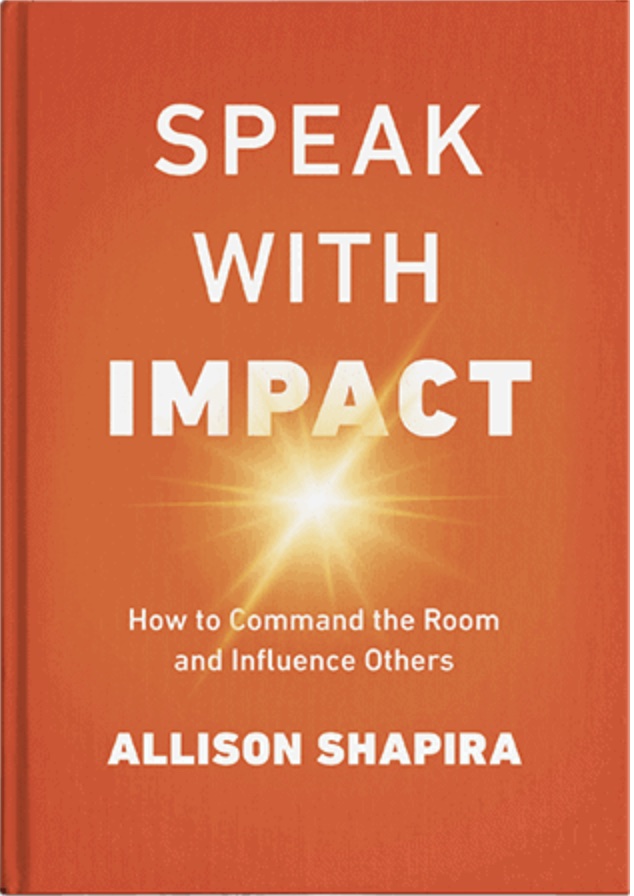
Shapira, A. (2018). Speak With Impact: How to Command the Room and Influence Others. HarperCollins Leadership.

“Public speaking is related to leadership in many ways. When giving a speech, you must “stand up on behalf of your ideas, your vision, your organization, or your community—and [persuade] others to join you to achieve a shared goal.”
“In order to craft an effective speech, first research your audience. Learn to “speak their language.” If they understand you, they are more likely to both listen to and agree with you.”
“It’s common to feel anxiety before giving a presentation. A critical and underrated skill to combat that is conscious breathing. Purposeful, or diaphragmatic breathing, has invaluable benefits when it comes to public speaking: it dispels nervous energy, calms you down, and allows you to command a room by adding richness to your voice. Shapira recommends practicing breathing for a few minutes in the morning and again at night.”
“When onstage, read the room, and don’t become stressed if the audience seems disengaged. Some techniques to combat disengagement are, if appropriate: to open it up for discussion, ask the audience a question, pair them in groups of two, summarize your main points, and tell a story.”