



Key Quote:
“Sometimes, no matter how hard we try and no matter how well informed we are about how to persuade others effectively, our strategies will fall short” (p. 73).
Key Points and Concepts
Using the Natural Pull of People
People are motivated to conform to existing social norms. Because one of the most basic human desires is to belong and gain the approval of others, messages should avoid associating the intended behavior with an undesirable social position. Messages are more influential when they stress that the majority of the market segment already participates in the behavior (p. 2).
Messages are more successful when they are “framed in terms of deviating from the perceived social norm rather than conforming to it. For example, an individual that thinks healthy eating habits are the norm would be more successfully persuaded by messages that negatively depict those that have unhealthy eating habits. A group that thinks healthy eating habits are less common would be better influenced by a message that positively depicts those with healthy eating habits (p. 17).
One behavioral study found that people in long-term relationships are less able to predict a partner’s preferences than a new acquaintance is. The authors suggest that this might occur because there is no longer a high level of motivation to learn more about each other, or because partners assume time spent together equates to a surefire understanding of one another. In a business context, occasionally bringing in a colleague that is less involved with a specific client or team is a good tactic to unearth new opportunities or questions that might have otherwise gone unspoken (p. 34).
Following Through: Commitment and Consistency
In the UK, the National Health Service estimates that “no-show” appointments total £800 million in losses every year (p. xiv). Several studies have shown that asking patients to visualize arriving for their appointment or, better yet, to write down their appointment date and time, decreases no-show rates. (p. 38).
There are several important factors to getting individuals to commit to and consistently follow through with a behavior:
• Make the initial commitment specific rather than general (p. 42).
• Create cues to act as triggers in the environment where the commitment and related desirable behaviors will be performed (p. 42).
• Give people the opportunity to actively engage with the commitment, even in a small way, to increase feelings of ownership of the behavior (p. 43).
• Arrange for some aspect of the commitment to be public (p. 43).
Use implementation intentions when persuading. These are the specific steps or processes for completing a task. For example, research done during the 2008 presidential primary elections showed that people were more likely to show up and vote when they were asked questions like, “What time will you vote?” “Where will you be coming from?” and “What will you be doing beforehand?” (p. 60).
Many healthcare companies have adopted the practice of repackaging medicines into blister packs or producing them in different colors so that the parameters are more rigid and the patient is more likely to follow rules and complete the treatment. When the choice to participate is simple and the motivation is strong, use a flexible completion structure. When the change is harder and the motivation is lower, a more rigid structure will be more effective in achieving completion levels (p. 189).
Talk About What’s Important
Recent research shows that potential may have a greater pull in influence than reality. One study asked participants to read comments under a stand-up comedian’s YouTube video. Comments about the comedian’s potential, like, “This guy could be the next big thing” or “Next year, everyone could be talking about this comedian” were more likely to incite participants to watch the video than factual statements like, “Critics say he has become the next best thing” or “Everyone is talking about this guy!” (p. 90). Emphasize potential instead of past performance when working with prospective clients or applying for a promotion.
Adding extra features to products or deals cheapens the overall proposition. Study participants found more value in an iPod alone over an iPod plus a $20 music download gift card. The authors suggest that “rather than investing additional resources to add a small extra feature for every customer…make a small shift by investing the same amount in a more significant feature for fewer selected customers” (p. 167).
Common belief favors the idea that people cognitively process every message they receive and that message clarity, structure, and logic are the most important aspects in every message. While these factors are certainly important, most people defer to the experts. Make your or your team’s expertise known early on in a conversation with a potential client (p. 103). Research also shows that experts who show uncertainty about their opinions are more intriguing and influential than infallible or over-confident experts (p. 106).
When combining multiple approaches of influence, less is more. One study found that participants who read a variety of advertisements for the same product rated the product highest when the ad included three features or claims. After that, each additional claim increased skepticism and resistance (p. 228).
Making the Most of Meetings
Meetings often do not maximize information sharing, although that’s their purpose. The authors write that in order to increase meeting efficiency you can make small changes like:
• Asking attendees to submit relevant information before the meeting to increase the number of voices heard.
• Allowing the leader of the meeting to speak last to avoid overpowering the others.
• Creating and using a simple checklist to make sure no items are forgotten.
• Arranging the seating in the room in a circular pattern for group-focused thought production or a more angular pattern for individual-focused thought production (pp. 95-96).
One study showed evidence that holding meetings that require creativity in rooms with higher ceilings will set the context for liberating and unrestrained thought flow, while holding meetings that require specific or time-sensitive action planning in rooms with lower ceilings will encourage individual and task-specific thinking (p. 113).
Influence in Negotiation and Donation
Having a more powerful body posture (for example, leaning back in a chair with hands over head) or remembering a time when you felt powerful is enough to make you more successful in negotiations (p. 120).
Numbers or deadlines that are more specific result in less resistance (for example $2,135 instead of $3,000 or 13 days instead of two weeks) (p. 151).
In situations where cost can be broken down by parts of a greater whole, such as fundraising, employ unit asking to increase donation amount. Instead of requesting a flat dollar amount, ask, “How much would you be willing to give to support one student?” to increase the donor’s baseline (p. 171).
Arranging for Exchange and Productivity
Arrange for exchange is a principle that optimizes the giving or favor process in the workplace. It includes two steps: “1) be the first to give favors, offer information, or provide service, and 2) be sure to verbally position your favor, information, or service as part of a natural and equitable reciprocal arrangement” (p. 131). For example, saying something like “Of course. I know that if the situation were ever reversed, you’d do the same for me” when someone thanks you for doing a favor, will make him or her more likely to help you in the future and will maximize your initial effort.
Similarly, showing gratitude increases compliance rates for new requests (p. 136).
The unexpectedness of the first exchange also increases compliance rates. In one study, a food server who left a piece of candy with the bill received a 3.3% increase in gratuity via the rule of reciprocity—when people receive something from someone, they feel obligated to give something back in return. However, when the server came back unexpectedly a few minutes later with a second piece of candy, gratuity increased by 21% (p. 140).
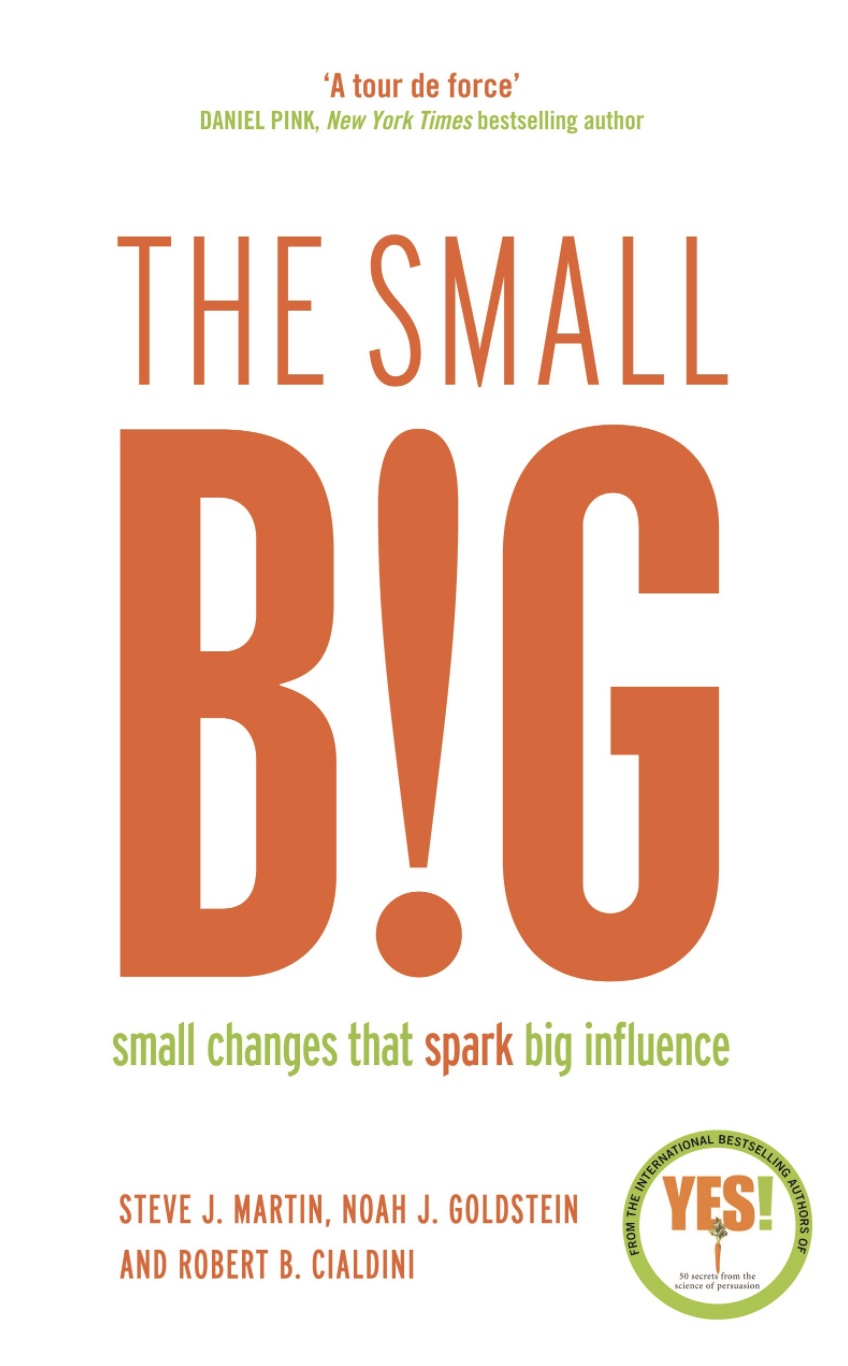
Martin, S.J., Goldstein, N.J., & Cialdini, R.B. (2014). The Small Big: Small Changes That Spark Big Influence. New York: Grand Central Publishing.

“Sometimes, no matter how hard we try and no matter how well informed we are about how
to persuade others effectively, our strategies will fall short” (p. 73).
“Prioritize what needs to be done and then assess how much time each task will take in terms of relativity, rather than time estimates, for instance, use the Fibonacci sequence to assign which tasks will have more weight in terms of time and effort.”“Messages are more successful when they are “framed in terms of deviating from the perceived social norm rather than conforming to it. For example, an individual that thinks healthy eating habits are the norm would be more successfully persuaded by messages that negatively depict those that have unhealthy eating habits.”
“One study showed evidence that holding meetings that require creativity in rooms with higher ceilings will set the context for liberating and unrestrained thought flow, while holding meetings that require specific or time-sensitive action planning in rooms with lower ceilings will encourage individual and task-specific thinking.”
“In situations where cost can be broken down by parts of a greater whole, such as fundraising, employ unit asking to increase donation amount. Instead of requesting a flat dollar amount, ask, “How much would you be willing to give to support one student?” to increase the donor’s baseline.”