



Key Quote:
“Personality should not be the only factor used to make hiring decisions, nor do we advocate directly excluding someone because their personality misaligns with the behaviors you identified were most important for a role. However, seeing personality match or mismatch can give you an idea of important questions to discuss in an interview” (p. 297).
Key Points and Concepts
Personality guides one’s decision-making processes, core motivations, and communication style (p. 35).
“‘Nature versus nurture’ theory implies that people develop different behavioral patterns from a mixture of our internal hardwiring and external influences” (p. 19).
The Biggest Challenges to Conversation
Observable differences in brain chemistry lead to specific personality traits. However, free will gives people the opportunity to act in opposition with their default action (p. 24).
Relational blind spots create gaps in one’s understanding of another person that prevents the recognition of opportunities or threats in working or interacting with them (p. 25).
Relational blind spots are caused by four types of biases (p. 26).
• Confirmation bias occurs when new information supports pre-existing beliefs.
• Bandwagon effect is when one relies on the actions of others to influence their decisions.
• Halo effect occurs when positive traits are assigned due to success in a different area.
• Optimism bias is the irrational belief that a negative event is more likely to happen to others than to oneself.
The prevalence of social media has led to more control in manipulating perceptions, relationships being regarded as a checkbox, and an increase in relationship options (pp. 28-29).
Direct observation is the most straightforward way to understand someone and their personality. However, this is not a luxury that people have all of the time (p. 191).
Personality AI
“The goal of personality AI is to identify someone’s behavioral patterns as accurately as possible, which is usually represented by a
personality type or a set of specific personality traits. With that information, it can power tools that facilitate more effective communication, stronger relationships, and better decision-making” (p. 167).
Personality AI is the intersection of personality psychology, social networks, and machine learning, or the use of computers to analyze large amounts of data to identify trends and make predictions (p. 154).
AI uses two methods to measure personality (p. 58).
• Text sample analysis determines the personality type of a person based on the content and style of their writing (p. 58).
• Attribute analysis calculates the personality type of a person through analyzing data like their
job title, employers, interests, and skills (p. 58).
The best way to detect a personality type from a text sample is through an n-gram – a group of two to three words – analysis. People within different personality types tend to use similar phrases, such as “return on investment” or “weekly meetings” (pp. 177-178).
Personality tests that rely on human reporting, such as questionnaires, are susceptible to manipulation and bias by the person completing them (p. 57).
Inaccuracies will arise if the identity of the author is in question, such as if the person isn’t the real author or if the person doesn’t write in a way that reflects their true personality (p. 179).
The Ethics of Personality AI
Crystal abides by three rules to govern data usage (pp. 306-307):
• To be transparent about what the accessed personal data is used for
• To only use data that is publicly available or has been given with permission that a person could analyze and draw conclusions from on their own
• To only publish data with consent
Personality AI is used as a method to better learn the personality of another and identify the best strategies for successful communication. This involves predicting behavioral tendencies, preferred communication styles, and what opener will be most effective in beginning a dialogue (p. 303).
Personality AI is not capable of reaching a conclusion that can’t be drawn from trends in available and existing data. The information generated is not factual and cannot be used for manipulation (p. 303).
The Personality Map
The Personality Map is a compilation of 16 behavioral patterns that people tend to fall into. Each pattern has a name, associated DISC type, and common personality traits (p. 43).
The vertical position indicates how a person interacts with their physical and social environment. Those on the top tend to direct, shape, and change their environment while those on the bottom tend to organize and bring structure to the environment around them (p. 47).
Vertical distance represents how two people naturally collaborate. People with personalities at the top of the map prefer to control situations and provide direction to others. People toward the bottom tend to be more comfortable supporting others and adapting to their environment (pp. 260-261).
Control conflict occurs when two people have each of their personalities at the top of the map (p. 262).
Control vacuum occurs when both people have their personalities at the bottom of the map (p. 263).
The horizontal position reveals how a person interacts with others. Behaviors on the left are independent and business-like while behaviors on the right are open and casual towards others (pp. 48-49).
Horizontal distance represents how two people naturally interact. Those with personalities on the left side of the map prefer independence and space with their relationships. People with their personalities on the right side of the map tend to be trusting and prioritize emotional connections (p. 264).
Interpersonal comfort occurs when people are closer on the map (p. 265).
Interpersonal resistance occurs when people are farther apart on the map (p. 265).
Using Personality AI as a Manager
To navigate high-pressure environments or situations, a leader must be aware of the strengths, blind spots, and motivations of each person on their team (p. 278).
Personality types shed light on preferred benefits and core motivations (pp. 208-209).
Energy-oriented thinking is when a manager increases employee productivity by having employees spend more time doing things that require the lowest energy cost for their personalities (p. 147).
Employee burnout can be avoided by reducing the time the person spends away from and maximizing the time spent close to their place on the personality map (p. 144).
“Increased productivity as individuals has directly correlated with rapid revenue growth, product innovation, and a much healthier bottom line” (p. 147).
Teams work best when people have personality types that are balanced. Balanced personalities still do have risks of miscommunication, control issues, and conflicting motivations (pp. 295-296).
“Personality should not be the only factor used to make hiring decisions, nor do we advocate directly excluding someone because their personality misaligns with the behaviors you identified were most important for a role. However, seeing personality match or mismatch can give you an idea of important questions to discuss in an interview” (p. 297).
Using Personality AI as a Communicator
Insights generated by Personality AI accelerate trust and openness between people speaking for the first time, help professionals write emails in a style that will appeal to the recipient, predict the relational dynamics that two people are likely to experience when working together, and match people with roles and tasks that will give them more energy (p. 163).
Personality types explain how people want to interact in terms of formality and medium (p. 210).
While Personality AI can predict what communication style and medium works best for each person, mood and environment can change how the conversation needs to take place (p. 224).
Insights from Using Crystal1
An analysis by Crystal of a person’s LinkedIn page takes less than five seconds and determines the following outputs: a one-sentence description of their personality, personality type on the Personality Map, one thing that appeals to them, one thing to avoid with them, coaching tips for communicating within over 20 situations, a comparison between your personalities, email advice, tips for working with them, tips for speaking with them, tips for motivating them, and their DISC assessment.
Results were accurate in situations where the person was active on LinkedIn and felt as though the voice on their account aligned with their authentic voice.
Results were less accurate when people felt as though they were cultivating a specific image online.
One person shared that Crystal’s identification of topics of conversation that appealed to them was so accurate that only their closest friends engage in those conversations with them.
Ultimately, Crystal cannot be relied upon to provide facts. However, the insights generated present opportunities for a greater chance at connecting through conversation and have the potential to lead to dialogue within teams on optimizing productivity through catering tasks to each personality.
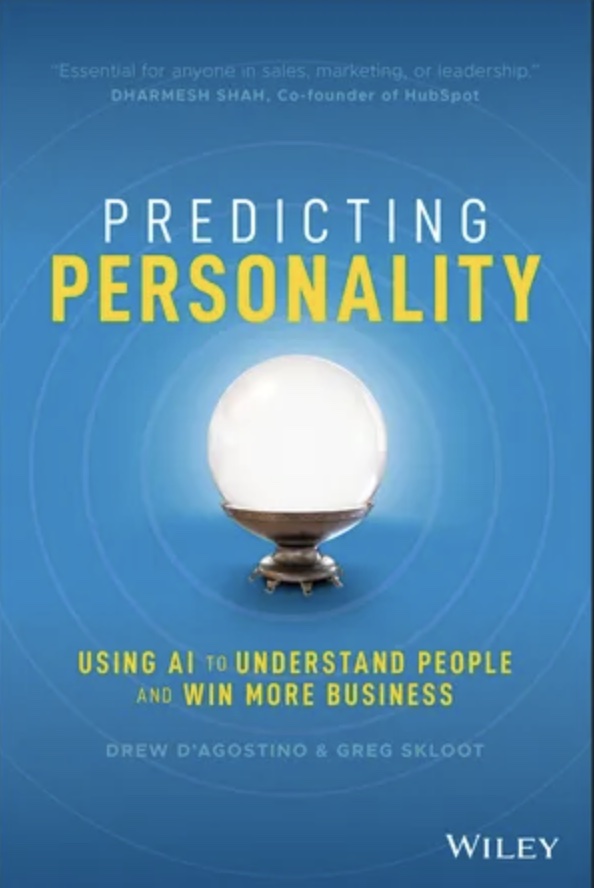
D’Agostino, D. and Skloot, G. (2019). Predicting Personality: Using AI to Understand People and Win More Business. John Wiley & Sons.
1 These insights were drawn from use of the Crystal software and not from Predicting Personality.
“The Personality Map is a compilation of 16 behavioral patterns that people tend to fall into. Each pattern has a name, associated DISC type, and common personality traits.”
“Personality should not be the only factor used to make hiring decisions, nor do we advocate directly excluding someone because their personality misaligns with the behaviors you identified were most important for a role. However, seeing personality match or mismatch can give you an idea of important questions to discuss in an interview.”
“Ultimately, Crystal cannot be relied upon to provide facts. However, the insights generated present opportunities for a greater chance at connecting through conversation and have the potential to lead to dialogue within teams on optimizing productivity through catering tasks to each personality.“