



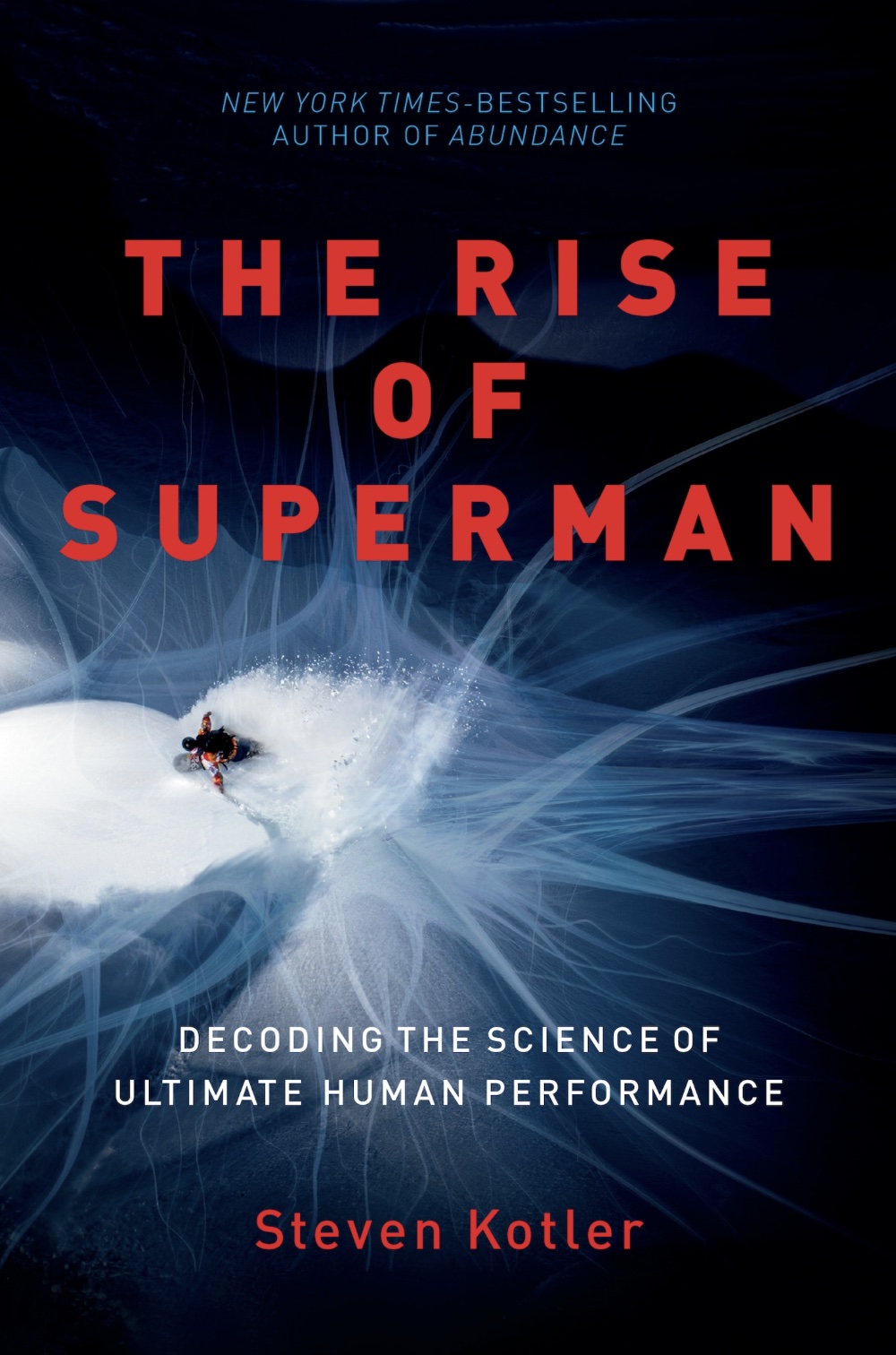
Key Quote:
“Flow is more than an optimal state of consciousness—one where we feel our best and perform our best—it also appears to be the only practical answer to the question: What is the meaning of life? Flow is what makes life worth living.” (p. 21) — Steven Kotler
Key Points and Concepts
Why Action and Adventure Athletes?
As Bill Russell explains in his biography Second Wind, entering moments of flow while on the court sent chills pulsing up and down his spine. Over the course of his career, these experiences came few and far between. For an action and adventure athlete, flow is a necessity, because every time they perform, they could be seriously injured or killed. As a result, advancements in action and adventure sports have grown exponentially.
10 Components of Flow (p. 30)
- Clear goals: Expectations and rules are discernable and goals are attainable and align appropriately with one’s skill set and abilities. Moreover, the challenge level and skill level should both be high.
2. Concentration: Extreme focus on a limited field of attention.
3. A loss of the feeling of self-consciousness: The merging of action and awareness.
4. Distorted sense of time: One’s subjective experience of time is altered.
5. Direct and immediate feedback: Successes and failures are apparent, so behavior can be adjusted as needed.
6. Balance between ability level and challenge: The activity is neither too easy nor too difficult.
7. Control: One should feel in charge of the situation.
8. Intrinsically Rewarding: Beneficial to the person, making the action effortless.
9. Lack of awareness: Pain, fear, fatigue all dissipate in flow.
10. Absorption: Narrowing of awareness down to the activity itself.
The Flow Cycle (pp. 120-121)
1. Struggle: the loading phase for flow. In order to enter flow, we need to be operating at the edge of our abilities.
2. Release: by taking our minds off the struggle and issues, it allows us to sink into the flow state and remove distractions from the experience.
3. Flow
4. Recovery: flow is very taxing on the body, both mentally and physically. In order to enter another flow state, we need to recover from the first.
The Results of Flow
• “A ten-year study done by McKinsey found top executives reported being up to five times more productive when in flow. Creativity and cooperation are so amplified that Greylock partner venture capitalist James Slavet, in a recent article for Forbes.com, called ‘flow state percentage’—defined as the amount of time employees spend in flow—the ‘most important management metric for building great innovation teams’” (p. 21).
• “According to research done by Harvard Business School professor Teresa Amabile, not only are creative insights consistently associated with flow states, but that amplified creativity outlasts the zone. People report feeling extraordinarily creative the day after a flow state, suggesting that time spent in the zone trains the brain to consistently think outside the box” (p. 41).
External Triggers of Flow
1. Risk
a. “Certainly, risk is needed for flow, but if you don’t want to take physical risks, take mental risks. Take social risks. Emotional risks. Creative risks. Especially creative risks. The application of imagination—one very shorthand definition of creativity—is all about mental chance taking.
And the risk is real. Loss of respect, loss of resources, loss of time—the consequences of betting on a bad idea can certainly threaten survival” (p. 102).
2. Rich Environment
a. “A ‘rich environment’ is a combination platter of novelty, unpredictability, and complexity—three elements that catch and hold our attention much like risk. Novelty means both danger and opportunity. To our forbearers, a strange scent in the wind could be prey or predator, but either way it paid to pay attention. Unpredictability means we don’t know what happens next, thus we pay extra attention to what happens next. Complexity, when there’s lots of salient information coming at us at once, does more of the same” (p. 104).
3. Deep Embodiment
a. “The last external flow trigger, ‘deep embodiment,’ is a kind of full-body awareness. Humans have sensory inputs all over the place; 50 percent of our nerve endings are in our hands, feet, and face…Deep embodiment means paying attention to all of these sensory inputs at once… If we want to pull the deep embodiment trigger in less extreme environments, then we simply have to learn to pay attention to all these input streams” (pp. 105-106).
Internal Triggers
1. Clear Goals
a. “Generally, the thinking’s been that clear goals help identify our task (so we know what to do) and align that task with belief (so we know why we’re doing it) …The point is this: when the brain is charged with a clear goal, focus narrows considerably, the unimportant is disregarded, and the now is all that’s left” (p. 114).
b. “Applying this idea in our daily life means breaking tasks into bite-size chunks and setting goals accordingly. A writer, for example, is better off trying to pen three great paragraphs at a time—the equivalent of moving through Mandy-Rae’s kick cycles—rather than attempting one great chapter. Think challenging, yet manageable—just enough stimulation to shortcut attention into the now, not enough stress to pull you back out again” (p. 115).
2. Immediate Feedback
a. “Immediate feedback, our next internal trigger, is another shortcut into the now. The term refers to a direct, in-the-moment coupling between cause and effect. The smaller the gap between input and output, the more we know how we’re doing and how to do it better. If we can’t course correct in real time, we start looking for clues to better performance—things we did in the past, things we’ve seen other people do, things that can pull us out of the moment. When feedback is immediate, the information we require is always close at hand. Attention doesn’t have to wander; the conscious mind need not get involved” (p. 116).
3. Challenge/Skill Ratio
a. “The idea behind this trigger (challenge/skill ratio) is that attention is most engaged (i.e., in the now) when there’s a very specific relationship between the difficulty of a task and our ability to perform that task. If the challenge is too great, fear swamps the system. If the challenge is too easy, we stop paying attention. Flow appears near the emotional midpoint between boredom and anxiety, in what scientists call the flow channel—the spot where the task is hard enough to make us stretch but not hard enough to make us snap. How hard is that? Answers vary, but the general thinking is about 4 percent. That’s it. That’s the sweet spot. If you want to trigger flow, the challenge should be 4 percent greater than the skills. In technical terms, the sweet spot is the end result of what’s known as the Yerkes-Dobson law—the fact that increased stress leads to increased performance up to a certain intensity, beyond which performance levels off or declines” (pp. 116-117).
Optimal Versus Ultimate Performance
Everyone has seen someone who performs great in “practice” or low-pressure situations yet can’t seem to perform in game-time circumstances. In order to increase potential, we need to improve ultimate (game-time), not optimal (practice), performance.
• “The past three decades have witnessed unprecedented growth in what researchers now term ultimate human performance. This is not the same as optimal human performance, and the difference is in the consequences. Optimal performance is about being your best; ultimate performance is about being your best when any mistake could kill” (p. xvii).
Lateralization
• “Sooner or later, there’s always a Jaws: a mental hurdle we can’t clear, a decision too dangerous to attack head on. In those situations, sideways is forward. Plus, these days, sideways is often the way life works. ‘Careers are a jungle gym, not a ladder,’ wrote Facebook COO Sheryl Sandberg in her book Lean In, and she’s not wrong. Statistics vary, but today, the average person changes jobs seven times between ages eighteen and forty. Most important, there’s momentum on the flow path. Lateralization allows you to hold on to that thrust no matter the circumstances” (p. 126).
The Roger Bannister Effect
It took thirty years for someone to run a sub-four-minute mile. Within a decade of Roger Bannister’s feat, five people, including a teenager, had matched it.
• “Running a sub-four-minute mile still required running a sub-four-minute mile. All that changed was thought, assumption, the mental frame built around the challenge. Every athlete interviewed for this book agrees: after something has been done once, it becomes considerably easier to repeat” (p. 175).
The Power of Visualization
Athletes, musicians, and businesspeople often cite visualizing themselves performing at the highest level as key to their success when the performance comes around. The study below lends support to that belief.
• “In 2004, for example, Cleveland Clinic physiologist Guang Yue wanted to know if merely thinking about lifting weight was enough to increase strength. Study subjects were divided into four groups. One group tried to strengthen their finger muscles with physical exercise; one tried to strengthen their finger muscles by only visualizing the exercise; another tried to increase arm strength through visualization; while the last group did nothing at all. The trial lasted twelve weeks. When it was over, those who did nothing saw no gains. The group that relied on physical training saw the greatest increase in strength—at 53 percent. But it’s the mental groups where things got curious. Folks who did no physical training but merely imagined their fingers going through precise exercise motions saw a 35 percent increase in strength, while the ones who visualized arm exercises saw a 13.5 percent increase in strength” (p. 176).
Kotler, S. (2014). The Rise of Superman: Decoding the Science of Ultimate Human Performance. New York: Houghton Mifflin Harcourt Publishing Company.

“Flow is more than an optimal state of consciousness—one where we feel our best and perform our best—it also appears to be the only practical answer to the question: What is the meaning of life? Flow is what makes life worth living.”
“According to research done by Harvard Business School professor Teresa Amabile, not only are creative insights consistently associated with flow states, but that amplified creativity outlasts the zone. People report feeling extraordinarily creative the day after a flow state, suggesting that time spent in the zone trains the brain to consistently think outside the box.”
“Apologizing to friends and loved ones over text is an artificial truce, not a resolution to a disagreement. It communicates “I no longer want to talk about this or have tension with you.” It’s a way to avoid confrontation dealing with the real issues.”