



Key Quote:
“When we communicate on our digital devices, we learn different habits. As we ramp up the volume and velocity of our online connections, we want immediate answers. In order to get them, we ask simpler questions; we dumb down our communications, even on the most important matters. And we become accustomed to a life of constant interruption” (p. 35). — Sherry Turkle
Key Points and Concepts
The Danger of Online Communication
Online communication is a way to increase the control we have over self-presentation. When we’re online, we are able to take the time to craft witty messages. We’re allowed to retouch, edit, and review our online selves until we’re able to project the kind of person we’d like others to perceive us as (p. 21).
Creating a virtual world allows us to try out new selves, create avatars, and practice asserting our opinions. It allows us to try on different identities that we later incorporate into our real life. However, this can inhibit inner dialogue, making us focus more on self-presentation and less on reflection (p. 81). With the ability social media gives us to track our friends’ and families’ homes, jobs, partners, children, etc. we can easily measure our day-to-day against the highlight reel of others’ lives. This can lead us to develop an other-directed life where we measure our value in relationship to others instead of developing an inner-directed life, where we measure our value against
a personal standard (p. 145).
In regard to romantic relationships, technology enables us to view an abundance of choices. As an unintended consequence, this gave us permission to simply drop out of electronic communication with potential romantic partners. The rise of online dating is an illustration of the paradox of choice. Although we believe that we would be happiest if we maximize our choices, constrained choice leads to a more satisfied life. Economist and psychologist Herbert A. Simon distinguished between people who try to maximize, and those who satisfice. Those who satisfice, unlike those who maximize, are happier because they are not haunted by limitless choice. They have standards and then make the most of what they have available (p. 183).
When mobile phones became popular, they were primarily used for flirting and to connect in the case of an emergency. As mobile devices become increasingly common, we cling tighter to the rules of a “catastrophe culture.” If we don’t have our phones on us, or if someone can’t get in touch with us, we assume the worst (p. 299).
The Value of Conversation
“When we communicate on our digital devices, we learn different habits. As we ramp up the volume and velocity of our online connections, we want immediate answers. In order to get them, we ask simpler questions; we dumb down our communications, even on the most important matters. And we become accustomed to a life
of constant interruption” (p. 35).
Parts of conversation will be boring. These boring moments, or lulls in the conversation, are often the seeds of a deeper, more meaningful discussion. There is no way to know what this lull will turn into if you remove yourself from it by checking your phone. Remain curious about your boredom. Use it as a space to reflect and make new connections.
In conversation, there is a seven-minute rule, which is the amount of time you need to wait to see if something interesting will happen. If you want a real conversation, you need to be prepared to put in at least seven minutes. After the seven minutes, there might be a lull, or an uncomfortable moment, and that’s when the real conversation starts (p. 153).
An empathetic response does not begin with “I understand what you’re going through, I understand how you feel.” It begins when you realize that you don’t know how the other person feels. Beginning a conversation with “tell me how you feel” versus “I know how you feel” signals accompaniment and commitment (p. 172).
Educational training that takes place exclusively online weakens the quality of the education. Students aren’t able to challenge ideas live or see how their professors formulate arguments on the spot. There is no time for questions and answers, and no space for students to respond thoughtfully to each other (p. 240).
Fighting Online
Apologizing to friends and loved ones over text is an artificial truce, not a resolution to a disagreement. It communicates “I no longer want to talk about this or have tension with you.” It’s a way to avoid confrontation dealing with the real issues (p. 33).
The worst thing a friend can do online is to not respond, which is not a choice in face-to-face conversation (p. 178).
Some couples claim that they fight online because it makes the fights more “fair.” There is now a record of what was said, and some couples become more conscious of the fact that their words can be reviewed at a later date (p. 195).
Online messaging allows you to both be simultaneously warmer, and crueler than you’d be in real life. This can accelerate the progression of romantic relationships, as partners feel less inhibited behind a screen (p. 206).
Technology and Children
Children thrive when they have time and quiet. They find ways to occupy themselves, use their imaginations, and create their own worlds. With the distractions of new media and technologies, children lose out on time and stillness (p. 64).
To teach children to be comfortable with solitude, you start with a conversation. “Children develop the capacity for solitude in the presence of an attentive other. Consider the silence that falls when you take a young boy on a quiet walk in nature. The child comes to feel increasingly aware of what it is to be alone in nature, supported by being “with” someone who is introducing him to this experience. Gradually, the child takes walks alone…Attachment enables solitude” (p. 65).
A child’s capacity to negotiate boredom and play alone contentedly is a marker of developmental achievement and psychological health (p. 71).
“From infancy, the foundations for emotional stability and social fluency are developed when children make eye contact and interact with active, engaged faces. Infants deprived of eye contact and facing a parent’s “still face” become agitated, then withdrawn, then depressed” (p. 108).
How to Manage Electronic Distractions
To manage electronic distractions, plan for your vulnerabilities. Even a silent phone sitting on your desk signals that your attention is divided elsewhere. The screen is too powerful, so you must design your space and routines around it.
A new measure of friendship is if you silence your phone in the presence of your friend. A college student self-reports “Ignoring a text for me means a lot to me” (p. 156).
One parent refuses to let her children cancel family plans through text message. If one of her children wants to cancel dinner, he or she must personally call. During the call, the child can hear the disappointment in their voices, hear that dinner is already in the oven, and understand that their presence will be missed.
Create sacred spaces in your home, such as the living or dining room, which are device-free.
Disable your email or Wi-Fi temporarily.
Have your assistant, co-worker, or friend take your cell phone away while you concentrate on a particular project.
Use programs like Freedom and SelfControl to turn off connectivity on your computer for a set period of time.
Take notes by hand, instead of electronically. When people use computers to take notes, they become stenographers. When they write by hand, they organize the material in a personal way that requires them to think about and engage with the material on a deeper level (p. 225).
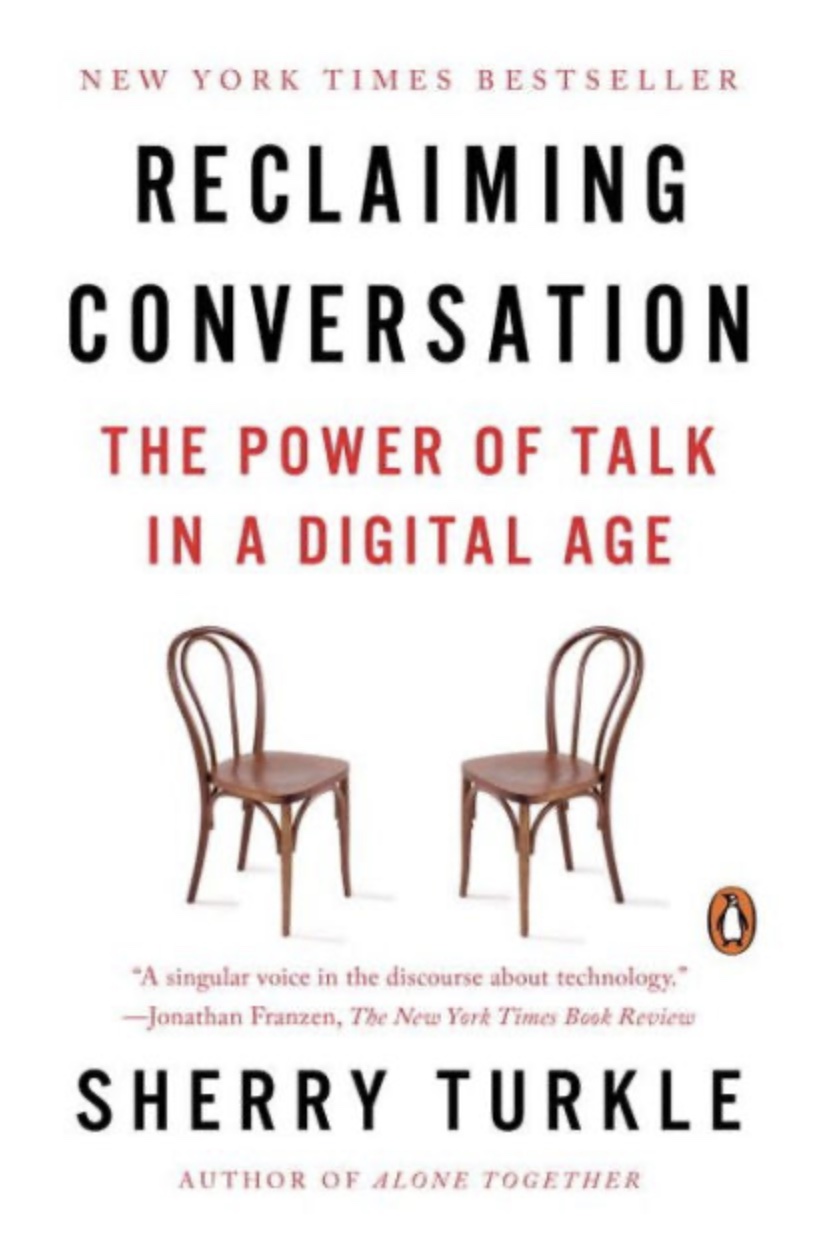
Turkle, S. (2015). Reclaiming Conversation: The Power of Talk in a Digital Age. New York: Penguin Press.

“When we communicate on our digital devices, we learn different habits. As we ramp up the volume and velocity of our online connections, we want immediate answers. In order to get them, we ask simpler questions; we dumb down our communications, even on the most
important matters. And we become accustomed to a life of constant interruption.”
“Apologizing to friends and loved ones over text is an artificial truce, not a resolution to a disagreement. It communicates “I no longer want to talk about this or have tension with you.” It’s a way to avoid confrontation dealing with the real issues.”
“Organizations institute systems, including organizational structures, reward systems, and information systems, that affect what their employees will pay attention to – and what they will overlook. In our rapidly changing world, even the most astute individuals can overlook crucial and accessible information in their surroundings.”“Take notes by hand, instead of electronically. When people use computers to take notes, they become stenographers. When they write by hand, they organize the material in a personal way that requires them to think about and engage with the material on a deeper level.”