



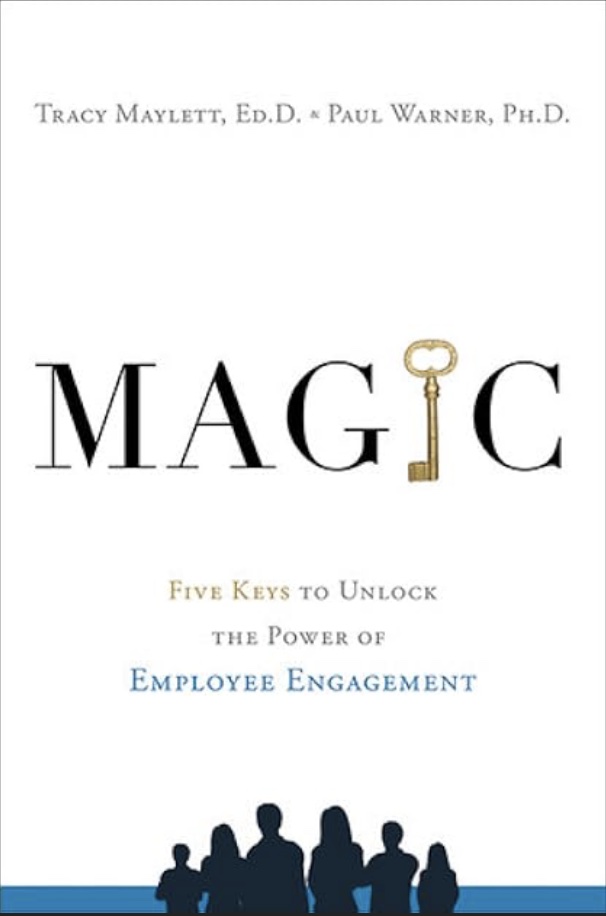
Key Quote:
“Culture must be authentic, and employees should be able to play a role in shaping it” (p. 177). — Tracy Maylett, Ph.D. + Paul Warner
Key Points and Concepts
What is Employee Engagement?
“Employee engagement is an emotional state where we feel passionate, energetic, and committed toward our work. In turn, we fully invest our best selves in the work we do” (p. 14).
Organizations value employee engagement because it can “substantially improve organizations’ revenue, profitability, open market value, employee retention, and customer satisfaction” (p. 31).
While you can’t have engagement without satisfaction, satisfaction does not ensure engagement. In fact, efforts to increase satisfaction are “transactional and contractual” (p. 21), and Maylett and Warner believe a transactional environment is the opposite of an engaged culture.
Employees can be satisfied, motivated, and happy without being engaged. These elements together can nurture and encourage individual engagement, but they cannot create engagement on their own (p. 25).
Engagement is a 50-50 proposition based equally on the choices of both the employer and the employee. Culture, benefits, and management can make this decision harder or easier, but every individual holds the power to be personally engaged regardless of their environment (p. 188).
Similar to many character qualities, engagement exists on a continuum rather than in an absolute state (p. 194). No person can claim to be kind or unselfish in every situation on every day, and employees are not 100 percent engaged throughout every day of work. Employers need to focus on progress and growth in overall engagement throughout the long term (p. 195).
Behavioral and organizational psychologists have identified 3 distinct types of engagement:
• Trait engagement emerges from inborn characteristics of employees who engage proactively without needing external influences (p. 53).
• State engagement changes over time because motivation is emotion based (p. 54).
• Behavioral engagement happens when employees both feel and act engaged in their work (p. 55).
Meaning: Your work has purpose beyond the work itself
Humans need to find meaning as reflected in our constant questioning of “why?” Without a satisfactory answer, employees disconnect and often become cynical and skeptical of other’s motivations (p. 68).
Meaning is found when you view what you do as a calling, rather than just a job. “It’s when you know your work makes a difference that you
care about it personally” (p. 67).
Meaning is not universal, and employees determine it based on their unique priorities and private goals. The self-determined nature of this factor requires individuals to translate their work into a personal perspective that holds meaning (p. 74).
Meaning can be inherent or associated based on the work being done. Inherent meaning comes directly from what the work accomplishes, like creating life-saving medication. Associated meaning is found in what the work allows an employee to accomplish outside of the job, like paying for a child’s college education. These two are not mutually exclusive, and one is not more valuable than the other (p. 77).
While organizations cannot create personalized meaning for each employee, there are 4 factors that can be used to encourage individuals to design their own meaning:
• Congruent Values allow employees to identify and resonate with the mission and vision as it reflects the truth of how the company operates in the world (p. 79).
• Giving evokes a connection with employees when they believe their company is making the world a better place through philanthropy (p. 80).
• Impact allows employees to see the direct results of their work and how it influences others (p. 81).
• Story shows meaning through placing employees in their roles within a larger narrative (p. 81).
Autonomy: Power to shape your work environment in ways that allow you to perform at your best
Employees perform their best work when they have freedom to determine how to accomplish set goals with teamwork and the support of leadership. Obviously, this freedom requires continued trust (p. 90).
“Ambiguity is lethal to autonomy” (p. 94) because employees must understand expectations and believe they can accomplish a task in order to be successful.
The authors explain these elements: Boundaries + Freedom + Accountability = Autonomy (p. 93).
External motivators can create an abundance of perks without personal satisfaction, but intrinsic motivators can satiate individual’s needs and produce lasting motivation to continue improving (p. 95).
The authors believe there are 4 types of autonomy that organizations can grant (pp. 95-96):
• Spatial autonomy comes from the ability to choose where to work and what the space looks like.
• Social autonomy allows employees to choose who they work with on projects.
• Temporal autonomy grants the ability to choose when to work.
• Task autonomy permits employees to decide how to approach and complete work and set timelines.
• The removal of autonomy results in resignation and/or learned helplessness (p. 102).
Growth: Being stretched and challenged in ways that result in personal and professional progress
“Achievement is a universal human need” (p. 135), and organizations can use this desire to motivate and engage employees.
Growth cannot be measured with promotions because people can be pushed into roles beyond their capabilities or desires (p. 117).
When growing employees, beware of pushing them beyond challenges into the stress zone (p. 117). As people get overwhelmed, stress can strangle their productivity. Managers need to remember that stress is measured by perception, not objective reality (p. 119).
Some managers fear the ‘grow and go’ syndrome will mean they have ‘wasted their time’ developing someone who leaves instead of using those skills to further the company (p. 128).
Growth develops through “flow” which occurs when you are completely absorbed in an activity which produces energy, focus, and enjoyment of the process (p. 131).
Organizations can construct a culture that teaches and encourages ‘flow’ through four steps: providing mentors, creating a ‘build a resume’ culture, developing a ‘fail forward’ culture, maintaining high expectations (p. 133).
Impact: Seeing positive, effective, and worthwhile outcomes and results from your work
While impact and meaning are closely related, the authors differentiate these two factors because impact is based on results and meaning comes from a purpose (p. 139). However, results and impact are not interchangeable (p. 141).
‘Law of Impact Proximity’–organizations who can ‘close the distance’ between work and impact will have a higher level of engagement (p. 151). If employees can easily identify how their daily tasks result in a positive impact on others, they are more likely to be engaged in their work.
Effort or impact alone does not create engagement. Instead, “Effort + Impact = Engagement” (p. 143).
Employees need to feel valued by managers, peers, and the organization as a whole, without creating a transactional relationship based on outcomes (p. 146).
Organizations cultivate impact awareness through four steps: 1) measurement of impact by the accomplishing of their mission 2) proximity shown through visible impact 3) providing context through framing and effective storytelling and 4) rewarding value by celebrating impact (pp. 155-157).
Connection: Sense of belonging to something beyond yourself
Connection is the one element of the five that is projected outward instead of felt inward (p. 172). It is also powerful because connection can motivate employees to choose to find meaning, growth, autonomy, and impact in their work (p. 173). It has been proven that “Connection fuels collaboration” (p. 168).
Employees must trust management and upper-level leadership for the connection to be lasting and genuine. “Trust is the absolute knowledge that your words reflect your future actions” (p. 178).
Before achieving connection, people typically feel they 1) fit into existing culture and/or environment 2) belong with company values and 3) integrate by believing the organization is part of who they are (p. 165).
Connection exists in many different forms, and the authors believe 5 types in particular influence employee engagement (pp. 165-166).
• Social connection comes from the people who you spend time with at work.
• Organizational connection occurs when you feel valued or enjoy your daily work experience.
• Mission connection emerges from being united with the mission and purpose of an organization.
• Values connection develops from the belief the company shares and respects your values.
• Task connection happens when you have close proximity with team members as you work.
Communication is the key differentiation between connection and alienation among employees (p. 168).
• Just as an irrigation channel must reach the roots to be effective, communication needs to make it all the way to bottom rungs of an organization to be productive (p. 169).
• Spatial proximity is helpful to this process (p. 169) because messages can be limited to non-rich mediums when limited by distance.
• Organizations need to create channels for communication to flow upward and not only down from the C-suite (p. 170).
Culture creates the environment where connection can either thrive or starve (p. 175).
• Narrative and stories play a large role in shaping culture, but the essential piece remains backing up stories with concrete actions that prove genuineness. “Culture must be authentic, and employees should be able to play a role in shaping it” (p. 177).
Organizations cannot force connection, but they can cultivate connection through actions. This can begin by prescreening hires based on their cultural fit, tapping into cultural interests by soliciting and using employee feedback, and planting core beliefs by reinforcing culture with actions (p. 181)
Kofman, F. (2018). The Meaning Revolution: The Power of Transcendent Leadership. New York: Currency Publishers.

“Employee engagement is an emotional state where we feel passionate, energetic, and committed toward our work. In turn, we fully invest our best selves in the work we do.”
Employees perform their best work when they have freedom to determine how to accomplish set goals with teamwork and the support of leadership. Obviously, this freedom requires continued trust.
While impact and meaning are closely related, the authors differentiate these two factors because impact is based on results and meaning comes from a purpose. However, results and impact are not interchangeable.
Organizations cannot force connection, but they can cultivate connection through actions. This can begin by prescreening hires based on their cultural fit, tapping into cultural interests by soliciting and using employee feedback, and planting core beliefs by reinforcing culture with actions.