
“We don’t learn from success; we learn from failure. And when you can laugh at your mistakes, you’re more likely to try again” (p. 160).
Key Points and Concepts
Formulas for Funny
When people laugh in groups, they are most often laughing at a shared truth (p. 15).
One formula for comedy is “tragedy plus time.” More accurately, the formula is “tragedy plus time plus distance.” Repeated exposure to negative situations naturally results in distancing, which explains the dark humor in emergency personnel and military professions (pp. 108-114).
Recognition is an essential tool for humor. Improv artists use “the element of recognition as a way of generating comedy at The Second City, from localizing content when we perform in another city, where the mere mention of an adjoining suburb elicits howls of laughter, to a simple callback, wherein the audience laughs when a character from a previous scene pops up in an unconnected scene later in the show” (p. 112).
There is power in discomfort and surrendering yourself to embarrassment. If you can willingly look foolish or address the elephant in the room, you now control the situation. For example, if a scene didn’t go well, saying something like “well, that happened” allows both the actor and audience to laugh and move on. “By simply acknowledging the failure with a quick joke, that failure’s power has been instantly dissipated” (pp. 119-157).
Pain, discomfort, tension, incongruity, or any kind of cognitive dissonance is useful for generating comedy. Artistic Director Anne Libera says “you can’t have comedy without something just a little bit uncomfortable. Even the simplest and most childish of jokes (Q: What is brown and sticky? A: A stick) contains brief discomfort due to the feeling of ‘I thought I knew the answer and discovered that I was wrong’ and the stick joke has additional discomfort connected to a taboo” (p. 113).
Leonard and Yorton elaborate that “Comedy is truth and pain. If you want to find the funny, you have to be willing to go to uncomfortable places. That’s where the audience recognizes themselves, and that’s where the laughter comes from” (p. 110). They also note that callbacks and running gags are powerful because they create a sense of community between performers and audience, as everyone is in on the joke (p. 112).
Creative Collaboration
When creating, the focus should be on finding the idea, not your idea. Being able to support and build on others’ ideas is just as, if not more important, than generating original thoughts (p. 86).
When improv actors embrace the philosophy of “Yes, And,” their sole job is to agree with whatever was said before and to add something new to the statement. Accepting and elaborating advances the dialogue and opens up numerous directions for the conversation (p. 25). Example dialogue:
• Actor 1: “Wow, I’ve never seen so many stars in the sky.”
• Actor 2 (poor response: rejecting Actor 1’s statement): “I can’t see a single star…it’s broad daylight.”
• Actor 2 (good response: accepting and building on Actor 1’s statement): “I know! Things look so different up here on the moon.”
Respect is essential to creative collaboration, but reverence kills originality. If you respect your partners’ work, you build on it. If you revere your partner, they are untouchable and you don’t add to their work. Thus, new ideas are not contributed and lower status team members never bring attention to areas where their leader can improve. The Second City has coached some of their corporate clients to release an internal newsletter with a blooper reel of senior management. This is designed to prevent reverence and to encourage a culture of feedback (pp. 124-128).
At The Second City, the troupe updated the maxim “you’re only as good as your weakest member” to be “your ensemble is only as good as its ability to compensate for its weakest member” (p. 71).
The authors emphasize that “ensemble” is at the core of Second City’s philosophy. “No one is the star; the ensemble is the star,” they write (p. 73). This means that success is measured not by individual brilliance, but by how well the group works together and supports each other. They also mention that “listening is the currency of improv,” and that active listening is the foundation for all creative collaboration (p. 29).
Improv in Practice
“Exposure” is a game frequently played in improv classes. One classmate stands in front of the room and the rest of the students stand back in the audience. The class is instructed to stare at the person on stage. After a certain period of time, everyone starts to fidget until the instructor gives him or her a task. They might ask the person on stage to count all the bricks on the opposing wall. With a task, the person on stage no longer focuses on himself or herself, which immediately stops their nervous behavior (p. 22).
“Talk Without I” is an improv technique that functions like the name implies, two people cannot use the word I in conversation. This is used to teach students how they filter information through themselves. This forces them to frame ideas in ways that are more accessible to their audience and also minimizes conflict. Conflict is a quick way to kill humor (p. 58).
Elliott Masie, a Broadway producer, used improv techniques to manage his way through an impromptu speech. He said “I showed up to give a speech, and they had confused me with somebody else. What they wanted me to talk about, I knew nothing about. I had nothing funny to say. I had nothing to say. And everybody was expecting me to talk at length about this topic. I got up there and said ‘Tell me the one thing you find most confusing about X’…So people shared their concerns, and I’d be like ‘OK, I’ve got a question. Who has an answer?’ And I kept the ball rolling like that. And at the end of the hour, I got a standing ovation. And then I got four more invitations to speak on that topic” (p. 181).
Leonard and Yorton also describe the “Failure Bow,” a practice where, after a mistake or flop, performers take a big, theatrical bow and the group applauds. This re-frames failure as a necessary and even celebrated part of the creative process, reducing fear and encouraging risk-taking (p. 159). They note, “We don’t learn from success; we learn from failure. And when you can laugh at your mistakes, you’re more likely to try again” (p. 160).
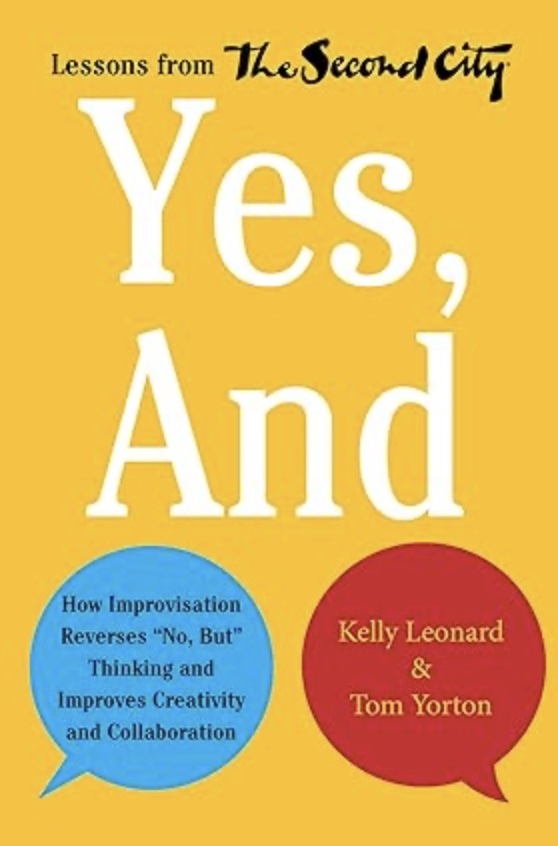
K. Leonard & T. Yorton (2015). Yes, And: How Improvisation Reverses “No, But” Thinking and Improves Creativity and Collaboration—Lessons from The Second City. New York, HarperCollins.

“Pain, discomfort, tension, incongruity, or any kind of cognitive dissonance is useful for generating comedy. Artistic Director Anne Libera says “you can’t have comedy without something just a little bit uncomfortable.”
“There are three paradoxes of charisma: trying to be charismatic has the opposite effect, you attract other people’s attention by giving them yours, and to connect with many people, connect with one.”
“Talk Without I” is an improv technique that functions like the name implies, two people cannot use the word I in conversation. This is used to teach students how they filter information through themselves. This forces them to frame ideas in ways that are more accessible to their audience and also minimizes conflict. Conflict is a quick way to kill humor.”