
“Leadership is a relationship, and the first relationship is self-directed.” (p. 90)
Key Points and Concepts
Building Morale
One key to building high morale among employees is recognizing their merits. “Catch people doing something right and bring it to their attention” (p. 3).
Your emotional state is the thermostat for your entire team. Keeping a positive and optimistic outlook makes it easier for your reports to do the same.
Every time you interact with a member of your team, you are communicating the way you see them. “Understand how much power your influence really carries,” and ensure that your interactions help to build or strengthen your relationship (p. 3).
Instilling a sense of personal achievement in your team starts with motivation. “Seek out what motivates a subordinate, and figure out how that can be harnessed to help the team achieve its goals” (p. 5).
At the end of the day, “employees come to work for their own personal fulfillment, not for yours” (p. 87).
Systems of accountability need to be self-sustaining. Let your reports choose whom and for what they want to be accountable, and then hold them to that. Furthermore, have employees give input on the ideal outcome of a project, asking them what action steps they need to take and when. Keep them accountable to those dates, and ask if there’s anything you can do to help them reach the outcome. If and when mistakes are made, use them as learning moments (p. 27).
Living Your Values
The most important aspect of leadership is trust. Your followers, your employees, and / or your fans need to trust you. Communicate the trust you have in your people and you will foster “silent accountability” among them (pp. 7-8).
Leadership is servanthood. As a leader, you put others before yourself. Create a culture of giving through your time and effort. “Give and take… but mostly give” (p. 22).
Leadership is also never given to you, you earn it by “adopting an attitude of leadership” and “by living your life in a way that attracts both followers and greater levels of responsibility to you” (p. 89).
To live your values, you must “assume the heart of leadership,” and lead by example. Leaders’ hearts are fullest when they are prosperous––true leaders ensure there is room for everyone to win (p. 7).
To grow in your relationships, you must begin with the relationship you have with yourself. “Leadership is a relationship, and the first relationship is self-directed.” Accept what it means to be responsible for yourself, and an authenticity in your leadership will follow (p. 90).
Delivering Positive Feedback
As a leader, it is your job to ensure that your followers are following the path that you have set out for them. Build the skill of delivering feedback––in the right way: it’s critical to your guidance (pp. 14-15). Keep these four elements in mind when you have a major feedback conversation:
1. Encourage employees by saying that your motivation is to develop them and take them to a new level in their career.
2. Reaffirm the confidence that you have in them and their ability to get the job done.
3. Guide them in appraising their strengths by asking questions about their motivation for excellence.
4. Help them leave behind the identity bound up with their old performance and introduce them to a new one of stronger performance.
When listening to your employees, listen with a positive influence. Sitting down next to the person, getting off the floor or in a neutral space, and giving them undivided attention all communicate that you’re engaged in what they have to say. Providing them with emotional validation and repeating their message back in your own words expresses that you really understand what they’re expressing (pp. 97-98).
On Selling
Approach customers with confidence by developing a legitimate relationship with them––focus initially on pacing the relationship and conveying appropriate levels of respect.
Identify the needs of your customer before you pitch. Decisions are made on emotional and personal grounds, not intellectual ones. “It is the emotional belief in your contribution and the way it will benefit them on a personal level that will encourage them to buy, not rebuttal number nine” (p. 105).
Figure out from prospective buyers why they would buy from you by asking “What is important to you in buying this thing?” and sell to that. In your preparation, consider the following questions: Why would my prospect benefit from this product on a personal level? What would those personal benefits be? When would they be realized?
Paint the whole picture: have a win for the prospect, one for the team, and one for the greater good in general. Similarly, what you sell should have a purpose in the world, as “the difference that you make in this world is what makes the difference in your business.” Infuse the sense of purpose of your products or services into the way you talk about them (pp. 10-11, 116).
Identify patterns of buying behavior of previous customers––both of the satisfied and unsatisfied––and use that to guide you. Make it easy for people who’ve bought from you to buy from you again, and be laser-focused on figuring out what went wrong with the customers you lost or who were unsatisfied. Improvement grows from those insights. Asking these questions of yourself and your customers may feel like minor changes, but “minor changes in major areas are the essence of lasting achievement” (p. 70).
On Hiring
Ultimately, people want to be personally fulfilled by their work. When you hire, tell the employee about how their work impacts the larger picture of the company (p. 41).
Lou Adler’s SMART objectives help set expectations in the hiring process, ensuring you and your candidate are both aligned on the role:
• How do you Specifically define success?
• How do you Measure success?
• What Action steps need to be taken for them to be considered successful?
• What are the Results you need?
• What Timelines are associated with these issues?
Think of critical hires and star talent as important clients, and prioritize developing your relationship with them. Theoretically, these hires will bring in as much revenue as a long-term client, with the potential for much more (p. 94).
Development and Improvement
When it comes to development, many people think, “What if I develop my people and they leave?” Perhaps a better question is “What if you don’t develop them and they stay?” Development should be a priority for every business owner or executive (p. 65).
If there isn’t room in the budget for development, consider making an informal study of leadership part of your leadership team’s practice, asking for stories from front-line managers in your company about how they lead, and building a culture of discussing personal development among your leadership team.
Find potential areas for improvement across the organization, using the model of the Four Ms of performance improvement:
1. Metrics. Know what needs to be improved and start measuring it.
2. Motivation. Build internal motivation to give your company a competitive edge.
3. Message. Show customers why they benefit personally from working with you.
4. Meaning. Bring the long-term vision into the foreground of the everyday (pp. 72-74).
Always seek to improve, especially when things are going well. If you think of your resources (time, patience, budget, etc.) as being limited, you become more protective over them. “People only conserve that which they believe to be finite.” Being protective of what you have and what you do allows you to be more thoughtful and efficient about how you work (p. 83).
In times of organizational flux, “action is the balm that soothes the wound of chaos.” Don’t paralyze yourself or your company by over-thinking. Assess the situation and options, consult with stakeholders, determine a direction, and execute (p. 125).
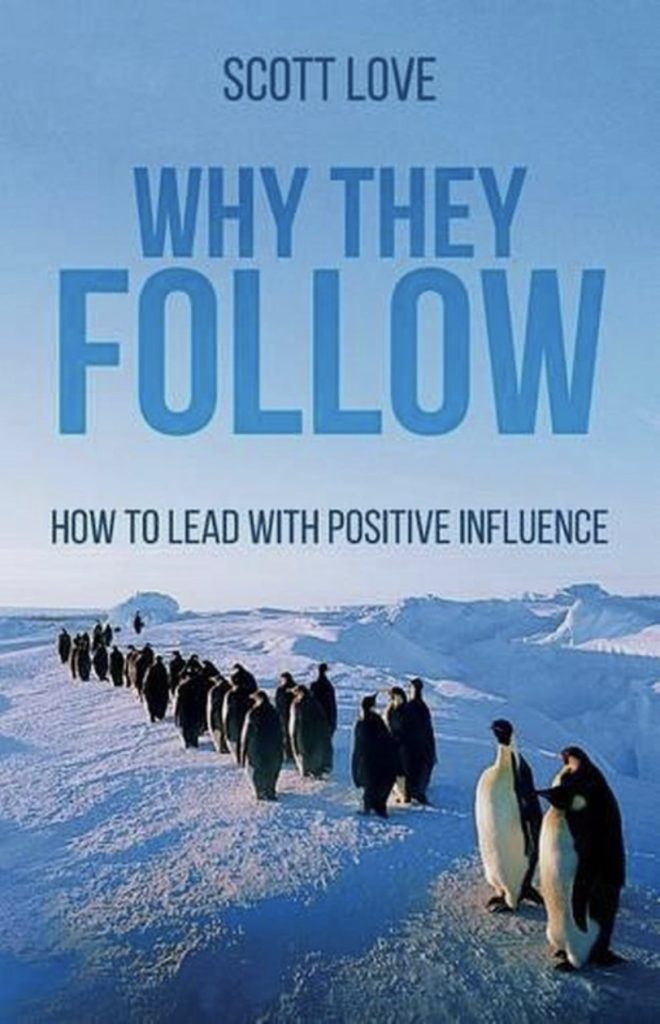
Love, Scott. (2016). Why They Follow: How to Lead with Positive Influence. South Carolina: CreateSpace Independent Publishing Platform.

“Every time you interact with a member of your team, you are communicating the way you see them. “Understand how much power your influence really carries,” and ensure that your interactions help to build or strengthen your relationship.”
“Approach customers with confidence by developing a legitimate relationship with them––focus initially on pacing the relationship and conveying appropriate levels of respect.”
“In times of organizational flux, “action is the balm that soothes the wound of chaos.” Don’t paralyze yourself or your company by over-thinking. Assess the situation and options, consult with stakeholders, determine a direction, and execute.”