
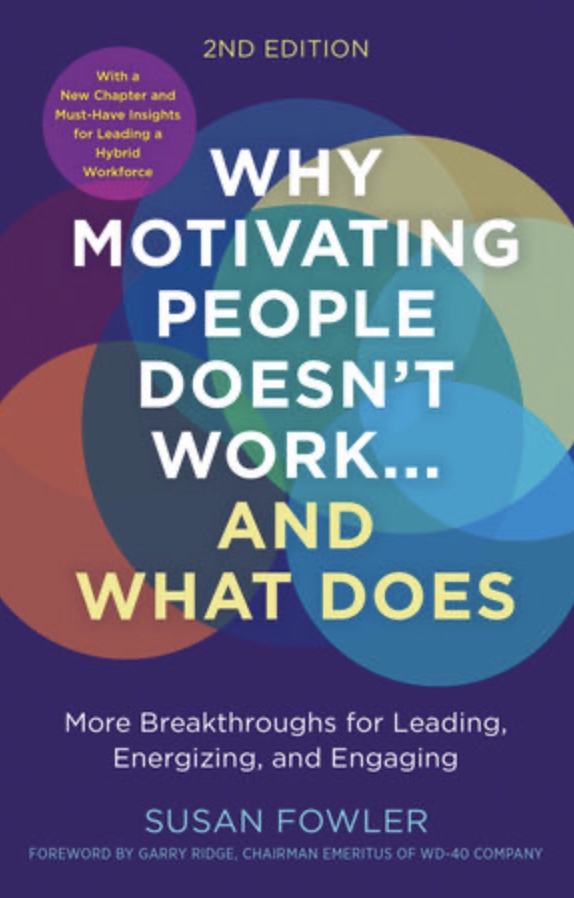
A Rule of Three Book Summary by Admired Leadership
The Book in 3 Sentences:
The author challenges the belief that leaders are responsible for motivating others, arguing that motivation comes from within. Grounded in motivational science research, the book explains why common tactics like rewards, praise, or pressure fail to sustain people’s motivation. It offers a framework for creating conditions from which people can tap into optimal motivation.
The 3 Most Important Concepts:
1) The motivation question: Organizational leaders believe they are supposed to motivate their teams to drive results and create outcomes, so they turn to external influences (e.g., money, gifts, praise, fear, approval) to direct desired behavior, but motivation isn’t
external. It lies within each of us—the question isn’t “what motivates us,” it’s “why are we motivated?”
2) The motivation dilemma: Organizations hold their leaders accountable to motivating their teams and double down on short-term results even though this approach has negative effects on individual and team long-term success. Leaders can’t motivate their team members, but they play a crucial role in creating an environment and situation where optimal motivation can exist.
3) The Spectrum of Motivation® model: The foundation of the book which outlines six motivational outlooks:
Sub-optimal motivation:
• Disinterested motivational outlook
• External motivational outlook
• Imposed motivational outlook
Optimal motivation :
• Aligned motivational outlook
• Integrated motivational outlook
• Inherent motivational outlook
The Book’s 3 Most Essential Claims:
1) Any tactic you apply to persuade, coerce, or nudge someone to do something is short-sighted and toxic to optimal motivation. The author likens it to motivational “junk food.”
2) People who are optimally motivated have strong self-regulation abilities (the ability to effectively manage feelings, thoughts, values, and purpose) and are meeting their psychological needs (choice (autonomy), connection, and competence). The state of optimal motivation is fragile and can change at any time.
3) Leaders must first be optimally motivated before they themselves can create the conditions to truly help others achieve optimal motivation.
3 Surprising Facts or Insights
Drive theory is behind our modern, popular beliefs about motivation. It explains that our desires to act (or not) are based on needs to meet our biological needs like (food, water, and sex).
You must meet all three psychological needs (choice, connection, and competence) simultaneously; if one is lacking for you, there is a “domino effect” and your entire motivational outlook suffers.
The lessons outlined in the book hold significance for parents, who may find it easier than organizational leaders in complex organizational structures to create conditions that foster choice, connection, and competence. These conditions help children develop and sustain their own motivation.
Actionable Recommendations:
Stop asking people what motivates them—they rarely know that the root of their lack of motivation is an unmet psychological need.
Make deepening connection with your team a key priority—this could be connection to the organization’s vision and purpose as well as to you and their colleagues.
Become a better teacher to help others build competence.
3 Questions the Book Raises:
What are leaders to do if they want to create an environment for optimal motivation within their team, but the broader organization has created systems and processes that reinforce sub-optimal motivation like sales trips, online rewards centers, and participation incentives?
Where does recognition fit into this approach—how can leaders show appreciation and celebrate team members’ great work without risking a hit to their motivation?
Leaders can do a lot to help create conditions for choice, connection, and competence, but they have less influence over someone’s self-regulation (the other element of motivation), with this in mind, should leaders be hiring people with higher quality self-regulation, and if so, how should they screen for that?
3 Criticisms of the Book:
The author is too idealistic; the application of her concepts will be impractical for many leaders. Her advice is to be courageous, but leaders have goals to achieve. There’s not enough conversation in this book about the complexity of real-world, real-life challenges. The case studies focus on people who apply her recommendations—but there is limited discussion about the challenges in doing so.
The editor should have simplified and shortened the book. The Spectrum of Motivation® is complicated—the main points of optimal and sub-optimal motivation could be more clearly and simply explained. There were too many case studies, and the book would have been clearer with fewer examples and a simpler through-line.
There’s not enough conversation in the book about recognition—which is often the short-hand leaders use when they are trying to motivate their teams.
3 Quotations Worth Remembering:
“The least used leadership behavior may be one of the most-essential: showing and telling how—or teaching people the skills necessary—to achieve their goals.” (p. 98)
“A common myth is that people don’t leave companies, they leave bad bosses. The truth is just the opposite. People leave companies that enable that bad boss to exist” (p. 121)
“Treating people with equality doesn’t necessarily mean they all get the same deal—it means they get the same level of respect and consideration. Procedural justice is essential when encouraging choice in a workforce where one size doesn’t fit all.” (p. 126)
