
Key Quote:
“The science of timing has found – repeatedly – what seems to be an innate preference for happy endings. We favor sequences of events that rise rather than fall, that improve rather than deteriorate, that lift us up rather than bring us down. And simply knowing this inclination can help us understand our own behavior and improve our interactions with others” (p. 161).”
Key Points and Concepts
Part One: The Day
The Hidden Pattern of Everyday Life
Pink begins by examining the timing of daily life starting with average tasks like waking up, making breakfast, starting work, etc. Through the studies presented, Pink identifies trends in productivity and how the mind works during different times of day.
Generally, people tend to be more positive and upbeat in the morning. As the day goes on, we become increasingly more irritable and negative. When applied to a larger group, these trends have
a greater impact on business as a whole.
• This was proven in an example where Campbell’s Soup executives began holding their quarterly earnings calls in the morning rather the afternoon, which resulted in improved stock prices and ensured a greater sense of confidence in investors and leadership.
Identifying our personal chronotype can help to determine our most productive time of day and when we should approach decision-making.
• “Each of us has a ‘chronotype’ – a personal pattern of circadian rhythms that influences our physiology and psychology” (p. 27).
• Pink names three chronotype categories that people can fall into based on the time they fall asleep and when they wake up. The middle point of sleep cycle determines which category an individual falls into.
• The three categories Pink uses are: Larks (12am-3am), Third Birds (4am-5am) and Owls (6am-12pm) (p. 28). People can change categories through childhood and early adulthood development before settling in one range.
• Larks tend to be morning people, more introverted, agreeable and emotionally stable, while Owls tend to be extroverted and impulsive. Third Birds share qualities of both Larks and Owls. The early risers are more efficient in the morning and have better decision-making thought processes in the afternoon, whereas the opposite is true for night owls.
• Understanding these factors and findings ultimately help people to establish “synchrony” – aligning types of work, tasks and timing for optimal results. To understand your personal “when-to,” record your activity hourly and describe the task you are working on (analytical vs. insight), your mental alertness and physical energy (p. 40).
The Power of Breaks
The afternoon is the most common time during the day when mistakes are made and we are less likely to be motivated. For most professions, this is not a fatal trend, but for medical professionals and hospitals, this creates a challenge in providing effective care (p. 54).
Taking breaks can help people to refocus and come back to work with new energy, which is critical to improve efficiency.
• For example, doctors at University of Michigan Medical Center began a pre-operative practice referred to as “vigilance breaks” – “a brief pause before a high-stakes encounter to review instructions and guard against error.” (p. 52)
• In this particular hospital, the anesthesiologist would lead and read off the following: introductions of people in the room, patient identifiers/procedure/surgery, blood & special research consents, side and site marked, diagnostic and radiology test results displayed, and allergy review. (p. 52)
• While mistakes are still more likely to occur in the afternoon, this practice has helped prevent death and decreased complications.
• For more stationary jobs, Pink recommends five guiding principles for taking breaks (pp. 60-63):
1. Something beats nothing – Frequent shorter breaks are more beneficial than one long one.
2. Moving beats stationary – Simply walking for five minutes every hour improves blood flow and can boost energy levels.
3. Social beats solo – Taking breaks with others gives us the opportunity to talk about something other than work.
4. Outside beats inside – Spending time outdoors improves mood and helps us feel less trapped inside.
5. Fully detached beats semidetached – Tech-free breaks can reduce emotional exhaustion.
Part Two: Beginnings, Endings and In Between
Beginnings
In regard to beginnings, Pink first calls out the importance of when the day starts and how to achieve success from the beginning.
• This particular principle in the book uses the example of high school students learning a foreign language. Teenagers not only need more sleep, but they also tend to stay up later and have trouble waking up in the morning. A study at McGill University determined that the quality of sleep and start times had the greatest impact on students’ performances in foreign language classes. Further research supported these findings leading the American Academy of Pediatrics to recommend middle schools and high schools begin class no earlier than 8:30am. Academic performance improved, along with standardized test scores, and even the number of car accidents involving teen drivers fell. (p. 91)
Starting on specific dates or days of the week can also have a significant impact on attitudes and success. The “fresh start effect” can be either social or personal but is a clearly stated time to begin. Social landmarks would be: Mondays, the first day of the month or a national holiday. Personal landmarks are unique to the individual: birthdays, anniversaries or job changes. (p. 95)
• “People can strategically create turning points in their personal histories. Similarly, organizations can use this technique, too. Rather than waiting until the next quarter, an obvious fresh start date, leaders can find a meaningful moment occurring sooner – perhaps the anniversary of the launch of a key product – that would relegate the previous screw-ups to the past and help the team get back on track” (p. 97).
To begin at the same time, or “starting together,” we can identify trends in college graduates and the job market.
• For example, students who graduated in the same year during a recession are likely to experience the same financial impact in their salaries compared to their peers who graduated years earlier or later. The recession not only impacts their starting salary but also creates a barrier to what they could be earning years later since they began at a lower salary.
• “In any dynamic system, the initial conditions have a huge influence over what happens to the inhabitants of that system” (p. 100).
• “The Federal Reserve Bank of New York, looking at these early indicators, warned that ‘those who begin their careers during such a weak labor market recovery may see permanent negative effects on their wages” (p. 101).
• “The goal here is to recognize that slow-moving when problems have all the gravity of fast-moving what calamities – and deserve the same collective response” (p. 104).
Midpoints
“In the middle, we relax our standards, perhaps because others relax their assessments of us. At midpoints, for reasons that are elusive but enlightening, we cut corners” (p. 123).
The midpoint in any project, game or activity signals a turning point for the participants. Up until the midpoint, groups usually do not accomplish what they set out to do. The halfway point approaches and the realization sets in that time is now winding down.” This turning point creates a sense of urgency to take action (p. 127).
• “Groups didn’t march toward their goals at a steady, even pace. Instead, they spent considerable time accomplishing almost nothing – until they experienced a surge of activity that always came at ‘the temporal midpoint’ of a project” (p. 126).
In sports, the midpoint can define the outcome of the game.
• “It’s not surprising that teams ahead at halftime won more games that teams that were behind. However, there is an exception to the rule. Teams that are down by one point at halftime are more likely to win. Home teams with a one-point deficit at halftime won more than 58 percent of the time” (p. 131).
Ways to Avoid Midpoint Slump (pp. 137-139):
1. Set interim goals.
2. Publicly commit to those goals.
3. Stop your sentence midway through (to create a spark for where to pick up next time).
4. Don’t break the chain (keep up with good habits).
5. Picture one person your work will benefit.
Endings
Endings ultimately determine how we remember experiences. If an event ends on a high note, we are more likely to remember that positive moment, whereas if it ends poorly, we have trouble remembering the better moments during the experience.
• “The peak-end rule says that when we remember an event we assign the greatest weight to its most intense moment (the peak) and how it culminates (the end)” (p. 154).
A survey of first-time marathoners found that more than 48 percent of participants were at an age that ended in -9, or “9-enders” (p. 147). These participants, for various reasons, represent a population determined to either do something different or accomplish a certain goal before entering their next decade of life. This idea of ending a decade has become a deadline for many first-time marathoners.
Other than creating a deadline, endings often shape the view of a person’s life or professional career.
• “The science of timing has found – repeatedly – what seems to be an innate preference for happy endings. We favor sequences of events that rise rather than fall, that improve rather than deteriorate, that lift us up rather than bring us down. And simply knowing this inclination can help us understand our own behavior and improve our interactions with others” (p. 161).
• When delivering mixed news, it is always preferred to lead with the bad news first, and the good news second. The lasting impression of the conversation will be on a positive note, rather than the negative it began with.
Pink recommends creating better endings in these four cases: the workday, semester, vacation and a purchase. Through these four experiences, we can evaluate goals, measure progress and reminisce on accomplishments up until that point.
Part Three: Synching and Thinking
Synching
Pink concludes the book by emphasizing the importance of synchronization between people and timing. “An external standard sets the pace. A sense of belonging helps individuals cohere. And synchronization both requires and heightens well-being” (p. 181).
Synchronization requires a leader or “boss” to focus the collective mind, a tribe of followers and to the heart of each individual (p. 181).
“Entrainment also occurs in organizations. Certain activities – product development or marketing – establish their own tempos. But those rhythms necessarily must synchronize with the external rhythms of organizational life – fiscal years, sales cycles, even the age of the company or the stage of people’s careers” (p. 184).
“Taken together, all of these studies suggest that the path to a life of meaning and significance isn’t
to ‘live in the present’ as so many spiritual gurus have advised. It is to integrate our perspectives on time into a coherent whole, one that helps us comprehend who we are and why we’re here” (p. 217).
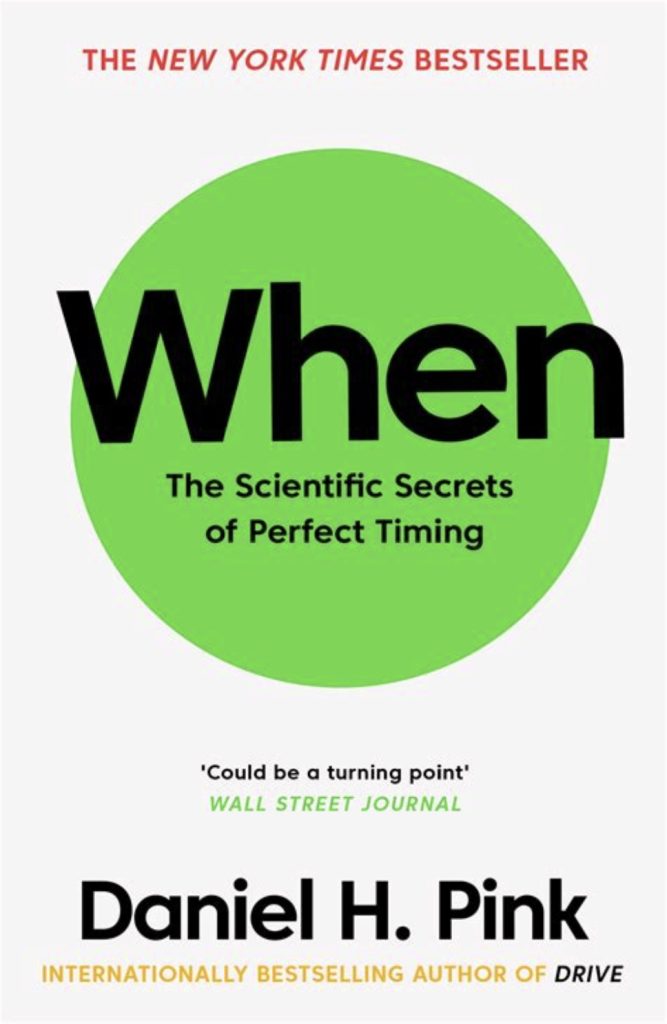
Pink, D. (2018). When: The Scientific Secrets of Perfect Timing. New York: Riverhead Books.

“The science of timing has found – repeatedly – what seems to be an innate preference for happy endings. We favor sequences of events that rise rather than fall, that improve rather than deteriorate, that lift us up rather than bring us down. And simply knowing this inclination can help us understand our own behavior and improve our interactions with others.”
“When delivering mixed news, it is always preferred to lead with the bad news first, and the good news second. The lasting impression of the conversation will be on a positive note, rather than the negative it began with.”
“Pink concludes the book by emphasizing the importance of synchronization between people and timing. “An external standard sets the pace. A sense of belonging helps individuals cohere. And synchronization both requires and heightens well-being.”