
“Organizations can’t always do everything with the talent they have, especially when the most urgent issue at hand is something entirely different from what the organization is accustomed to doing…I was committed to bringing in a caliber of talent that had never before worked in a local police department—the kind of people who had probably never even considered police work before. Real world-class experts in their fields who could help me take the NYPD to a whole new level” (p. 250).
Key Points and Concepts
Upbringing and Training Years
“The new families were moving to New York for the same old reasons our parents and grandparents had—for opportunity, for jobs, for the great American dream…But the way we looked at it was that we had to defend the neighborhood. That was our job” (pp. 26-27).
“By the age of 20, I had been inside two of America’s most vaunted institutions, the New York City Police Department and the U.S. Marine Corps” (p. 48).
“I remain a huge believer in the Marine Corps way…virtually everything I know about being a leader, I learned in the Marine Corps. How to deliver clear messages. How to set standards and stick to them. How to treat other people and how to treat yourself” (p. 52).
“After Quantico and my additional training, leading others felt somewhat natural to me, and my urban upbringing helped define my leadership style. I took the direct I’m from New York approach” (p. 57).
New York City Police Department – Pre 9/11
Kelly was promoted to captain in 1980 and instituted changes that reflected “basic police practice and leadership psychology: elevated expectations, clear responsibilities, an orderly work environment, objective performance measurements, praise for those who succeeded, and
close supervision of those who did not” (p. 97).
While earning his master’s degree in public administration from Harvard University, Kelly began to recognize the limitations of NYPD and sought out the intellectual diversity of other academics and professionals. “I came to understand how police departments were first and foremost organizations composed of human beings who could be developed, encouraged, and motivated in ways that few police executives have ever thought of before” (p. 101).
“Fighting crime would always be our top priority, I said. But I was also committed to having a department as diverse as the city it served” (p. 130).
The 1993 World Trade Center bombing in New York City demonstrated the first real threat of radical Islamic terrorism. “We learned that these weren’t random individuals in solo acts of violence. It was a network. It might be loosely organized. It might have many tentacles. But it did have some kind of organizational structure and an impressive ability to plan” (p. 139).
New York Police Department – Post 9/11
In January 2002, Mayor Bloomberg appointed Kelly as Police Commissioner; in this role, Kelly sought to rebuild public confidence and protect the city from another terrorist act. He realized the process would “require a fundamental rethinking of the role of the police in New York City, a thorough reordering of the department’s priorities, and some genuine cultural change” (p. 243).
“Organizations can’t always do everything with the talent they have, especially when the most urgent issue at hand is something entirely different from what the organization is accustomed to doing…I was committed to bringing in a caliber of talent that had never before worked in a local police department—the kind of people who had probably never even considered police work before. Real world-class experts in their fields who could help me take the NYPD to a whole new level” (p. 250).
“We had to cover all three of the C’s—counterterrorism, crime fighting, and community relations. Those three together, I knew from the beginning, would be the central pillars of my time as police commissioner” (p. 262).
Counterterrorism
“The sixteen plots to attack New York City were not just the wide-eyed rantings of zealous believers or the harmless fantasies of the mentally ill. Let me be clear about this: they were live, active conspiracies, perpetrated by people intent on mass murder, stopped somewhere on the road to execution by diligent law enforcement and, yes, quite a bit of luck” (p. 307).
Kelly realized that the department “needed to get started immediately gathering [their] own intelligence—and analyzing it. The days of waiting for federal assistance and guidance were over” (p. 259).
“Starting in 2003, we stationed New York police detectives in Tel Aviv, and the program grew to include detectives stationed in Abu Dhabi, Lyon, Amman, Madrid, London, Paris, Toronto, Montreal, Singapore, and the Dominican Republic, listening for anything that might have an impact on New York” (p. 297).
“We knew that no one would protect New York like New York would. We knew our city would always be a prime target for terrorists. We vowed we wouldn’t let our guard down. We never forgot the importance of robust information gathering” (p. 438).
Crime Fighting
“The basics of crime fighting were well established and well known. Be visible. Patrol. Interact with the citizenry. Don’t be lazy. Don’t be corrupt. Be open. Be respectful. Be flexible…Most important, be proactive” (pp. 267-268).
“One of the biggest challenges in leading any modern police department is keeping the cops constantly active and engaged. Police work, when it’s done well, requires energy and initiative…any good officer is always on the lookout for people behaving suspiciously” (p. 269).
Kelly created a system called the Real Time Crime Center which served as a “massive searchable database that gave our people up-to-the-minute reports on crimes, perpetrators, criminal histories…and a vast amount of other information—across the entire city, twenty four hours a day” (p. 284).
The record of annual homicides in New York City continually dropped from 587 to 333 during Kelly’s period as police commissioner. “By 2005, New York had the lowest overall crime rate among the ten largest cities in the United States…These numbers were gratifying and a credit to the entire department” (p. 288).
Community Relations
“We also created a new Liaison Unit that reported directly to me. The unit was composed of police officers with direct lines of communication to the African American, Haitian, Asian, Jewish, Muslim, and LGBT communities. I met with these officers on a weekly basis” (p. 278).
Kelly diversified the police force to the extent that at one point, the department was made up of natives from 106 countries. “New York is a highly complex city, tribal in many ways. The more closely a department reflects the city it serves, the better its understanding will be…It gave us enormous depth, understanding, and new lines of communication” (p. 279).
“We devoted greater resources to community relations than the NYPD ever had before—inviting citizens into the local station houses, getting our officers to mix more casually in the community, encouraging precinct commanders to get to know people in the neighborhoods where they served, and making sure the police were helping to solve local issues long before they grew into violence or crime” (p. 440).
“It matters when the police commissioner shows up, for our own people and for those we are privileged to serve. I spent countless hours attending worship services, visiting hospitals, going to public meetings, marching in parades—making sure I was plainly visible, especially in parts of the city where police brass was rarely seen except in the aftermath of some horrific disturbance or crime. It was far better, I believed, to build personal relationships in calmer moments. Then, at the very least, we’d have open lines of communication when the next crisis occurred” (p. 443).
Conclusion
“My four plus decades at the NYPD meant I knew the place well—its strengths, its characters, its far-off corners, its weaknesses—far better than any outsider ever could…My experience outside the NYPD was valuable as well. Having led U.S. marines in combat in Vietnam, I learned some things about motivating people and the tools of crisis management, especially the importance of effective teamwork when the stakes are highest” (pp. 444-445).
“Law enforcement agencies have to be open to asking for help. Police need support from communities, from the street corners to the executive suites. If the police are going to be part of the people—not just among the people or on top of the people—we need to engage productively with everyone” (p. 459).
Each of the thwarted terrorist plots “teaches us an important lesson going forward, including the biggest one of all: in the years and decades that are coming, we must never drop our guard” (p. 308).
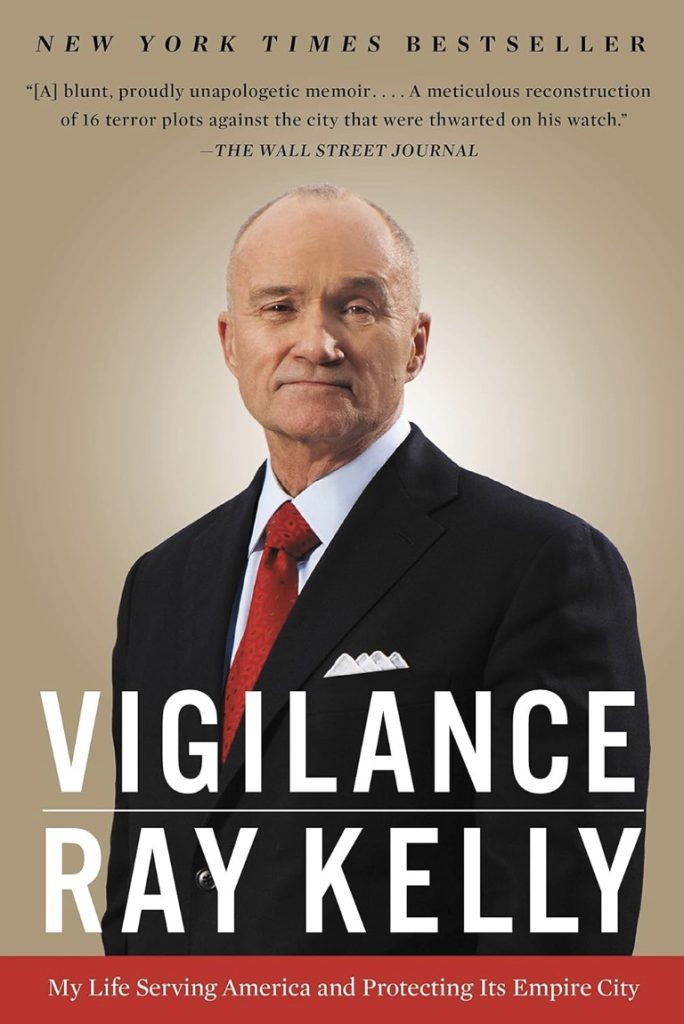
Kelly, R. (2015) Vigilance: My Life Serving America and Protecting Its Empire City: New York: Hachette Book Group..

“The basics of crime fighting were well established and well known. Be visible. Patrol. Interact with the citizenry. Don’t be lazy. Don’t be corrupt. Be open. Be respectful. Be flexible…
Most important, be proactive.”
“It matters when the police commissioner shows up, for our own people and for those we are privileged to serve. I spent countless hours attending worship services, visiting hospitals,
going to public meetings, marching in parades—making sure I was plainly visible, especially in parts of the city where police brass was rarely seen except in the aftermath of some horrific disturbance or crime.”
“Law enforcement agencies have to be open to asking for help. Police need support from communities, from the street corners to the executive suites. If the police are going to be part of the people—not just among the people or on top of the people—we need to engage productively with everyone.”