
“Intellectually knowing how habits form and play out in your life builds speed and momentum so that later, when you have all the tools in hand, you can change them” (p. 59).
Key Points and Concepts
Anxiety Is Common
“Since any event that is about to happen is imminent and the only thing we can be certain about is that things are uncertain, anxiety can rear its head in just about any place, situation, or time of day” (p. 5).
In 2018, the American Psychological Survey reported that 80% of 1,000 U.S. adults surveyed felt the same level of anxiousness, if not more, than the previous year (pp. 12-13).
“Anxiety doesn’t just come out of the blue. It is born” (p. 14). A range of studies show that anxiety can strike a person at any point, especially when paired with fear.
Anxiety is contagious. Through social contagion, the spread of emotion from one person to another, interacting with an anxious person can cue your own anxiety (pp. 22-23). It’s important to be mindful of our state of mind when we communicate with others.
The dictionary definition of addiction is “Continued use despite adverse consequences” (p. 28). According to this definition, the overuse of just about anything is considered an addiction, anxiety included.
The addiction to anxiety manifests itself in everyday habits. As such, managing anxiety begins with building awareness of the bad habits, such as stress eating or procrastination, that you continually revert to despite knowing they are harmful (pp. 33-36).
Fear + Uncertainty = Anxiety
Anxiety and panic are similar in relation, and both originate from fear. “Fear itself does not equal anxiety. Fear is an adaptive learning mechanism that helps us survive. Anxiety, on the other hand, is maladaptive; our thinking and planning brain spins out of control when it doesn’t have enough information [to predict the future]” (p. 17).
Through negative reinforcement, humans learn to avoid dangerous circumstances. We use environmental cues, the behavior spurred by that cue, and the result of that behavior to determine whether to repeat or avoid the action (pp. 15-18).
Three factors diminish our brain’s ability to make choices: the difficulty of the task, the complexity of the choices, and the level of uncertainty. Contradictory information can increase the degree of uncertainty, making it more difficult to make a choice. When fear takes form, a mind in a state of anxiety instantly spurs into action and demands more information.
To break the cycle of anxiety, we must “hack” our brains. You must learn to be aware that you are getting anxious as it is happening and consider the results of the panicked state (p. 24).
Anxiety as a Habit Loop
Anxiety occurs in a habit loop – a cycle between a trigger, an associated behavior, and a subsequent reward (pp. 37-38).
In the case of anxiety, unpleasant emotions trigger the cognitive behavior of worry, which in turn gives the “reward” of distraction. Once the reward has diminished, the loop repeats, cycling back to the trigger stage and becoming a habit (pp. 37-41).
The Three Gears / Stages of “Unwinding Anxiety”
First Gear: Map out anxiety “habit loops” (p. 50).
Second Gear: Tap into your brain’s reward system (p. 50).
Third Gear: Use your brain’s neural capacities to replace bad habits with new ones (p. 50).
First Gear: Mapping Habit Loops
Visually mapping out these habit loops by recording triggers, behaviors, and rewards is the first step to “unwinding” anxiety and regaining control (p. 43).
Once you have mapped out each loop, map out related habit loops. As part of this exercise, map out how the loops drive one another, but do not immediately try to fix them, which in and of itself can become a harmful habit loop (pp. 57-59).
“Intellectually knowing how habits form and play out in your life builds speed and momentum so that later, when you have all the tools in hand, you can change them” (p. 59).
Unsuccessful Anti-Habit Strategies
Willpower: According to Brewer, willpower is a myth. The more effort a person puts toward calming down, the more depleted they feel. In essence, when we need willpower most is when it is least effective (pp. 67-69).
Substitution: In this method, you replace the behavior in the habit loop with something healthier. Since the habit loop remains, it is easy to fall back into the old behavior, especially if it is less rewarding than the previous one (p. 69).
Prime Your Environment: This method includes removing triggers from the environment to avoid decisions involving self-control in the first place. It’s easy to fall back into an old habit pattern as soon as you come in contact with the original trigger (p. 70).
Mindfulness as an Anti-Habit Strategy
“Mindfulness is not about stopping, emptying, or ridding ourselves of anything. Thoughts, emotions, and physical sensations are what make us human… Mindfulness is about changing our relationship to those thoughts and emotions” (p. 86).
Habit loops frequently become so ingrained that they become part of our identities, and we accept them as part of who we are. The practice of mindfulness helps to recognize unhealthy habits and understand the need to replace those habits with new ones (pp. 71-90).
Second Gear: Updating the Brain’s Reward Value
“Habits free up our brain to learn new things. But not every action becomes a habit. Your brain has to choose what to lay down as habit and what not to do again. Remember, you learn a habit based on how rewarding the behavior is. The more rewarding a behavior is, the stronger the habit” (p. 107).
The brain records a hierarchy of behaviors based on their reward values. It then acts on the behavior with the highest level of reward. We must update the level of reward associated with negative behaviors in order to shift them lower in the hierarchy (pp. 107-110).
The more rewarding a behavior, the more valuable the brain deems it, and the more likely we are to repeat it in the future (pp. 24-25).
On Awareness
Awareness is critical to updating reward values. Our brains assume that the reward value of each of our behaviors remains the same over time. We need to give our brains new information to understand that the value from the past has become outdated. The brain updates reward values based on the latest information it has (pp. 110-113).
“The reward value can change only when you bring awareness to bear and see the actual reward value” (p. 112).
Awareness, in this case, does not occur in the mind, but in the body. Thinking about results does not alter behavior. Instead, focusing on the feelings of anxiousness in our bodies, through the practice of mindfulness, enables us to analyze results and update reward values accordingly (pp. 112-115).
Fixed and Growth Mindsets
We hold a particular mindset, or a way of seeing the world, based on our previous experiences and the rewards we gained from each of those experiences (pp. 129-130).
In a fixed mindset, the person believes that success is based on innate ability and is “fixed.” In a growth mindset, the person believes that progress is based on hard work, learning, and training (p. 130).
In a fixed mindset, one cannot overcome anxiety because it is seen as unchangeable. Using awareness as a tool, you can work to move into a growth mindset. Learning, even from negative experiences, can be seen as a reward (pp. 132-134).
On Attitude
Having a positive attitude while shifting habit loops is important. If you have a negative attitude when you notice a habit loop repeating, the negative attitude will become a habit itself (pp. 140-141).
Curiosity can be used to help shift these bad attitude loops. Using the practice of mindfulness, you can pay closer attention to the negative emotions you are experiencing and see them as absurd (pp. 140-141).
“Bring that playful attitude to any thoughts and emotions that come up. Instead of fighting against them or pushing them away, you can simply and playfully recognize them as thoughts and emotions” (p. 141).
Third Gear: Find a Bigger, Better Offer for the Brain
To break old habits and leave new ones in their place, you need to update the reward value of the old habit and find another “bigger, better offer” or BBO to replace it (pp. 163-165). Doing so will build better habits worth repeating.
A BBO is a behavior that is more rewarding than the previous one. It is not a substitute but rather an improvement (pp. 163-168).
Effective BBOs do not reinforce the old habit loop or introduce a new, harmful one (pp. 169-172).
The Two Forms of Curiosity
Deprivation curiosity: Driven by a lack of information, deprivation curiosity is when someone feels as though they need to know the information they are searching for (pp. 175-176). The best leaders often have a healthy dose of deprivation curiosity about their business, their team members, and their industry.
Interest curiosity: This form of curiosity, as its name suggests, is when someone wants to obtain information about something out of a genuine interest in learning about it (pp. 177-178).
When we see gaps in knowledge or information, we naturally seek to fill them. This innate drive for information is curiosity. Curiosity is positive when you can fulfill it, but also negative when you are unable to find the information you’re seeking (pp. 174-175).
The two forms of curiosity differ in reward level. With deprivation curiosity, the answer is the reward. With interest curiosity, the process of information seeking is rewarding (p. 178).
Interest curiosity is a BBO due to its never-ending, internal nature. You can use this curiosity to explore the physical manifestations of anxiety in one’s body out of pure interest without searching for answers (pp. 183-185).
The Growth Zone
When a person moves out of their comfort zone, the unfamiliarity alerts the survival instincts in the brain, going directly into the “panic” zone. Brewer asserts that there is a third zone between the two, the “growth zone” (pp. 188-189).
In the growth zone, we learn how to lean into the discomfort of not knowing rather than immediately transitioning to panic. The more a person learns to accept discomfort, the larger the growth zone becomes (pp. 189-191). There is tremendous value to consciously expanding your growth zone.
Suggested BBO’s
Breathing exercise: Focus on breathing. When taking a deep breath, try to feel the breath going all the way to where the anxiety is felt most strongly within the body (pp. 193-196).
RAIN: When an anxiety loop hits, use RAIN to stay present. Recognize what is arising, then accept / allow it to be there. Investigate the associated feelings, emotions, and thoughts. Lastly, note what is happening from moment to moment (pp. 202-205).
Loving kindness: Loving kindness is the capacity for genuine well-wishing toward ourselves and others, even when feeling anxiousness linked to that person. Practice loving kindness by using kind phrases to stay centered, seeing the image of someone you are targeting loving kindness toward, or focusing on the feeling of kindness in the body that arises (pp. 209-211).
Noting: Focus on the five senses, as well as physical sensations in the body and thoughts. Take note of which is most prominent in each moment. Repeat this frequently (pp. 229-231).
Focus on the what, not the why: Figuring out why someone is anxious can make the anxious feelings worse. Anxiety triggers matter less than how someone reacts to them, so focus on controlling this reaction (pp. 217-220).
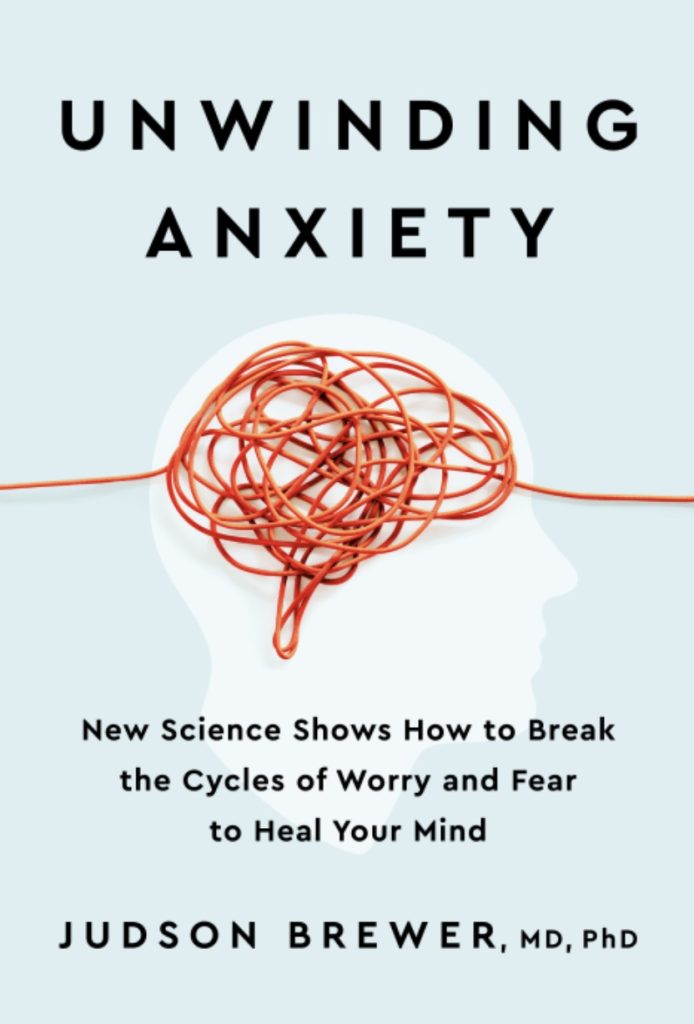
Brewer, J. (2021). Unwinding Anxiety: New Science Shows How to Break the Cycles of Worry and Fear to Heal Your Mind. New York: Penguin Random House. .

“In a fixed mindset, one cannot overcome anxiety because it is seen as unchangeable. Using awareness as a tool, you can work to move into a growth mindset. Learning, even from negative experiences, can be seen as a reward.”
“When we see gaps in knowledge or information, we naturally seek to fill them. This innate drive for information is curiosity. Curiosity is positive when you can fulfill it, but also negative when you are unable to find the information you’re seeking.”
“Loving kindness is the capacity for genuine well-wishing toward ourselves and others, even when feeling anxiousness linked to that person. Practice loving kindness by using kind phrases to stay centered, seeing the image of someone you are targeting loving kindness toward, or focusing on the feeling of kindness in the body that arises.”