
Key Quote:
“Before you can talk about project goals with your team, you need to understand problems. You should have just as much ownership of these problems as the solutions that your teams will create, test, and implement”
Key Points and Concepts
Part One: The Day
Why Rituals
Great teams are built behavior by behavior. Rituals cultivate behaviors that lead to success and create positive working experiences. “Rituals and routines are integral to how works gets done on high performance teams” (pp. 1-2).
Rituals and routines are useful only when they are regularly evaluated. “Just as teams change and grow, so do the rituals that bind them together. Cueing the appropriate ritual with a struggling team can transform their work” (p. 2).
“Leaders know that improved teamwork—and the behaviors that surround it—is a critical factor in employee engagement, retention, inclusion, and empowerment” (p. 1).
Workplace Rituals Defined
“Rituals are group activities during which people go through a series of behaviors in a specific order” (p. 2).
There are two reasons teams create rituals: to respond to the needs of their organization and to support the behaviors they want to see from each other (p. 3).
Setting Expectations
Each ritual detailed in the book takes about an hour to complete.
Suggested supplies include a whiteboard, markers, and sticky notes.
“We’ve seen the best results with teams that use as little technology as possible during a ritual” (p. 5).
DNA of a Workplace Ritual
To be considered a workplace ritual, these six elements must be followed (pp. 4-9).
1. Start each ritual with a question.
2. Visualize the ritual’s output (Remote teams should consider a shared, central document to capture all ritual outputs that is easily accessible by anyone at any time).
3. Give each member a chance to lead.
4. Create and share individual work before discussion.
5. Discuss and decide after understanding everyone’s perspective.
6. Create action steps.
How to Begin
It is important to use the following rituals within the first two weeks of starting a project (p. 12).
Choose the rituals that fit your team’s situation best. “It’s unlikely that any new project could accommodate all of these rituals before your dive into the work” (p. 12).
Before the Kickoff: Use the following three rituals as a starting point to build your team dynamic (p. 13).
• RITUAL: What Do We Bring to the Team? (pp. 14-21). Recommended for teams working together up to three months (p. 14).
• RITUAL: What Do We Value as a Team? (pp. 21-26). Recommended for teams working together from three months to several years (p. 22).
• RITUAL: What Habits Do We Want as a Team? (pp. 27-30). Recommended alternative to “What Do We Value as a Team?” for short-term projects (p. 27).
Framing the Problem: Use the following two rituals when you are defining the problem to be solved (p. 31).
• RITUAL: What Problem Are We Trying to Solve? (pp. 33-37). “This ritual shows you a whole-team approach to developing a problem statement” (p. 33).
• RITUAL: What Do We Know? What Do We Need to Learn? (pp. 38-40). Recommended for teams doing innovation or invention work or anytime your problem statement needs revision (p. 40).
Defining Success: Use the following four rituals to “define metrics of success that work for everyone” (p. 40).
• RITUAL: What Does Success Look Like? (pp. 42-45). “This helps your team see the constellation of their effort before they begin their project work” (p. 42).
• RITUAL: What If We Don’t Succeed as a Team? (pp. 45-47). Recommended to use after “What If We Don’t Succeed as a Team?” to refine your team’s success criteria (p. 45).
• RITUAL: What Is Our Team Expected to Do? (pp. 47-52). This ritual is helpful when it is not clear how team members will divide up work (p. 48).
• RITUAL: What Should We Celebrate as a Team? (pp. 52-54). Use this ritual to decide what things to celebrate as a team, both positive and negative (p. 53).
Planning the Kickoff: Use the following two rituals to determine who to invite and what activities to include at your project’s kickoff meeting (p. 57).
• RITUAL: Who Gets Invited? (pp. 57-61). This ritual will help you “figure out who needs to be in the room” (p. 57).
Core Team: People doing the everyday work
Accountable: People who are sponsoring the project
Consulted: People whose input or opinions matter
Informed: Groups that will hear about what you’re doing through the course of the project
• RITUAL: What Activities Should Be in the Kickoff? (pp. 61-67). Use this ritual to determine the agenda for your project’s kickoff meeting (p. 61).
Working Through Conflict
“Deciding to solve an important problem within your team is the strongest act of team-building” (p. 65).
Delivering Feedback: Use the following three rituals to help create the right kind of conflict (p. 67).
• RITUAL: Can I Give You Some Feedback? (pp. 69-73). This ritual is intended to be discussed one-on-one with specific teammates (p. 70). Created by product manager Arthur Nicholls and adapted by the Sherwins, the following feedback framework is used to label and sort feedback (pp. 70-71):
Reinforcing feedback: Often called “positive” feedback as it is intended to “preserve aspects of the team’s work or behavior” (p. 70).
Adjusting feedback: This feedback suggests adjustments to your team’s work product or behavior.
Rejecting feedback: This feedback involves a request to completely replace something with another idea or behavior.
• RITUAL: What Should We Do with This Feedback? (pp. 74-77). Use this ritual to make sense of feedback as a group (p. 74).
The Four Player Model by David Kantor theorizes that there are only four ways that people “play” in conversation (pp. 77-78):
• Mover: “Here’s a direction I think we can take…”
• Follower: “I’m going to help make that idea happen…”
• Opposer: “I’m not sure that’s a good idea, for these reasons…”
• Bystander: “I need to observe and reflect…”
Kantor explains that once you can identify each “player” in a conversation, you can better choose how to foster debate or to advance the discussion within your team (p. 78).
• RITUAL: How Can We Improve Our Project Work? (pp. 79-82). This ritual is intended “to help team members clarify their intentions for in-progress work and expand the number of options available to them” (p. 79). Recommended for teams that are creating tangible deliverables. This ritual could also be called a work share meeting, critique, work update, or showcase (p. 79).
Making Decisions: The following five rituals include repeatable processes from making tough decisions together (p. 82). It is important that these five rituals are followed in order.
- RITUAL: What Decision Are We Trying to Make? (pp. 83-85). This ritual is intended to help the team agree on what needs to be done to make a major decision happen (p. 84).
2. RITUAL: What Criteria Apply to Our Decision? (pp. 85-89). “This ritual will help your team generate criteria in advance of discussing options (p. 85).
3. The Sherwins explain there are two types of criteria: yes/no and dynamic. Yes/no criteria are either true or false when applied to decision-making options. Dynamic criteria are relative to the
options you are considering (pp. 85-86).
4. RITUAL: What Are Our Options? (pp. 89-91). “This ritual will help your team identify which
options they want to include in their decision-making process” (p. 89).
5. RITUAL: What Are the Trade-Offs? (pp. 91-94). “This ritual will help your team evaluate the options you’re considering against the criteria that you’ve generated” (p. 91).
6. RITUAL: Which Option Are We Most Confident About? (pp. 94-99). This ritual will help your team “agree on a particular course of action” (p. 94). It’s important to put the options you’re considering in a place where everyone can see them before you start this ritual.
Process of Experimentation: Use the following three rituals to “test versions of your team’s ideas, learn what’s working, and make adjustments over time to reach desired outcomes” (p. 100).
• RITUAL: What Do We Think Will Fix This Problem? (pp. 100-105). This ritual “helps you harness the best ideas and insights from everyone on the team while using future states to thoroughly explore the problem” (p. 100).
• RITUAL: What’s Our Hypothesis for this Change? (pp. 105-109). This ritual “will help your team determine exactly what it will take to translate an idea into a measurable experiment” (p. 105).
• RITUAL: What’s the Impact of This Change? (pp. 109-115). Recommended when your team is planning a high-stakes experiment as it helps to identify the potential positive and negative effects that come from an idea (p. 109).
Crossing the Finish Line
“These rituals will help teams reflect on what they’ve learned, communicate the impact of their work to stakeholders, and create closure as their projects wrap up” (p. 114).
Team Reflection: Use the following three rituals to create a space for sharing perspectives and feedback. “Teams can only improve if they take time for reflection, then fold what they’ve learned back into their process and projects” (p. 115).
• RITUAL: What Should We Change? (pp. 116-121). “This ritual is best conducted when a project is mid-flight” because it helps team members share what they’ve learned so far in working together (p. 116).
• RITUAL: What Were the Ups and Downs? (pp. 121-124). This ritual is also known as an Emotional Seismograph, Peaks and Valleys, or an Experience Map as it helps to identify the root-cause of issues the team faced (p. 121).
• RITUAL: What Can We Not Change? (pp. 124-128). “This ritual will help your team have a structured conversation about what they would like to change but may not have the agency to
do so” (p. 125).
• Examples of project constraints: Technical debt, financial debt, staffing, material resources, legal regulations, cultural norms of behavior, unrealistic expectations (pp. 125-126).
Expressing Accomplishment: Use the following two rituals to communicate the impact of your work (p. 128).
• RITUAL: Who Was Affected by Our Work? (pp. 128-131). This ritual usually helps teams discover they had a much bigger effect than they’d anticipated at the outset of their project (p. 129).
• RITUAL: What Effect Should Our Communication Have? (pp. 131-134). “This ritual will help your team determine what kind of influence you want to create with your end-of-project communication” (p. 132).
On Endings
Far too often the ending of a project feels like a let-down. You could move too quickly into another project or the first project doesn’t end cleanly due to a cancellation or loss of funding (p. 134).
The Sherwins suggest a simple solution to making endings matter: the team needs to thank each other (p. 135).
“A team that works together should end things together. They should take a moment to thank each other, no matter how big or small the fanfare and bonus checks, no matter how quickly it will all be forgotten” (p. 135).
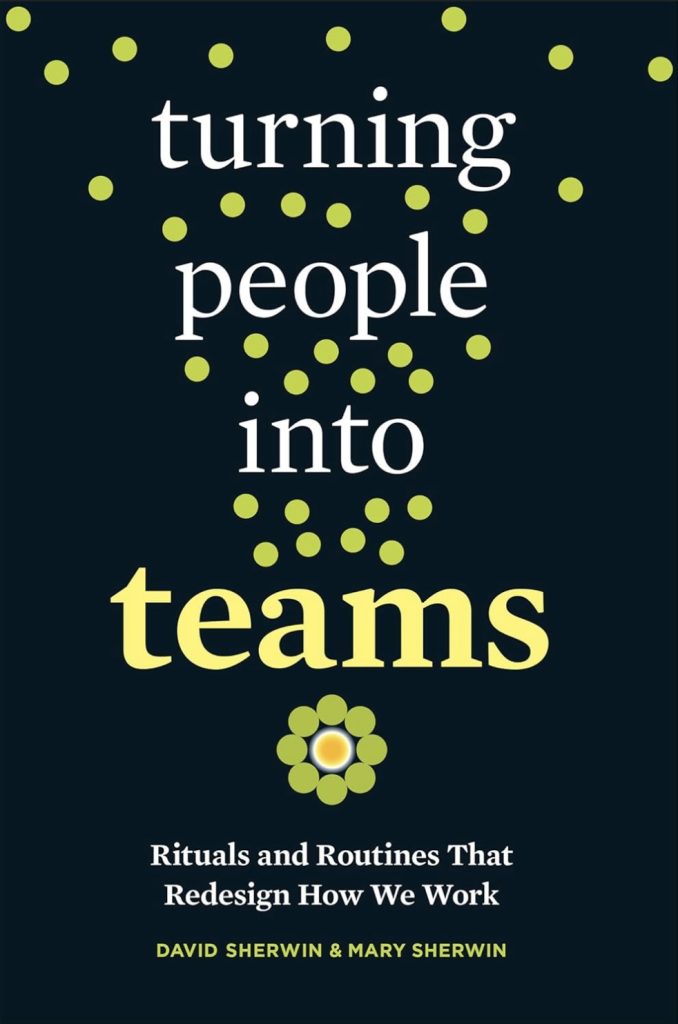
Sherwin, D. (2018). Turning People Into Teams: Rituals and Routines That Redesign How We Work. Oakland: Berrett-Koehler Publishers.

“The science of timing has found – repeatedly – what seems to be an innate preference for happy endings. We favor sequences of events that rise rather than fall, that improve rather than deteriorate, that lift us up rather than bring us down. And simply knowing this inclination can help us understand our own behavior and improve our interactions with others.”
“When delivering mixed news, it is always preferred to lead with the bad news first, and the good news second. The lasting impression of the conversation will be on a positive note, rather than the negative it began with.”
“Pink concludes the book by emphasizing the importance of synchronization between people and timing. “An external standard sets the pace. A sense of belonging helps individuals cohere. And synchronization both requires and heightens well-being.”