
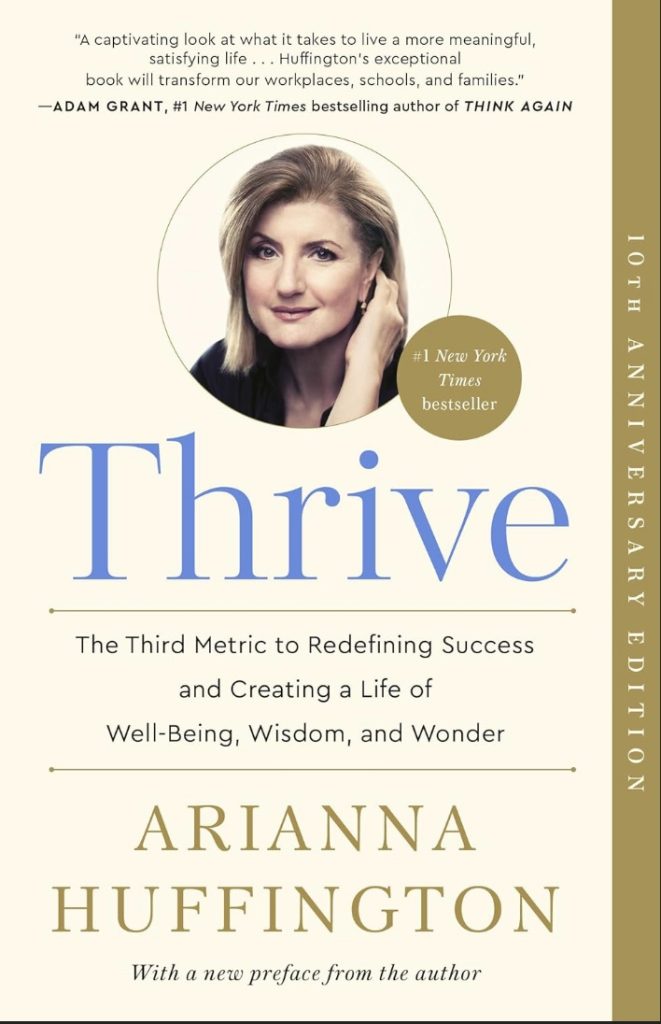
A Rule of Three Book Summary by Admired Leadership
The Book in 3 Sentences: Huffington challenges society’s two-dimensional definition of success—money and power—arguing for a third metric consisting of four pillars: Well-being, Wisdom, Wonder, and Giving. She asserts two fundamental truths: we all have a centered place of wisdom within us, and we will inevitably veer away from it repeatedly—the key is how quickly we return (p. 8). Through practical strategies ranging from meditation to gratitude exercises, the book provides a roadmap for leaders to achieve sustainable success without sacrificing health, relationships, or meaning.
The 3 Most Important Concepts:
The Third Metric is Huffington’s framework for redefining success beyond money and power, consisting of four pillars: Well-being (managing stress and burnout), Wisdom (learning from life experiences), Wonder (maintaining curiosity and awe), and Giving (serving others through compassion). This metric recognizes that traditional success often comes at the cost of health, relationships, and fulfillment.
Mindfulness and Present-Moment Awareness forms the foundation for better decision-making and life satisfaction. This includes breaking automatic behaviors by paying attention to routine tasks, using waiting time as opportunities for presence, and practicing meditation to change how we experience the world. As Huffington notes, those who are more mindful make better decisions.
The Practice Principle treats well-being skills like learnable abilities rather than fixed traits. Richard Davidson’s research shows “happiness not as a trait, but as a skill, like tennis… If you want to be a good tennis player, you can’t just pick up a racket—you have to practice… We can actually practice to enhance our well-being… It’s not different than learning to play the violin or play golf. When you practice, you get better at it” (p. 46). This applies to gratitude, compassion, and resilience—all can be developed through consistent practice.
The Book’s 3 Most Essential Claims:
(1) Sleep deprivation has become a misguided badge of honor in our culture. “Sleep, or how little of it we need, has become a symbol of our prowess… I once had dinner with a man who bragged to me that he’d gotten only four hours of sleep the night before. I resisted the temptation to tell him that the dinner would have been a lot more interesting if he had gotten five” (p. 74). Sleep affects creativity, leadership, decision-making, and cognitive function.
(2) Giving paradoxically creates abundance rather than scarcity. “It is gravity that enables us to stand tall—that which seems to pull us down to earth and limit us actually enables us to expand upward. In the same way, it is when we give that we feel most abundant. Giving sends a message to the universe that we have all we need” (p. 233). This principle transforms leadership from accumulation to contribution.
(3) Life’s setbacks are teachers, not just obstacles. “When we reexamine what we really want, we realize that everything that happens in our lives—every misfortune, every slight, every loss, and also every joy, every surprise, every happy accident—is a teacher, and life is a giant classroom” (p. 118). This reframe is essential for resilient leadership.
3 Surprising Facts or Insights:
Huffington identifies an “obnoxious roommate” living in our heads—the voice full of doubts and insecurities that undermines our success. Leaders must educate this internal critic by redefining success according to personal values rather than societal impositions.
Three types of empathy exist with different impacts: cognitive empathy (“knowing what someone else is knowing or thinking”), emotional empathy (“in which we actually feel what another person is feeling”), and compassionate empathy (“in which we know how a person is feeling, we can feel their feelings along with them, and we’re moved to act”) (p. 238). Only the third type creates transformational leadership.
The “three C attitudes” make responding to adversity successful: Commitment (“deciding to join in and try to be a part of the solution”), control (“fighting to maintain a sense of resolve as opposed to resignation”), and challenge (“finding ways to use the crisis to strengthen themselves, to build resilience, and grow”) (pp. 169-170).
3 Actionable Recommendations:
Implement Predictable Time Off (PTO)—scheduled periods with no email, work, or smartphone access. This isn’t vacation but regular disconnection to maintain perspective and prevent burnout.
Practice the “10 finger gratitude exercise” by counting one thing you’re grateful for on each finger. “In our daily lives, moving from struggle to grace requires practice and commitment. But it’s in our hands. … Whenever we find ourselves in a stop-the-world-I-want-to-get-off mindset, we can remember that there is another way and open ourselves to grace. And it often starts with taking a moment to be grateful for this day, for being alive, for anything” (p. 126).
Take walking meetings whenever possible. This simple change improves focus, health, and creativity while accomplishing necessary business discussions.
3 Questions the Book Raises:
How can organizations restructure incentives to reward the third metric rather than just profits and productivity?
If well-being skills are learnable like tennis, why don’t leadership development programs systematically teach practices like meditation and gratitude?
Can the third metric truly coexist with competitive business environments, or does it require a fundamental reimagining of capitalism?
3 Criticisms of the Book:
The advice may feel more accessible to those already successful by traditional metrics—it’s easier to prioritize well-being when financial security is assured.
Some recommendations (like regular meditation and digital detoxes) require privilege and flexibility that many workers lack, potentially limiting the book’s universal applicability.
The book could benefit from more systematic research on how organizations have successfully implemented these principles at scale, beyond individual anecdotes.
3 Quotations Worth Remembering:
“I’m convinced of two fundamental truths about human beings. The first is that we all have within us a centered place of wisdom, harmony, and strength…. The second truth is that we’re all going to veer away from that place again and again and again… The question is how quickly can we get back to that centered place of wisdom, harmony, and strength” (p. 8).
“Giving, loving, caring, empathy and compassion, going beyond ourselves and stepping out of our comfort zones to help serve others—this is the only viable answer to the multitude of problems the world is facing” (p. 224).
“Once, a stranger admired the necklace [Huffington’s mother] was wearing; my mother took it off and gave it to her. When the astonished woman asked, ‘What can I give you in return?’ my mother said, ‘It’s not a trade, darling, it’s an offering'” (p. 254)
Thrive: The Third Metric to Redefining Success and Creating a Life of Well-Being, Wisdom, and Wonder. Arianna Huffington. 2014.

“I’m convinced of two fundamental truths about human beings. The first is that we all have within us a centered place of wisdom, harmony, and strength…. The second truth is that we’re all going to veer away from that place again and again and again… The question is how quickly can we get back to that centered place of wisdom, harmony, and strength”
“Giving, loving, caring, empathy and compassion, going beyond ourselves and stepping out of our comfort zones to help serve others—this is the only viable answer to the multitude of problems the world is facing”
“Once, a stranger admired the necklace [Huffington’s mother] was wearing; my mother took it off and gave it to her. When the astonished woman asked, ‘What can I give you in return?’ my mother said, ‘It’s not a trade, darling, it’s an offering'”