
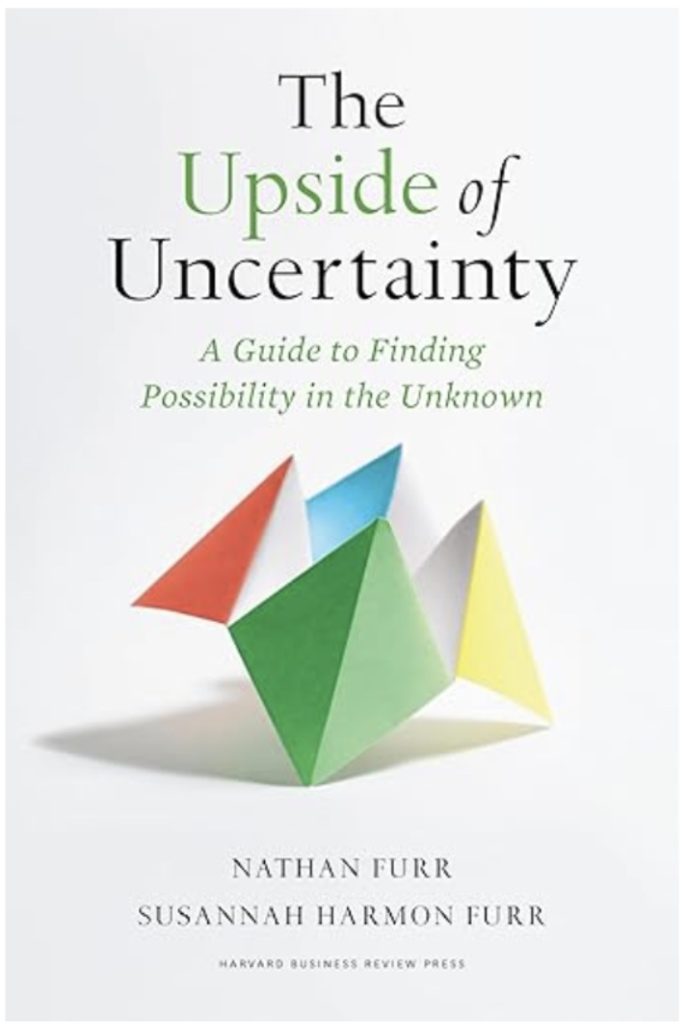
A Rule of Three Book Summary by Admired Leadership
The Book in 3 Sentences:
The authors assert that uncertainty is a natural and necessary state that can spur us to discover unexpected opportunities. The discomfort that accompanies being unsure about what to do next often disguises or temporarily holds us back from seeing what’s possible. The authors share and advocate for an approach that allows one to be bolder and avoid being paralyzed by lack of data by becoming more curious, taking courage from studying proven innovators, and pursuing small actions that make both risk and negative emotions manageable.
The 3 Most Important Concepts:
Uncertainty Ability is defined as a leader’s skill at navigating planned and unplanned unknowns in a way that raises the likelihood they will see and pursue breakthrough opportunities. This is the single biggest predictor of leadership success and can be learned through developing specific thinking tools and skills.
The Uncertainty First-Aid Cross is a repeatable framework that addresses both mindset and analysis. This non-linear, actionable construct guides one to reframe thinking, prime oneself to move forward, identify possibilities using a wider lens, and sustain forward progress despite challenges that demand recalibration or pivoting.
Transilience is a transformation that goes beyond resilience by allowing one to leap forward into higher growth as uncertainty becomes the catalyst for breakthrough action. It results from combining openness to uncovering possibilities while committing to moving forward rather than remaining in the status quo.
The Book’s 3 Most Essential Claim
- 1. Uncertainty is not inherently bad but rather a necessary forcing factor that spurs innovation and reveals bigger opportunities worth pursuing. Those who learn to see uncertainty positively can leverage it for breakthrough thinking and dogged persistence.
2. Leaders must intentionally develop a portfolio of thinking tools to avoid maladaptive traps like rushing to judgment or threat rigidity that limit thinking and deliver mediocre
results. They must become comfortable with high uncertainty levels and willing to calibrate
actions through faster learning cycles.
3. Innovation requires building muscle through practicing expansive thinking about options and risks, staying open to positive interpretations of setbacks, and embracing the upsides of pivoting when necessary.
3 Surprising Facts or Insights:
What works in chaos also works for everyday uncertainty. The same coping, reframing, and action planning used by military personnel or extreme innovation students to handle peak uncertainty applies to persistent everyday unknowns.
Humans overestimate the benefits of preserving the status quo, which amplifies risk perception and creates excessive need for answers before taking forward steps.
Leaders cannot be entirely rational when converting breakthrough ideas into reality. They often need to believe in positive magic or unexpected leaps in insight as a kind of “Dumbo feather” to convince themselves certain risks are worth taking.
3 Actionable Recommendations:
Focus on available resources and insights rather than fixating on what is missing or unknown when identifying solutions that yield better results.
Embrace constraints as positive forces that compel you to do less and differently than competitors, often revealing distinctive, resourceful approaches that leverage uncertainty to overcome challenges.
Pursue ideas through small experiments that test hypotheses about what might be possible, implementing an actionable version of “failing fast” to build forward momentum.
3 Questions the Book Raises:
Is it possible to leverage uncertainty into breakthrough ideas without first adopting a positive mindset about unknowns and doubling down on curiosity and learning?
Can one train to be more comfortable with adjusting action plans and pivoting when things go wrong? What kind of priming does this require to be ready when the need arises?
Is it possible to innovate in isolation, or does it require creating an environment of advisors, learning resources, and positive reinforcement that gives confidence to proceed and access to broadening ideas?
3 Criticisms of the Book:
The framework attempts to organize a grab-bag of psychological and behavioral views into one tool that can be applied in any order that “resonates” with readers. It would benefit from practicing on low-stakes past situations before applying to current breakthrough thinking challenges.
The authors rely heavily on brief examples to make their case, providing the most value when they offer deeper stories about how particular entrepreneurs built on ideas and failures to generate better solutions.
While the authors provide exercises to help readers execute the recommended approach, some sections reach to make exercises equally substantial, when simpler, more intuitive approaches might be more useful for practice.
3 Quotations Worth Remembering:
“If we try to avoid uncertainty or give up too soon—or if we mistakenly decide it’s safest to do nothing—the downsides of uncertainty will find us anyway. Because the truest downside to uncertainty is living a life smaller than what you are capable of.” (p. 274)
“The key is to take any setback, disappointment, or anxiety and argue with it until your view shifts from the setback being permanent, pervasive, and unchangeable to being temporary, isolated, and changeable.” (p. 230)
“If we focus on the joy of doing something well, we can shed some of the anxiety [that comes from an obsession with winning]. There’s always room for unique methods, ideas, ways of thinking, and values beyond being number one. Instead of seeing competition as a threat, we can see it as something that helps us do our best work, and maybe even reinvent how the game is played.” (p. 243).
