
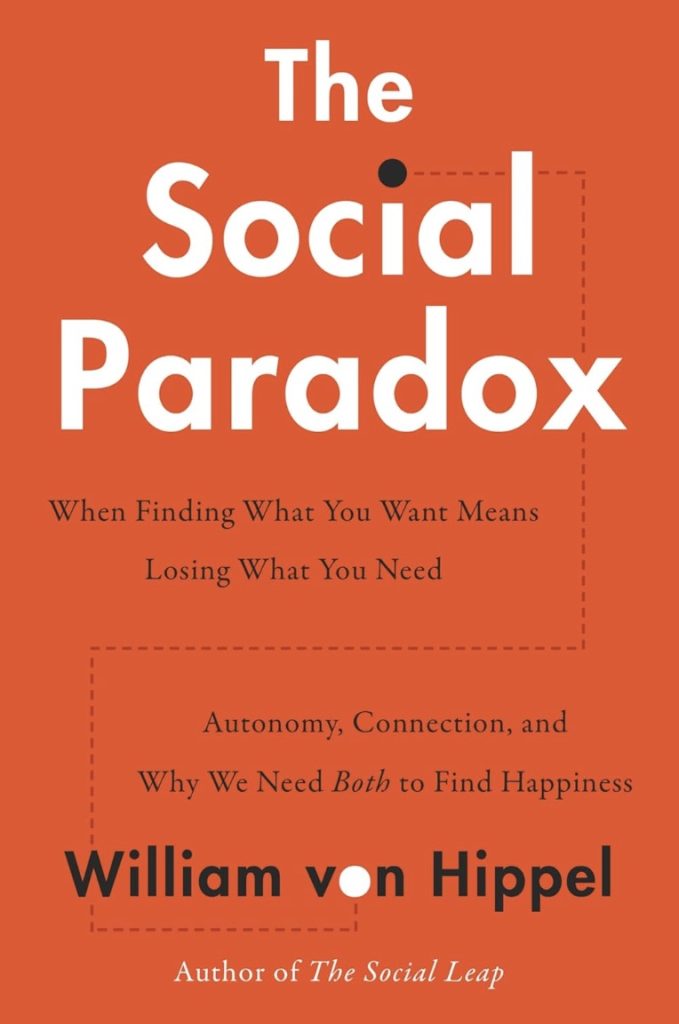
A Rule of Three Book Summary by Admired Leadership
The Book in 3 Sentences:
Von Hippel argues that humans evolved with competing needs for autonomy (independence, self-governance) and connection (social bonds, cooperation), but modern society has disrupted the balance between these needs by offering unprecedented freedom at the cost of meaningful relationships. This book traces how cities, education, and wealth systematically erode connection and community while amplifying both the value and facility of autonomy. Von Hippel proposes that to be fulfilled we must deliberately reintegrate connection into daily activities without adding burdensome social obligations, taking advantage of evolutionary psychology to thrive in this new state of affairs.s manageable.
The 3 Most Important Concepts:
An evolutionary mismatch between psychology and our environment explains our collective malaise. We evolved to reach for autonomy whenever it was available because it was rare. The abundance of choices now available to us triggers this ancient mechanism constantly, producing a pathological commitment to independence that undermines the relationships we need to feel whole.
Systematic forces drive this imbalance. Cities help us specialize our lives and careers but permit us to anonymize ourselves and avoid the mandatory sharing and mutual dependence that characterize small communities. Our education system teaches us to choose delayed gratification and personal success over comfortable social bonds. Wealth purchases freedom from reciprocal obligations that historically bound us together.
Modern substitutes for connection fail because they violate our evolutionary disposition. Virtual connection disrupts the interpersonal synchrony (facial reactions, body language) our brains expect through screen-flattening and transmission lag that prevent us from “clicking.” Social media gamifies social connection and anonymizes cruelty without a sufficient platform for empathy. These increasingly dominant modes of connection create hollow simulacra of relationships that check functional boxes but leave our psychological needs unmet.
3 Surprising Facts or Insights:
During food shortages, Efe hunter-gatherers expressed pleasure (28% of emotional utterances) nearly as often as displeasure (32%), while modern humans express displeasure at much higher rates despite unprecedented abundance.
Poor people who attend religious services several times weekly are happier than wealthy people who never attend, suggesting connection through religious community has greater impact on wellbeing than financial security.
Today, marriage doesn’t make people happier (most return to baseline within 5 – 10 years) yet unmarried people are significantly less happy than married people, suggesting those who prioritize autonomy suffer from insufficient connection across multiple life domains.
3 Actionable Recommendations:
Layer connection onto existing activities by calling friends during commutes, doing puzzles with relatives over video, or exercising with others. This adds social elements to things you already do rather than creating new obligations.
Find ways to link social behaviors to environmental triggers (“When the coffee is ready, I’ll call my sister to do the puzzle”) to make connection automatic rather than requiring repeated exercise of willpower.
Partner with others for accountability to connect individual achievement with social obligation. Find a running buddy who will call you when you’re not on your morning run. Schedule regular lunch meetings with mentors rather than eating at your desk. Join an art studio rather than painting alone.
3 Questions the Book Raises:
If seeking autonomy is evolutionarily hardwired and triggered automatically by abundance, can individual behavior be enough to resolve the paradox?
Can technology ever be a platform for genuine connection given its inability to facilitate key psychological mechanisms for connection?
How can we maintain the benefits of autonomy (individually and collectively) while restoring the level of connection we need for wellbeing?
3 Criticisms of the Book:
The research Von Hippel cites often suggests conclusions loosely rather than pointing to them directly. This suggests a lack of rigor as the author mistakes correlation for causation.
The book overromanticizes hunter-gatherer societies while ignoring measurement problems. Different cultures interpret and express happiness differently and suffer in ways that are difficult to measure.
This book falls into the same trap it is written to expose. The solutions Von Hippel proposes, while actionable, are themselves individualistic and don’t offer advice for how to scale collective (even localized) resistance to the overwhelming systemic forces he takes pains to show contribute to the “paradox” more than anything else.
3 Quotations Worth Remembering:
“Connection was our more important need, but the demands of our daily lives ensured that our connection needs were always met. As a consequence, we evolved to choose autonomy whenever we could get away with it.” (p. 234)
“…a world that provides so much autonomy is also a world that prunes our connections, with the results that we lack the connections that allow us to fully engage with the extraordinary autonomy that is available to us.” (p. 18)
“The key is to follow the Delphic maxim to know yourself and engage in the kind of socializing you can maintain.” (p. 228)
