
Key Quote:
“One does not overcome an obstacle to enter the land of no obstacles” (p. 172).
Key Points and Concepts
The Discipline of Perception
“Our perceptions determine, to an incredibly large degree, what we are and are not capable of. In many ways, they determine reality itself. When we believe in the obstacle more than in the goal, which will inevitably triumph?” (p. 50).
Situations and obstacles can affect us, but they can’t control thoughts, beliefs, or reactions (p. 21).
“Preconceptions tell us that things should or need to be a certain way, so when they’re not, we naturally assume that we are at a disadvantage or that we’d be wasting our time to pursue an alternate course” (p. 55).
Epictetus counseled: “Don’t let the force of an impression when it first hit you knock you off your feet; just say to it: Hold on a moment; let me see who you are and what you represent. Let me put you to the test” (p. 32).
Grace and poise precede the opportunity to use any other skill because they influence how you react to stress and whether you are at the whim of fearful instinctual reactions (pp. 25-26).
The ideal state is that of apatheia, or the “calm equanimity that comes with the absence of irrational or extreme emotions” (p. 29).
Perception in Practice
Exposing yourself to stressful situations is a form of training out the fear of uncertainty (p. 28).
Seek to ignore the totality of your situation and learn to be content and work in the present (p. 47).
Exercise for training away perceptions and practicing objectivity from Marcus Aurelius: “Describe glamorous or expensive things without their euphemisms – roasted meat is a dead animal and vintage wine is old, fermented grapes. The aim was to see these things as they truly are, without any of the ornamentation” (p. 34).
“The task…is not to ignore fear but to explain it away” (p. 37).
Logic is applied to counter emotions. Ask questions that allow yourself to work through an emotional moment to identify root causes (p. 30).
“Sports psychologists recently did a study of elite athletes who were struck with some adversity or serious injury. Initially, each reported feeling isolation, emotional disruption, and doubts about their athletic ability. Yet afterward, each reported gaining a desire to help others, additional perspective, and realization of their own strengths” (p. 57).
“An entrepreneur is someone with faith in their ability to make something where there was nothing before. To them, the idea that no one has ever done this or that is a good thing. When given an unfair task, some rightly see it as a chance to test what they’re made of – to give it all they’ve got, knowing full well how difficult it will be to win” (p. 52).
The Discipline of Action
The most basic level of action is starting. Yet, it’s this level that tends to be the most difficult for people (p. 75).
“The true threat to determination is not what happens to us, but us ourselves. Why would you be your own worst enemy?” (p. 160).
Waiting for external conditions to be perfect for action is a waste of time. The right way of doing something is what works (p. 99).
The way that works isn’t necessarily impressive. A true strategist prioritizes success over pride and ego (pp. 107-108).
Action in Practice
“The one way to guarantee we don’t benefit from failure – to ensure it is a bad thing – is to not learn from it” (p. 85).
The greatest obstacles are supposed to be hard. But energy is an asset of which we can always find more. “Stop looking for an epiphany and start looking for weak points. Stop looking for angels and start looking for angles” (pp. 80-81).
The ideal state of action is to be physically loose and mentally restrained. Physical and mental looseness is reckless and physical and mental tightness is “anxiety. (pp. 116-117).
Ask yourself: is what you’re doing enough to create the change you expect? (p. 75).
“We’re usually skilled and knowledgeable and capable enough. But do we have the patience to refine our idea? The energy to beat on enough doors until we find investors or supporters? The persistence to slog through the politics and drama of working with a group?” (p. 79).
The Discipline of the Will
The Stoic maxim, sustine et abstine, embodies the meaning of the Will: “Bear and forbear. Acknowledge the pain and but trod onward in your task” (p. 131).
Stoicism’s “Inner Citadel” is the “fortress inside of us that no external adversity can ever break down…we are not born with such a structure; it must be built and actively reinforced” (p. 137).
The Stoic phrase, premeditation malorum, means “premeditation of evils” (p. 140).
Anticipating the worst allows a person to understand the range of potential outcomes and prepare for negative outcomes (p. 142).
“Myopia is what convinces us, to our own detriment, that we’re the center of the universe. When really, there is a world beyond our own personal experience filled with people who have dealt with worse…We’re all, at varying points in our lives, the subject of random and often incomprehensible events” (pp. 165-166).
Recognizing that the situation and environment are bigger than yourself allows you to truly serve as an exemplary leader for others (p. 164).
The Will in Practice
“The philosopher and writer Nassim Nicholas Taleb defined a Stoic as someone who ‘transforms fear into prudence, pain into information, mistakes into initiation and desire into undertaking’” (p. 179).
Stoics command themselves to be cheerful in all situations, but particularly in the bad ones (p. 153).
“To do great things, we need to be able to endure tragedy and setbacks. We’ve got to love what we do and all that it entails, good and bad. We have to learn to find joy in every single thing that happens” (p. 151).
Weaknesses are not a permanent state of being and, therefore, shouldn’t be accepted (p. 135).
“One does not overcome an obstacle to enter the land of no obstacles” (p. 172).
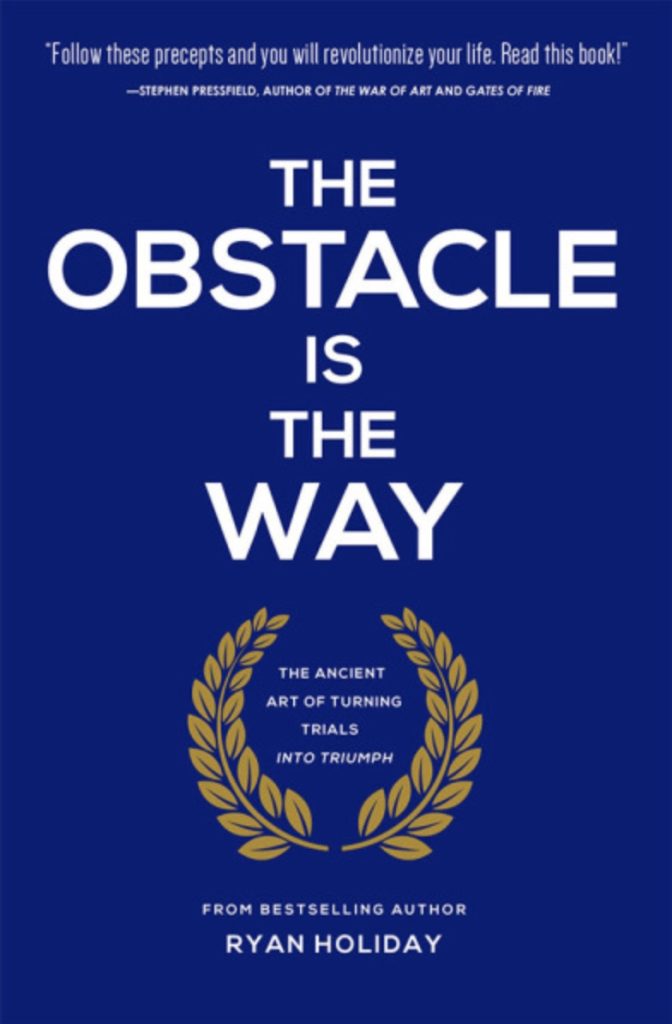
Holiday, R. (2014). The Obstacle is The Way: The Timeless Art of Turning Trials Into Triumph. New York: Penguin Group.

“Our perceptions determine, to an incredibly large degree, what we are and are not capable of. In many ways, they determine reality itself. When we believe in the obstacle more than in the goal, which will inevitably triumph?”
“The greatest obstacles are supposed to be hard. But energy is an asset of which we can always find more. “Stop looking for an epiphany and start looking for weak points. Stop looking for angels and start looking for angles.”
“To do great things, we need to be able to endure tragedy and setbacks. We’ve got to love what we do and all that it entails, good and bad. We have to learn to find joy in every single thing that happens.”