
Key Quote:
Drawing from the compelling metaphor of Tommy Caldwell’s ascent of El Capitan’s Dawn Wall, they illustrate how true leadership success requires continuous adaptation, learning, and personal reinvention. This summary explores their key findings about the five critical stages of CEO development, offering insights for both aspiring and current leaders about navigating the challenges and opportunities that come with executive leadership.
Key Points and Concepts
Setting the Stage: The Dawn Wall Analogy
In Chapter 1, Hildebrand and Stark compare the CEO journey to Tommy Caldwell’s free climb of the Dawn Wall on El Capitan. They argue that becoming a CEO is not the summit of one’s career but the start of a challenging ascent. “True success lies not in reaching the summit but in navigating the climb itself—the obstacles, setbacks, and triumphs along the way” (p. 12). The authors use Caldwell’s story to emphasize that preparation, adaptability, and resilience are essential for CEOs to succeed in their roles. These exceptional leaders understand a fundamental truth: their effectiveness comes not from their title or position, but from the small, intentional actions they take every day to build trust, develop others, and drive results.
The Importance of Preparation and Continuous Growth
The authors highlight that many aspiring leaders focus solely on obtaining the CEO title without adequately preparing for the role’s demands. “The years leading up to becoming a CEO are critical for broadening experiences, pushing beyond comfort zones, and cultivating rapid learning abilities” (p. 27). The most successful leaders share a distinctive trait: they are relentless learners who deliberately seek out situations that push them beyond their comfort zones. Rather than avoiding challenges, they actively pursue difficult experiences, viewing both successes and setbacks as opportunities to expand their capabilities and sharpen their leadership skills.
Navigating Career Paths: Internal vs. External Moves
Hildebrand and Stark explore the differences between CEOs promoted internally versus those hired externally. They note that internal hires often have a deeper understanding of company culture but may struggle with reinvention, while external hires bring fresh perspectives but face steeper learning curves. “The path to the top is not linear; it requires deliberate career choices that build diverse skills and experiences” (p. 45). The most effective leaders, regardless of their path, succeed by developing a deep understanding of organizational dynamics while maintaining the fresh perspective needed for innovation. What matters most isn’t the route taken to leadership, but rather how one approaches learning and relationship-building throughout the journey.
Building Trust with Stakeholders
In the early stages of their tenure, CEOs must focus on building trust with their boards and stakeholders. “The first year is critical for establishing credibility and creating alignment around strategic priorities” (p. 63). The authors recount examples of CEOs who used their initial months to solidify relationships and gain buy-in for bold initiatives. For instance, one case study highlights how an incoming CEO successfully navigated board skepticism by over-communicating progress and delivering early wins (p. 67).
Hildebrand and Stark emphasize that trust is not simply given but earned through consistent actions and transparent communication. CEOs who prioritize open dialogue, actively solicit feedback, and demonstrate a commitment to stakeholder interests are more likely to establish strong, enduring relationships. Furthermore, they note that early wins, while important, should not come at the expense of long-term credibility. CEOs who overpromise or prioritize short-term gains over sustainable value creation risk eroding trust and undermining their long-term effectiveness. The authors found that CEOs who invest time upfront to understand stakeholder concerns, address potential conflicts, and establish clear expectations are better positioned to navigate challenges and achieve lasting success.
The Complacency Trap: A Cautionary Tale
Years six through nine in a CEO’s tenure are described as the “Complacency Trap,” where leaders risk stagnation after initial successes. “Even high-performing CEOs can fall victim to complacency if they stop challenging themselves or their organizations” (p. 92). The authors provide strategies for avoiding this trap, such as fostering a culture of innovation and seeking external feedback. The most successful executives maintain a persistent drive for improvement even after achieving significant success, constantly looking for ways to elevate both their organizations and their people. The authors also share cautionary tales of leaders who failed to adapt during this phase, leading to declining performance (p. 97).
Legacy: Preparing for Succession
In the final stage of the CEO Life Cycle—Legacy—leaders must balance driving growth with preparing their organizations for succession. “A CEO’s ultimate success is measured not only by their achievements but by the strength of the organization they leave behind” (p. 123). The authors stress that succession planning should begin years before departure, involving mentorship of potential successors and ensuring long-term strategic alignment (pp. 125-127). The most successful executives focus on developing future leaders throughout their tenure, not just at the end. They understand that their greatest legacy is building a strong bench of capable leaders who can take the organization forward.
Mental Resilience is Key
Throughout the book, Hildebrand and Stark emphasize the importance of mental resilience in leadership. “Great CEOs possess an extraordinary ability to remain calm under pressure, make difficult decisions with limited information, and inspire confidence in others” (p. 143). They recount interviews with prominent CEOs like Indra Nooyi and Ajay Banga, who share insights into how they cultivated emotional intelligence and self-awareness throughout their careers. These exceptional leaders develop specific behaviors and routines that help them maintain composure and make clear decisions even in challenging circumstances. They understand that emotional control isn’t just about personal stability – it’s about creating an environment where others can perform at their best.
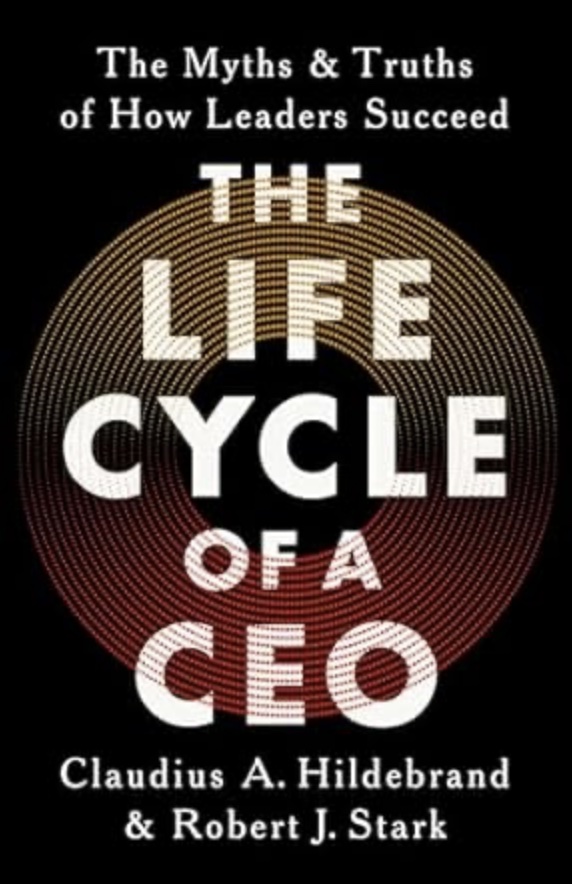
Hildebrand, C. A., & Stark, R. J. (2024). The Life Cycle of a CEO: The Myths and Truths of How Leaders Succeed. New York: Public Affairs.

Drawing from the compelling metaphor of Tommy Caldwell’s ascent of El Capitan’s Dawn Wall, they illustrate how true leadership success requires continuous adaptation, learning, and personal reinvention. This summary explores their key findings about the five critical stages of CEO development, offering insights for both aspiring and current leaders about navigating the challenges and opportunities that come with executive leadership.
“The most successful leaders share a distinctive trait: they are relentless learners who deliberately seek out situations that push them beyond their comfort zones. Rather than avoiding challenges, they actively pursue difficult experiences, viewing both successes and setbacks as opportunities to expand their capabilities and sharpen their leadership skills.”
“In the final stage of the CEO Life Cycle—Legacy—leaders must balance driving growth with preparing their organizations for succession. “A CEO’s ultimate success is measured not only by their achievements but by the strength of the organization they leave behind.”