
A Rule of Three Book Summary by Admired Leadership
The Book in 3 Sentences:
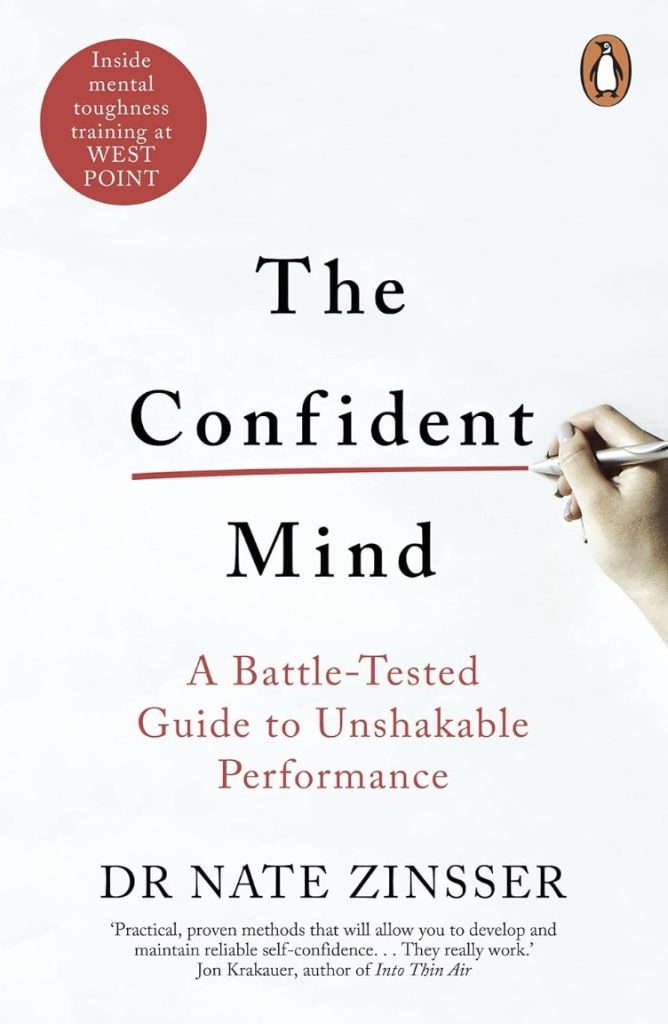
The author argues that true peak performance depends not only on skill but also on the confidence to execute under pressure. The Confident Mind offers strategies for cultivating self-belief, overcoming fear and setbacks, and reframing challenges as opportunities for growth. Rooted in the idea of the self-fulfilling prophecy, the book shows how positive mental habits can transform competence into consistent, high-level performance.
The Book’s 3 Most Important Concepts:
Confidence is defined as trust and certainty in your own capabilities, so that you are able to execute without conscious thought. According to the author, it’s better to avoid thinking when seeking peak performance – instead relying on certainty in your abilities.
Your psychological bank account of confidence, according to Dr. Zinsser, is the ever-fluctuating sum total of your perception of yourself and your abilities. Regardless of the pursuit, the author asserts that we all keep a tally to which we add all new thoughts and memories. The level of impact on this sum varies based on emotion tied to the concept and what matters to you. This bank account is essentially the sum total of your confidence, so to operate with confidence is about effectively managing this account.
According to the author, the mind-body connection also plays a critical role in confidence and ability to perform under pressure. State of mind has a profound influence on physical state – in turn, impacting performance.
The Book’s 3 Most Essential Claims:
1. Confidence isn’t static, as it’s a reflection of the full scope of our experiences. It’s a skill that can be developed and honed over time.
2. Confidence is driven by our mind-body connection, so to become truly confident requires shifts in mindset which impact how our body experiences the stress of performance.
3. Remembering success is far more important than remembering failure when building one’s confidence.
3 Surprising Facts or Insights:
Research shows that the highest achievers in any given field are those with only moderate perfectionism, as nothing drains confidence more quickly than one’s refusal to accept human imperfection.
Success and accolades don’t build confidence – in fact, they often undermine it by creating pressure and expectations.
Repetition of a negative word is received and processed by the brain even if it’s in a positive connection, as we hear that word and reinforce it, in turn altering our brain patterns.
3 Actionable Recommendations:
Track your “top ten”: list your top achievements in pursuit of excellence in your chosen field and reflect on them regularly to solidify confidence in future success.
Reflect only briefly on failures: be deliberate about how long you reflect on less-than-perfect performances in relation to successes – only about a quarter of the time. Do not ignore mistakes, but extract learnings quickly and move forward.
Find your pregame ritual: find your routine that helps physically prepare and get in a comfort zone before a performance.
3 Questions the Book Raises:
Why do people often focus more deeply on our failures than successes, and is there benefit to this approach?
Is it possible to strike a perfect balance between confidence and self-doubt, or is some tension between the two necessary for growth?
At what point, if there is any, can someone become too confident?
3 Criticisms of the Book:
The author utilizes hypothetical dialogues, but these dialogues are too straightforward. The imaginary students illustrate minimal reflection, and their responses clearly aim to reinforce the author’s argument.
The author is over-reliant on anecdotal evidence over objective science. Some counterexamples would help emphasize his points – but instead, he focuses only on those lines of thought which align with his own.
The book is too lengthy for its content. The same concepts and assertions could have been expressed in far fewer pages.
3 Quotations Worth Remembering:
“Confidence has relatively little to do with what actually happens to you, and pretty much everything to do with how you think about what happens to you.” (p. 22)
“Strive for perfection, but don’t demand it.” (p. 36)
“Pressure indeed ‘makes diamonds,’ but once that diamond is made and it’s time for that diamond to shine, you handle it very carefully and put it in a setting where its beauty can be seen… Leave it alone and just let it shine.” (p. 278)
