
A Rule of Three Book Summary by Admired Leadership
The Book in 3 Sentences:
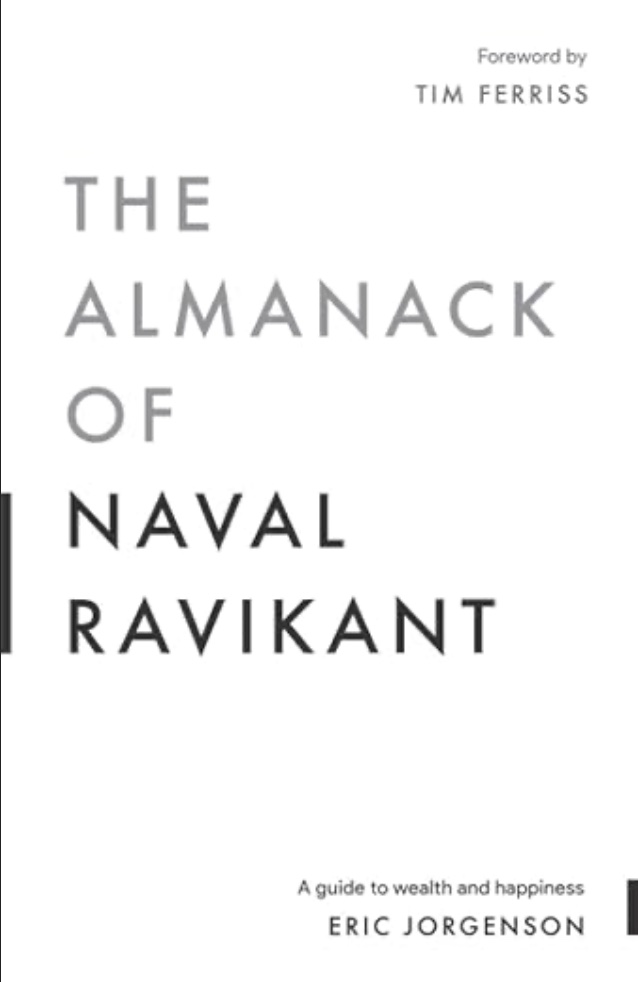
The Almanack of Naval Ravikant is a modern guide to wealth and happiness from the mind of Naval Ravikant, a successful Silicon Valley entrepreneur and investor, and was compiled and curated by Eric Jorgenson, a writer on technology and the CEO of Scribe Media. The book is divided into two parts on generating wealth and cultivating happiness, and each part provides highlights of Ravikant’s reflections on those topics based on his lived experience and observations from early childhood in India and New York and then an extensive career in Silicon Valley. A unique aspect of the book is that it’s a compilation of direct quotes by Ravikant from his writings, podcasts, and interviews. Besides the introduction by the author, all of the content is Ravikant in his own words grouped into chapters that loosely fit together under the two main themes, wealth and happiness.
The Book’s 3 Most Important Concepts:
Ravikant asserts that “specific knowledge” is essential for wealth creation. He defines it as a unique expertise that can’t be easily replicated or taught and that most often stems from genuine curiosity and deep passion. Combined with high levels of accountability and leverage, Ravikant teaches that special knowledge creates a powerful foundation for success.
Ravikant establishes early in the book the importance of leverage, which is the ability to amplify your special knowledge and efforts. He discusses its three forms and places special emphasis on the last:
1. Labor (other people working for you)
2. Capital (money that multiplies your decisions and efforts)
3. Products with no marginal cost of replication that provide infinite scale (code, media, books, etc.)
Happiness is a state of mind that can be cultivated and practiced as opposed to a destination to be reached. Ravikant’s views on happiness are mainly derived from mainstream Buddhism and modern mindfulness teachings and techniques.
The Book’s 3 Most Essential Claims:
To optimize your path to wealth creation:
1. Build specific knowledge in things you’re passionate about
2. Seek out and take on higher and higher levels of accountability to build your credibility and trust from others
3. Apply leverage, especially via code and media, in order to scale massively
Happiness isn’t something to obtain, inherit, or even choose, but rather a skill one can learn similar to other skills.
The concept of compound interest works everywhere. When you play the long game and consistently show up for your relationships, keep learning, and keep building, the returns stack on top of each other. Small consistent efforts today turn into something massive down the line, but you have to be patient in giving it time to compound.
3 Surprising Facts or Insights:
In our modern times, we have access to a new form of leverage – code, books, media, etc. – that goes far beyond the traditional ones of labor, money, and capital in terms of its ability to provide scale. Ravikant asserts that this new form’s manifestations are the most democratic because they are products with no marginal cost of application.
Demonstrated judgment built on specific knowledge is critical for success because learnable skills can be attained by others and scaled with modern times’ new form of leverage, making those skills’ advantages quickly obsolete.
Happiness isn’t a constant state you chase—it’s a skill you develop through practice. It means you’ve trained yourself to process whatever life throws at you without letting it disturb your baseline sense of calm. You stop resisting reality and start accepting things as they are, which naturally preserves your inner peace. It becomes effortless once you build that muscle.
3 Actionable Recommendations:
Arm yourself with specific knowledge, accountability, and leverage to build wealth and achieve success.
Get paid for your judgment – not your inputs or time — that draws heavily on your specific knowledge. That becomes very hard for others to replicate.
Invest in long-term relationships. Throughout the book, Ravikant repeatedly emphasizes the importance of developing long-term relationships with people of high integrity and character for both wealth generation and cultivating happiness.
3 Questions the Book Raises:
Can you truly separate wealth creation from time investment as the book asserts, especially for those without the highest levels of access Ravikant and his peers have to education, technology, and opportunity?
Is happiness really a skill that can be learned, or is this assertion oversimplifying complex emotional and psychological realities, like profound suffering or deprivation?
Is the tension between happiness (wanting nothing) and success (wanting something) that Ravikant creates in the book resolvable?
3 Criticisms of the Book:
There is almost nothing in this book that hasn’t been said or considered elsewhere. The section on happiness, for example, is directly derived from well-known, mainstream concepts from mindfulness and basic Buddhist teachings. The “do what you love” theme of wealth generation is a tired refrain, although Ravikant’s assertion to combine special knowledge, accountability, and leverage is a pithy recombination of what’s been said many times before.
While the book is organized around clear themes relating to wealth and happiness, the actual content itself is often disjointed or clumsily strung together. It takes work to extract the few compelling insights the book presents given the repetitive nature of many of the subchapters.
Perhaps the most disappointing aspect of the book is that Ravikant is clearly an inspiring, accomplished, and intelligent man, and one gets the sense reading the book that going deeper into a much smaller subset of his most compelling ideas would have served far better and honored his legacy in a much more profound way.
3 Quotations Worth Remembering:
“Specific knowledge is knowledge you cannot be trained for. If society can train you, it can train someone else and replace you.” (p. 33)
“Desire is a contract you make with yourself to be unhappy until you get what you want.” (p. 138)
“Retirement is when you stop sacrificing today for an imaginary tomorrow. When today is complete in and of itself, you’re retired.” (p.78)
