
Key Quote:
“Unlike factories, trucks, and advertising campaigns, people appreciate in value. Investments in training are strategic bets on your most valuable assets” (p. 125).
Key Points and Concepts
Alignment at the Top
A talent-first organization requires the leadership of a triumvirate, a “G3” comprised of the CEO, CFO and CHRO, “This is the core executive group of your new company, a powerful tool that will lead the transformation and ensure that talent is allocated wisely and in sync with capital” (p. 6).
The status of the CHRO must be heightened; creating parity with the CFO and broadening authority signals a commitment to a talent-driven environment. Traditionally, the CHRO is paid far less than the CFO, a disincentive for talented high performing individuals looking to ascend. “You must make clear that your CHRO is every bit as critical as your CFO” (p. 18).
You must prioritize G3 meetings and encourage an agenda of meaningful, actionable items focused on the deployment of human capital (p. 35).
The board must also be fully committed to the transition to a talent first organization and must realize the importance of the CHRO in the process. “Boards are proud to have expanded their contribution from ensuring compliance to providing advice on strategy and risk, with the goal of driving the greatest total shareholder return (TSR). You, instead are trying to get board members to focus on talent as much as strategy, and to assess the risks associated with both. Talent, strategy, risk: you want the members of the board to make this new TSR at least as important as the one they already worry about” (p. 38).
Restructuring the Organization
As an organization, it is a mistake to move the most skilled people into managerial positions. It saps the passion of key employees who often make the move for greater financial gains alone (p. 62).
A talent driven organization eschews traditional structures in favor of a fluid platform that assembles and allocates resources based upon need. Haier CEO, Zhang Ruimin, “radically restructured Haier by breaking down the entire organization into two thousand micro enterprises called zi zhu jing yi ti (which translates to independent operating unit, although colloquially Haier calls each unit a ‘small and micro’. These small and micros are the basic innovation units of the company’s new organizational grid” (p. 64).
In 2010, Volvo was sold to Chinese manufacturer Geely amid the recovery phase of the financial crisis. The merger was re-worked to function as a vehicle for talent acquisition that revamped the vision of the company. Volvo’s path forward now included further disrupting a culture full of longtime career employees while simultaneously importing outside talent with new skills and meshing these groups together to achieve unprecedented efficiency and creativity (p. 133).
“So-called acquihires—the process by which a big company typically buys a smaller one just for its talent, not its products or revenue—should be among the tools in your arsenal” (p. 139).
Redesigning Human Resources
Redesigning HR has been a general point for discussion for several years, as such, half-baked efforts have given way to a lack of enthusiasm for the transformation of HR into a bona fide talent hub. “If you want an HR department that contributes more than administrative support, you and your CHRO need employees to be business savvy. Your HR staffers should be as adept at understanding the needs of your business as they are at understanding the needs of your complex employees” (p. 86).
In a talent-driven company, HR should “own” talent just as finance “owns” the P&L. Organizations should produce a new role, specifically for some to drive strategic talent decisions and be held accountable for the performance of the talent in the business (p. 96).
Cultivating Innovative Talent
The G3 may be your company’s central brain trust, but without the support of the core employees who create disproportionate value, it is powerless (p. 24).
Blackrock founder and CEO Larry Fink directly links the long-term success of the company to securing top talent. Blackrock’s “heavily systemized approach to talent development ensures that talent decisions at every level of the company are grounded in a combination of smart judgement and empirical data. The result is a workplace where leadership knows it has deployed talent as well as it can, and where talent knows it has support and transparency from above” (p. 105).
Instead of struggling to adapt a legacy product, organizations should empower and encourage employees to seek new pathways. Facebook exemplified agility in its turnaround of its mobile platform which initially operated on software designed for desktop computers (p. 60).
A talent-driven organization must rethink compensation structures and abandon practices that squelch engagement and performance. “A talent-driven company needs a clear but flexible approach to compensation and careers, something that incentivizes everyone to perform well and upgrade their skills, and that keeps top performers from defecting by rewarding them based on their contribution and their market value” (p. 121).
“Unlike factories, trucks, and advertising campaigns, people appreciate in value. Investments in training are strategic bets on your most valuable assets” (p. 125).
The CEO at the Helm of Driving the Talent Agenda
Commitment from the CEO is integral to the transition to becoming a talent first organization, without it, the workforce will not be convinced. “Talent must be at the forefront of your thinking, before strategy, before numbers, before anything else” (p. 156).
You’ll have to carve out more time for talent issues, such as directly coaching top talent, and recruiting from the outside (p. 159).
Masahiko Uotani, CEO of Shiseido, describes the company’s commitment in a single Japanese word: kokorozashi. “‘Sometimes it is translated as commitment or vision, and it is similar. But it’s more like determination, personal determination’… Uotanu knows that bringing in the wrong people could undermine Shisiedo’s collective commitment to kokorozashi” (p. 162).
“It requires enough ego to be comfortable with making the hardest decisions, and enough humility to defer to the brilliance of other people” (p. 166).
A “red thread” is what pulls an experience together. Whether it’s a theme, story, question, or design, by running a “red thread” you make the experience more memorable (p. 159).
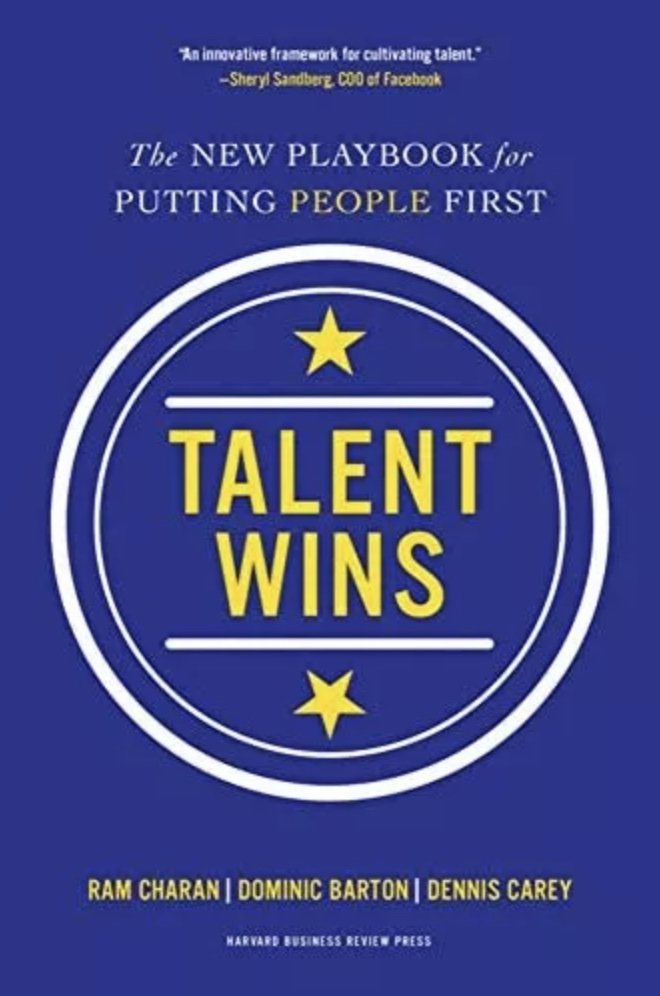
Charan R., Barton D., and Carey D. (2018). Talent Wins: The New Playbook for Putting People First. Boston: Harvard Business Review Press.

“Unlike factories, trucks, and advertising campaigns, people appreciate in value. Investments
in training are strategic bets on your most valuable assets” (p. 125).
A talent-first organization requires the leadership of a triumvirate, a “G3” comprised of the CEO, CFO and CHRO, “This is the core executive group of your new company, a powerful tool that will lead the transformation and ensure that talent is allocated wisely and in sync with capital.”
“Instead of struggling to adapt a legacy product, organizations should empower and encourage employees to seek new pathways. Facebook exemplified agility in its turnaround of its mobile platform which initially operated on software designed for desktop computers.”
“Commitment from the CEO is integral to the transition to becoming a talent first organization, without it, the workforce will not be convinced. “Talent must be at the forefront of your thinking, before strategy, before numbers, before anything else.”