
Key Quote:
“Today, power is moving toward those who are willing to admit uncertainty and stay open through authenticity…in other words, great leaders are embracing surprise” (pp. 68-69).
Key Points and Concepts
The Sequence of Surprise
Surprises, whether pleasant, neutral, or negative all elicit a strong neural response that shouts, “You were wrong!” (p. 5).
When people are truly surprised, they don’t look like the winners of Extreme Makeover: Home Edition, instead their expression can be most accurately described as a “Duh” face. This is the Freeze Phase (p. 6).
The Find Phase happens quickly as our brains devote full attention to analyzing whatever it was that caused the surprise. The duration of the Find Phase depends on how surprised you are. The bigger, more complicated the surprise, the longer it will take to understand (p. 8).
The Shift Phase happens when we’ve analyzed what’s in front of us and have shifted and stretched our beliefs to accommodate it (p. 10).
In the Share Phase, we relieve ourselves of the cognitive burden of surprise by sharing it with others (p. 12).
Capturing and Maintaining Attention
There are two effective techniques for grabbing someone’s attention:
• 1) Interrupting patterns
• 2) Creating knowledge gaps (p. 123)
Humans have a tendency to prioritize new, unexpected information over familiar information. By interrupting a known pattern or defying some expectation, you can force people to pay attention (p. 124).
When something happens that we can’t immediately explain, we stop and search for an answer, usually by asking questions. When crafting surprise or trying to grab someone’s attention, you can maintain and even build on this knowledge gap by responding to questions with questions of your own (p. 126).
One strategy to hold someone’s attention is by “unfolding mystery” bit by bit. Don’t give up the ghost right away—tease them with just a bit of information at a time to leave them wanting more (p. 131).
Writers at Pixar have what they call the “Unifying Theory of 2+2,” where the audiences don’t want to be given 4, they want to be given 2+2 and arrive at 4 on their own (p. 132).
Inspiration and Creativity
Inspiration doesn’t happen in a singular moment. For those moments of clarity—the proverbial apple falling from a tree—to happen, you need to wander in the “fog” of curiosity, learning, and exploration. Isaac Newton wasn’t just a random person who happened to get hit on the head with an apple. He was a scientist and mathematician who had spent years trying to understand how the world works. He had been working in the fog, and “the apple just served to clear the mist” (pp. 108-109).
Mixtures can spark creativity. Introducing new ideas, whether by reading a book you expect to hate, speaking to someone with radically different views, or even just taking a walk around an unfamiliar neighborhood can significantly increase creative output (p. 110).
“Modern-day decision makers don’t even think of themselves as making decisions. They call it an experiment” (p. 85).
Set yourself up for lots of small surprises through iteration. By reviewing, revising, and correcting mistakes early, you can avoid big (and unpleasant) surprises later on (p. 113).
Vulnerability
Surprise has a tendency to increase the intensity of emotions and create vulnerability—both of which make people uncomfortable (p. 17).
When we frame vulnerability in a negative way, surprise becomes a negative experience. We think that surprises make us look foolish and try to avoid them in favor of looking “cool.” Instead, reframe vulnerability as openness to new ideas and experiences.
“Cool is the enemy of growth” (p. 66).
“Distance is the enemy of influence” (p. 68).
“Today, power is moving toward those who are willing to admit uncertainty and stay open through authenticity…in other words, great leaders are embracing surprise” (pp. 68-69).
Ellsberg’s paradox states that we’re far more likely to take our chances with the sure thing, even if the odds don’t necessarily say that we should. For example, there are two jars of marbles filled with a mixture of black and white marbles. In one jar, you can see the marbles and you know that it’s a 50/50 split of black and white marbles. In the second jar, you can’t see any of the marbles. You place a bet on pulling out, at random, a black marble from either jar. Most people, even though there isn’t a mathematically valid reason for doing so, will pick from the first jar (pp. 69-70).
Ellsberg’s paradox only holds true if there is some risk of negative evaluation. A follow-up experiment showed that when there was no fear of a negative evaluation (e.g., if the individual selecting the marble didn’t share his/her bet and there was no actual repercussion to selecting incorrectly), people were actually more likely to take a chance with the unknown (p. 72).
On an unfamiliar playground, the children most likely to venture off without hesitation are those who are closest with their parents (p. 47).
“In times of ambiguity, it is best to have ‘strong opinions, weakly held’” (p. 93).
Relationships and Social Capital
“Talking helps us make sense of our experiences and forge a stronger connection with others” (p. 12).
“An element of surprise in a story also arms us with social capital. We want interesting things to tell others, and surprise gives us something to talk about…Once we pass on a story of surprise, the listener will often repeat it to others. The more surprising a story, the farther it goes” (p. 13).
Keep track of when people mention something they think is important or special. Having this information will make it easier for you to design delight for that person (and maybe others) (p. 140).
Find opportunities to “bury cookies.” This means taking an experience people think should be painful or frustrating and finding a way to inject a bit of delight into it (p. 145).
Look to create experiences above all else.
Negative surprises carry more weight than positive ones. On average, it takes five positive surprises to make up for just one negative surprise (p. 183).
According to Gay Chapman, there are five languages of love: 1) physical touch, 2) words of affirmation, 3) quality time, 4) acts of service, and 5) gifts. When surprising someone, use the language that the person you’re surprising uses. If the person prefers words of affirmation, write a letter instead of sending chocolates (p. 185).
A “red thread” is what pulls an experience together. Whether it’s a theme, story, question, or design, by running a “red thread” you make the experience more memorable (p. 159).
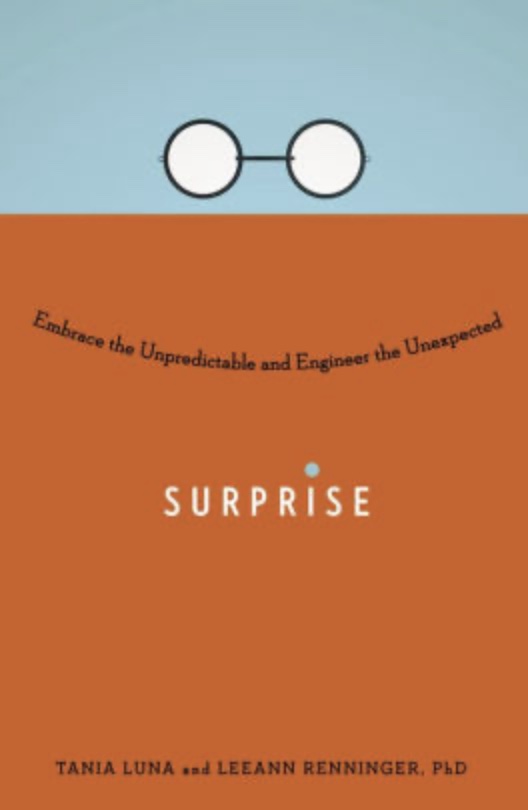
Luna, T. and Renniger, L. (2015). Surprise: Embrace the unpredictable and engineer the unexpected: New York: Penguin.

“Today, power is moving toward those who are willing to admit uncertainty and stay open through authenticity…in other words, great leaders are embracing surprise.”
“Humans have a tendency to prioritize new, unexpected information over familiar information.
By interrupting a known pattern or defying some expectation, you can force people to pay
attention.”
“When we frame vulnerability in a negative way, surprise becomes a negative experience. We think that surprises make us look foolish and try to avoid them in favor of looking “cool.” Instead, reframe vulnerability as openness to new ideas and experiences.”
“According to Gay Chapman, there are five languages of love: 1) physical touch, 2) words of affirmation, 3) quality time, 4) acts of service, and 5) gifts. When surprising someone, use the language that the person you’re surprising uses. If the person prefers words of affirmation, write a letter instead of sending chocolates.”