
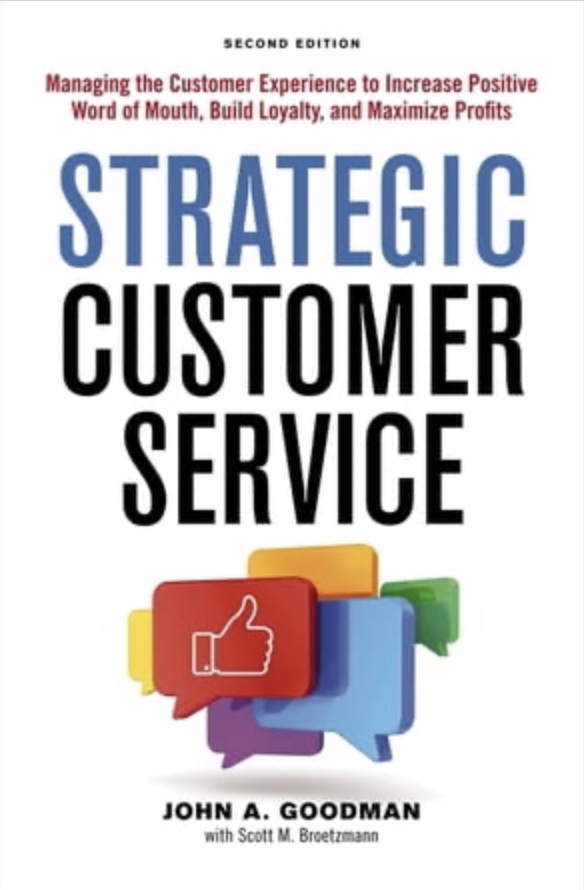
A Rule of Three Book Summary by Admired Leadership
The Book in 3 Sentences: The authors argue that most companies fundamentally misunderstand customer service by treating it as a cost center to be managed down rather than a revenue-generating function that builds loyalty and drives growth. Goodman and Broetzmann lay out a practical framework for building a customer service system that anticipates problems, makes it easy for customers to complain and be heard, and uses that feedback to improve the business rather than simply manage complaints. The central claim is that a strategic approach to customer service, one grounded in real data about customer expectations and financial impact, can be one of the most durable competitive advantages an organization has.
The 3 Most Important Concepts:
The Voice of the Customer (VOC) is the integrated system by which an organization gathers, synthesizes, and acts on customer feedback across every touchpoint and data source. A true VOC goes far beyond a satisfaction survey; it draws on complaints, warranty claims, employee input, and market research to produce a single, shared picture of the customer experience that every function in the organization can use.
The Multiplier is the ratio of problems customers actually experience to the number of complaints they formally report. The multiplier exists because most customers do not complain even when they are dissatisfied, meaning companies see only a small fraction of the real problem. Understanding your multiplier helps an organization estimate the true scale of customer dissatisfaction and act accordingly, rather than being lulled into complacency by low complaint volumes.
Strategic Customer Service is the authors’ framing of customer service not as a cleanup crew for unhappy customers but as a competitive differentiator that generates revenue and positive word of mouth. The strategic view requires quantifying the financial value of customer retention, calculating what dissatisfaction actually costs in lost revenue, and presenting those numbers to leadership in terms that earn investment rather than budget cuts.
The Book’s 3 Most Essential Claims:
1) The overwhelming majority of customer dissatisfaction, between 50 and 80 percent, comes from broken products, flawed service systems, and misleading marketing, not from employee attitude or error. This means that fixing the front-line service staff is addressing the wrong problem in most cases, and real improvement requires fixing the systems that create the problems in the first place.
2) Customers avoid complaining not because they are satisfied but because they do not believe it will change anything, fear damaging a relationship, or simply do not know how. This silence is dangerous because it prevents companies from learning about and fixing problems that are quietly eroding loyalty and driving customers away.
3) Customer service investments almost never fail to generate a positive return when measured correctly. The problem is that they are consistently presented on a budget line as costs rather than as investments in future revenue, which leads leadership to minimize them. Quantifying the lifetime value of a customer and the cost of losing one changes that calculation entirely.
3 Surprising Facts or Insights:
Research cited in the book suggests that roughly 90 percent of customers search for online before contacting customer service. This means the first, and often only, service interaction a customer has is with your website, not a human being. Companies that invest heavily in their service staff while neglecting their digital self-service experience are solving for the less common case.
Employee satisfaction and customer satisfaction are linked more directly than most executives assume. Service employees who lack information, authority, and recognition will escalate more problems, resolve fewer on the first contact, and deliver an experience that frustrates customers regardless of their individual effort. Supervisors trusting and empowering employees belongs in a job description, the authors argue, not just in a mission statement.
The appropriate financial framework for customer service is a calculation of one-year, three-year, and lifetime customer value, not a comparison of complaint volume to handling cost. Most executives resist building these models because the numbers feel imprecise, but even a conservative estimate transforms the business case for investment and reveals how much is being lost to preventable attrition.
3 Actionable Recommendations:
Calculate your multiplier. Survey a sample of customers to understand how many experienced a problem versus how many actually complained, and use that ratio to estimate the true scope of dissatisfaction your company is not seeing. This number alone tends to shift how leadership thinks about the real cost of service failures.
Design your customer contact system to have no more than three menu levels, a clear path to a human at any point, and minimal transfers between agents. Every additional step a customer must take to get help increases the risk of abandonment and generates the kind of frustration that turns into negative word of mouth.
When building the case for service investment, lead with the cost of inaction rather than the cost of the investment. Executives respond to demonstrations of what the company is losing today, in revenue, in loyalty, in word of mouth, far more reliably than to projections of what it might gain.
3 Questions the Book Raises:
The book frames customer service almost entirely around retention and word of mouth, which assumes that most customers who leave quietly would have stayed if their experience had been better. But what about customers whose expectations were set incorrectly by marketing or pricing from the start? At what point does strategic customer service become a substitute for making better promises?
The authors recommend that frontline employees be given significant autonomy to resolve problems without supervisor approval. How do organizations build that capacity without creating inconsistency, and how do they protect against the small percentage of customers who will take advantage of it?
The book was written at a moment when social media was becoming the primary arena for customer complaints and praise. Given how quickly the social landscape continues to shift, how durable is the strategic framework the authors propose, and which parts of it are most likely to need updating as technology changes how customers expect to communicate?
3 Criticisms of the Book:
The The book’s framework is comprehensive but can feel bureaucratic in practice. The seven service functions, the VOC integration requirements, the survey taxonomy, and the financial modeling methodology are each defensible in isolation, but together they describe a customer service organization that many companies, particularly smaller ones, would struggle to build and sustain.
There is a recurring tension in the book between the authors’ argument that most dissatisfaction comes from systemic problems and their extensive guidance on managing individual customer interactions. If the systems are the real issue, the tactical advice on how to handle complaints, though useful, addresses a symptom. The book would be stronger if it gave more space to how companies actually fix the upstream problems that generate the complaints in the first place.
The book is notably optimistic about the business case for customer service investment, but the examples tend to be drawn from situations where the numbers were already favorable. Real organizational life often involves competing investments with clearer near-term returns, and the authors underestimate how difficult it is to win those internal debates even when the customer service case is sound.

“The strategic view of customer service is not to look at the function as a cost to
be minimized, but as a competitive differentiator that generates revenue and positive word of mouth.” (p. 12)
“If you can demonstrate the cost of inaction, you can precipitate action.” (p. 114)
“As an executive, you cannot personally deliver excellent service to all customers. You
must depend on the staff and the overall culture created by the entire service team.” (p. 4)