
A Rule of Three Book Summary by Admired Leadership
The Book in 3 Sentences:
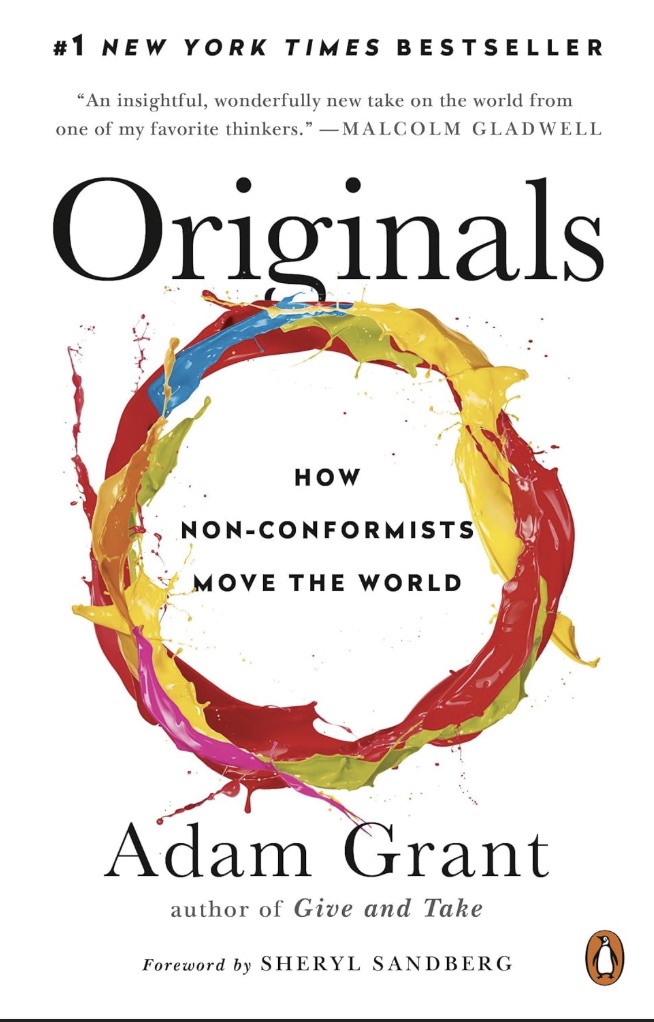
The author argues that originality belongs to anyone willing to question the default and act on what they find. The book shows how originals generate ideas, champion them, manage the fear and doubt that follow, build alliances, and choose when to act. The greatest originals do not eliminate risk or uncertainty; they learn to work within it.
The 3 Most Important Concepts:
Strategic procrastination is the practice of deliberately delaying progress to let ideas incubate. Grant presents research in which college students asked to write business proposals produced work rated 28 percent more creative when they procrastinated after starting the task. The boost only appeared when someone had already begun thinking about the problem. Grant connects this to King, who resisted committing to a theme for his 1963 March on Washington speech until four days before the event and gathered advisers the night before to go back to the drawing board. By keeping the task incomplete, King stayed open to new material, which allowed him to improvise the speech’s most iconic moments.
Balanced risk portfolios describe how originals offset bold moves in one area with caution in another. Grant opens with the four Wharton students who launched Warby Parker. The conventional reading is a massive leap of faith. The reality: All four took summer internships rather than work on the company full time. Neil accepted a full-time job after graduation. Dave did two internships and was talking with his former employer about rejoining. They hadn’t built a website and took six months to agree on a name. The pattern holds elsewhere.
Phil Knight worked as an accountant for five years while selling running shoes.
Wozniak stayed at Hewlett-Packard a year after co-founding Apple.
Google’s founders nearly sold the company for less than 2 million dollars because it distracted from their doctoral
research.
The Book’s 3 Most Essential Claims:
1) Originality is a choice, not an innate gift. In a survey of professionals across industries, 85 percent admitted to staying silent about an important concern rather than voicing it. The difference between originals and everyone else is the willingness to speak up.
2) The biggest obstacle to originality is idea selection, not idea generation. Creative people produce a large volume of work. Their advantage is recognizing which ideas have potential.
3) Fear and doubt are constant companions for anyone challenging the status quo, and trying to suppress them backfires. Grant draws on psychologist Julie Norem’s research showing that defensive pessimists perform best when they lean into anxiety rather than fight it. When asked to envision everything that could go wrong before a task, they were about 30 percent more accurate at darts and scored about 25 percent higher on mental math compared to when they tried to relax or distract themselves.
3 Surprising Facts or Insights:
People facing high-pressure moments perform better by reframing anxiety as excitement rather than trying to calm down. In Alison Wood Brooks’s research, students about to give a speech were randomly assigned to say either “I am excited” or “I am calm.” The “excited” group was rated 17 percent more persuasive and 15 percent more confident.
Entrepreneurs are more risk-averse than the general population. In a study of over 800 Americans, entrepreneurs chose between three ventures with different risk profiles and picked the safest option at higher rates. As teenagers, those who went on to start productive companies were nearly three times as likely as peers to break rules, yet they only took calculated risks.
A disregard for social approval does not set entrepreneurs apart. In a comprehensive analysis of 60 studies covering more than 15,000 entrepreneurs, people who had little concern for pleasing others were no more likely to start businesses, nor did their firms perform better.
3 Actionable Recommendations:
Balance your risk portfolio. When pursuing a bold idea in one area, be unusually cautious in another. Stability in one domain gives you the endurance to take meaningful risks somewhere else.
Lead with the reasons your idea might fail. When you name the biggest weaknesses first, you build credibility and force your audience to work harder to generate their own objections.
Look at your familiar environment with fresh eyes. At Google, employees who spent ninety minutes reimagining their jobs as flexible building blocks showed a spike in happiness and performance lasting at least six months. They were 70 percent more likely to land a promotion.
3 Questions the Book Raises:
Can strategic procrastination be taught, or does it only work when someone is already passionate about the task?
How do organizations that want a culture of originality manage the tension with the need for consistency and efficiency?
If the impulse to defend the status quo is as deep as Grant claims, what practical steps can leaders take to make questioning defaults feel safe rather than risky?
3 Criticisms of the Book:
The book leans on familiar examples: Warby Parker, King, Leonardo da Vinci, Steve Jobs. Readers of popular business books will recognize many of these stories from other works.
Grant devotes a full chapter to birth-order research while acknowledging that experts “continue to fundamentally disagree on many of the conclusions.” The caveats are genuine but do not offset the weight given to these findings.
The book is stronger on diagnosis than prescription. The “Actions for Impact” section offers useful recommendations, but much of the book describes how originals behave rather than providing a method for developing these habits.
3 Quotations Worth Remembering:
“ The hallmark of originality is rejecting the default and exploring whether a better option exists.” (p. 6)
“Originality is not a fixed trait. It is a free choice.” (p. 22)
“ We find surface ways of appearing original, donning a bow tie, wearing bright red shoes, without taking the risk of actually being original. When it comes to the powerful ideas in our heads and the core values in our hearts, we censor ourselves.” (p. 13)
