
“Leaders should encourage others in their organization to run and renovate. Getting the job done in the moment (running) but also determining what needs to be figured out to enable long-term success (renovating) is paramount to influencing a system” (p. 159).
Key Points and Concepts
Being Never Enough
No one is ever enough. There will never be a point in one’s life when additional growth and development are not possible. Mike Hayes has devoted his life to persistently grow — for himself, but also for the families, teams, and country he serves. Through stories from his work as a Navy SEAL to serving with the National Security Council, Hayes shares lessons on how we all can think, act, and lead strategically, even in the direst of conditions. We may never be enough, but we can push ourselves to do and be better for the sake of others.
“This continuous striving to make a bigger difference – for yourself, for your organization, or for the world – is what I believe holds the key to great outcomes in almost any situation” (p. 4).
“[Is] it too negative to imply that we could never be enough, do enough, invest enough of ourselves? I don’t think so. I think we can simultaneously recognize how much we accomplish each day and also understand that our work is never done. There is always growth possible for each of us, ways we can push ourselves to be more excellent, more agile, and infuse our day-to-day with more meaning. There are always more people whose lives we can touch, more people we can lift up and inspire to get better and reach greater heights” (p. 223).
“It’s easy to be complacent. It’s harder to keep on figuring out the work that we need to do. But that work is what drives us to our greatest heights. That work is what drives us to make a real contribution to our world — and the truth is that we all want to contribute, because that’s what makes any of us feel fulfilled” (p. 223).
Leading Like a Navy Seal
Our true self is shown, and our capabilities are revealed, when we are pushed outside of our comfort zone and beyond our perceived limits (pp. 47-48).
“At its core, being a SEAL is not just about living at the edge of human misery, but about thriving and achieving success in those conditions. In the non-SEAL world, there is still plenty we can each do to push our limits and make ourselves more comfortable with discomfort” (p. 49).
Training as a SEAL is “designed not just to be difficult, and not just to train SEALs to maintain their composure during the most challenging life-or-death situations, but to engender learning, growth, and the realization that you can do more than you think you can” (p. 25).There was little consistency in how résumé screeners evaluated candidates. Most spent only a minute or two on screening, and many ignored the cover letter altogether. The three most common criteria were school prestige, extracurricular activities, grades, and employment prestige. Rivera goes on to explain that all but one of these criteria (grades) are biased against diversity applicants (pp. 84-85).
Never Excellent Enough
“On an individual level, we must look to be never excellent enough and build our own capabilities in terms of knowledge and capacity, strength and control, and accountability and orientation” (p. 10).
The day you stop improving is the day you stop being excellent (p. 27).
“The growth that gets us to be more and more excellent over time is powered by hard work, absolutely, but it’s also powered by reflection and real learning” (p. 29).
“Being humble enough to admit what you don’t know but still confident enough to explain where you can add value is a balance that is often hard to strike. But you need to understand that it’s a strength, not a weakness, to know what’s beyond your knowledge or understanding at any point in time, instead of pretending otherwise” (p. 65).
Never Agile Enough
“On a team and organizational level, we must aim to be never agile enough and understand how to shift between roles to best serve our missions, how to put systems in place that lead to superior decision-making, and how to keep our teams as flexible and responsive as possible” (pp. 10-11).
“We’re never going to be in the exact same situation a second time, so the decisions themselves – the ‘what’ don’t matter. It’s the ‘why’ and the ‘how’ we have to think about” (p. 116).
“We need to be flexible in our roles, moving seamlessly between leading and following, and we need to be flexible in our decisions, setting up a framework that enables the most useful information to emerge and guide us even as situations change” (p. 166).
Dynamic subordination, or serving as both a leader and as a follower, and knowing when to be which, is an idea adopted by effective teams (p. 91).
“If hierarchy is getting in the way of the best decision being made, or precluding the best person from taking on any particular role, then something is deeply wrong” (p. 98).
It’s important to have people with a range of experiences and perspectives to have the broadest diversity of thought possible. “All the things that make us different provide the range of perspectives and points of view we absolutely need whenever we’re making decisions” (p. 121).
“You train the next generation at the same time as you execute your own duties. You set the tone that you want the entire organization to embody” (p. 144).
Never Meaningful Enough
“On an impact level, we must act to be never meaningful enough, knowing what will make the biggest difference for the people in our lives and in our communities, and potentially on an even larger scale” (p. 11).
“It’s not the specifics of my belief that matter in terms of helping me better my life and making me more effective in everything I do — it’s the fact that I believe in something, that there’s a core set of values driving my actions …. We all fall short, inevitably, but what matters is how we handle those moments, and whether we can get back on course” (pp. 170-171).
To align your life and actions with meaning, you must (1) believe in something, (2) identify and act according to what is meaningful to you, and (3) not wait to make decisions (p. 171).
“If you’re ever having trouble figuring out what is most meaningful to you or what kinds of goals you ought to be chasing, think about what you would do if you could spend your time doing anything you wanted. The activities and causes to which you naturally gravitate are the best places to start searching for opportunities to contribute” (p. 185).
“Diversity of faith isn’t something we always think about in the same way we think about all the other diversities we need to celebrate, but it’s just as critical. Sharing our beliefs with others, baring our truest selves, [and] finding common elements and bonding because of them can be so powerful” (p. 177).
Practicing Excellence, Agility, and Meaning
“The way to extract maximum knowledge from these hard challenges we undertake is to be truly objective and reflective about our performance, in success just as much as in failure” (p. 29).
It’s not about doing hard things. It’s about recognizing that hard things and trying periods are opportunities to reflect, believe in our capabilities, and overcome the external and internal pressures to succeed (p. 50).
Decisions that force you to pick one option or the other result from learning what to think. Instead, you should practice how to think, where you have “a true thought process, considering the bigger picture, having confidence about the elements of a situation that you can control, realizing that the best decisions don’t just follow a simple algorithm but actually involve a consideration of the principles layered on top of the rules, and the specific circumstances of the situation” (p. 115).
“We can’t be good partners, friends, spouses, and parents without emotion, without feelings, without vulnerability and genuine honesty. But we also can’t be effective performers if we aren’t able to compartmentalize, to put those feelings aside when they’re not helpful to the situation at hand. We need to be able to react well to whatever circumstance presents itself, and we need to remember that calm breeds calm” (p. 62).
Enter every conversation with the assumption that everyone else is better, smarter, and superior in all ways to you. Never assume that your idea is the correct idea from the beginning. That way, you are poised to identify the best solution, and not solely focus on defending yours (p. 66).
Practicing Excellence, Agility, and Meaning with Teams
“There are three principles I live by in [cultivating relationships]: to be intrusive in people’s lives, to be a do-er rather than a be-er, and to push to have real impact on those around me” (p. 200).
“Real networking comes from investing energy in other people, giving more than taking, without thinking about whether you’ll ever get paid back …. The people you invest in without an expectation of investment in return will be the first people who help you whenever it is they can” (p. 201).
“High-performing teams — and not just in the military — succeed and fail together, with the best players understanding at all moments what will make the mission more successful and what role they need to play to best enable that success” (p. 92).
“We all have to do what we can to make the lives of those around us easier, not harder” (p. 97).
“The highest return on investment in [reflective conversations on what did and didn’t work] is achieved when we discuss in an honest and direct way what we could have done better …. True, honest, specific, and shared feedback is how we improve” (p. 30).
Even if things are uncomfortable to share in front of the whole group, opinions and frustrations need to be owned and honestly communicated to the group to create trust (p. 30).
“When working in a situation where I can absorb some of a leader’s burdens — whether in the military, the White House, or in business — I’ve tried to divide the tasks we perform into three categories: what I can do that my boss doesn’t even need to think about, what I can do that I can tell my boss about later, and what I absolutely need to tell my boss about now to make sure we are on the same page” (p. 98).
Leaders should encourage others in their organization to run and renovate. Getting the job done in the moment (running) but also determining what needs to be figured out to enable long-term success (renovating) is paramount to influencing a system (p. 159).
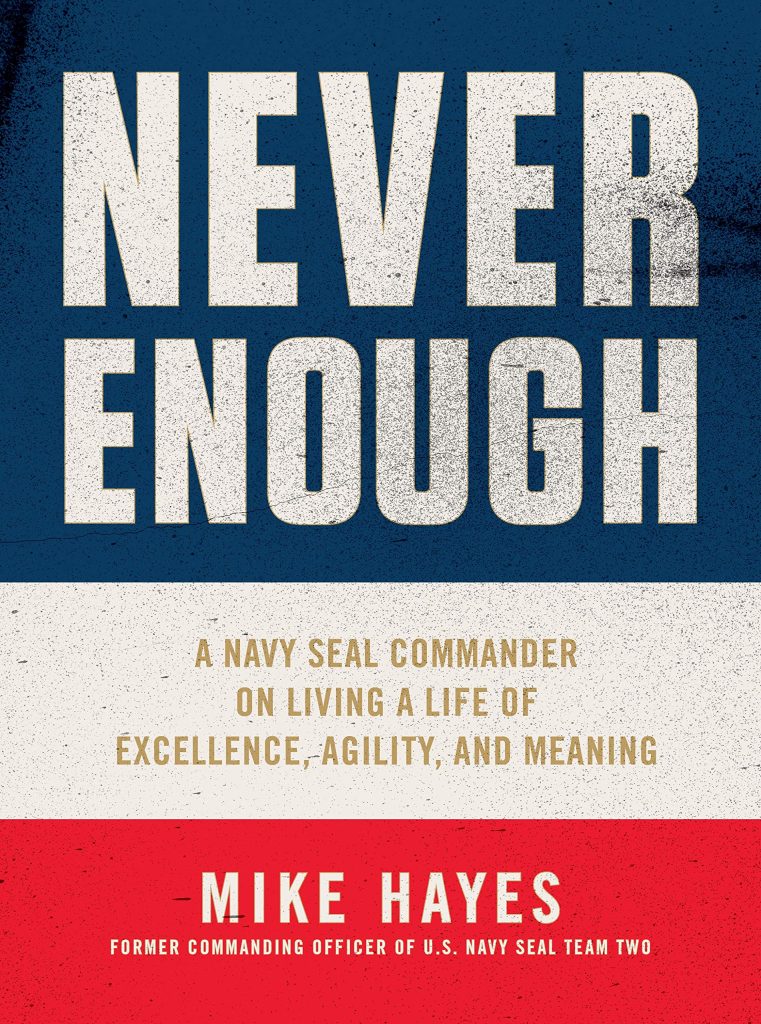
Hayes, M. (2021). Never Enough: A Navy SEAL commander on living a life of excellence, agility, and meaning. New York: Celadon.

“We all have to do what we can to make the lives of those around us easier, not harder”
“High-performing teams — and not just in the military — succeed and fail together, with the best players understanding at all moments what will make the mission more successful and what role they need to play to best enable that success”
“There are three principles I live by in [cultivating relationships]: to be intrusive in people’s lives, to be a do-er rather than a be-er, and to push to have real impact on those around me”