
Key Quote:
“Today’s successful leaders lead by example, empowerment, and inspiration instead of by position, level, or title. Irresistible leaders excel at moving people into roles that are right for both them and the organization. They align teams, develop networks, and reinforce culture and adherence to the organization’s values” (p. 81).
Key Points and Concepts
Defining Irresistible
To be an irresistible organization, the power of every individual in the organization must be leveraged. To achieve this, truly irresistible organizations prioritize employee experience, adopt agile frameworks, implement team-based structures, and focus on purpose at every level.
The Seven Secrets
Teams, Not Hierarchies
Abandoning the traditional hierarchical structure of the organization is required to empower employees and employers.
“Not only do hierarchies slow down decision-making, but they also hurt people’s aspirations” (p. 8).
Organizations still cling to the old hierarchical structure for many reasons, including stubbornness, fear of losing power, and career threats. This reluctance to adapt slows the adoption of new technology and processes due to siloing “people by function, or the type of work they do” while teams focus on a mission with a single goal: results (p. 12).
There is much to learn from how a team is organized, from a mission level to a management level.
The anatomy of a team starts with a diverse, multifunctional group of individuals who depend on one another to achieve a clearly outlined mission. Teams are not institutionalized groups; they are easy to build and disband (p. 12).
Organizations are not just one single team; managers coordinate with other teams to ensure the best use of each team’s efforts (p. 13).
Depending on the organization’s size, there can be many different teams with different yet similar objectives depending on their location. For instance, the IT division of ABC Corp’s West Coast branch can be considered a Tribe. Tribes are made up of multiple squads, which are teams of fewer than 10 people. The overarching brand is a chapter, and none of these are necessarily hierarchical but can be interdependent (p. 13).
Work, Not Jobs
Many have likely taken Uber or had food delivered using an app. This is the result of 59 million Americans as of 2020 working a “gig” job in the “gig” economy (p. 43).
This shift is making its way into the traditional office, where internal mobility is critical for the future of organizations and individual careers. This will not be easy, but the results are well worth it for both employees and employers.
Bersin explains that nearly every company has a bureaucratic job structure that gets in the way of work being done (p. 49).
The solution to this is internal job mobility. In 2020, Unilever rotated employees to different teams during the midst of the pandemic as team-focused restaurants were hit harder than other teams. This rotation generated revenue while unlocking “300,000 hours of work from these varied shifts where people lent a hand where needed” (p. 52). Many organizations furloughed or outright fired thousands while Unilever utilized their employees’ potential to generate value in new ways.
This idea of mobility starts at the ground level. For instance, when there is a job opening at Zappos, you can view which jobs are open, but the hiring manager pairs you to the work your experience is best suited for (p. 55).
Encouraging mobility and skill development is key as it removes the slow and rigid career path many organizations struggle with today. This old path encourages “experience” over “skills” (p. 65).
Managers should encourage their employees even if they fail. If there is not an opportunity to fail, learn, and be coached, individuals who fail “generally ended up at a competitor” (p. 73).
Coach, Not Boss
Effective leaders act as coaches, driving strategy, leading projects, and growing people. This is done by identifying which kind of leader a manager is: a project & work manager or a leader and coaching manager (p. 80).
Leaders must understand the network, the business model, and have influence and followership. This is achieved by being a sponsor for employees, helping them in their day-to-day tasks, providing career advice, and sponsoring them for new opportunities. A leader knows they’ve achieved this because they “have good followers” (p. 81).
“Today’s successful leaders lead by example, empowerment, and inspiration instead of by position, level, or title. Irresistible leaders excel at moving people into roles that are right for both them and the organization. They align teams, develop networks, and reinforce culture and adherence to the organization’s values” (p. 81).
High-performing leaders share traits with sports coaches: they communicate a clear direction, are good judges of people, develop winning game plans, and focus on developing people (p. 83).
Edgar Schein, a leader in the research of corporate culture, explained that “The most important part of a high-performing culture is people helping each other” (p. 87). Bosses have to become coaches so they can empower employees to manage themselves.
This is achieved through bosses setting goals, checking in, providing routine feedback, developing employees, reviewing performance, negotiating compensation annually, and creating development plans (p. 88).
Culture, Not Rules
The new workplace culture is defined by five elements: environment, well-being, inclusion, recognition, and flexibility (pp. 109-110). As work becomes more flexible, the environment must adapt as well.
Employee health, safety, and well-being are paramount. White-collar workers require different programs than blue-collar workers concerning health. This ranges from dealing with stress proactively to talking through it with colleagues (p. 118).
Workplace design should prioritize engagement and satisfaction.
88% of employees feel more engaged when they select where they work.
96% feel more engaged and productive when they can move around during the day.
94% feel more engaged and productive when they can work in teams uninterrupted.
98% feel more engaged and productive when they feel a sense of belonging in the company (p. 119).
Inclusion, recognition, and fair pay are critical components of a positive culture. This is a critical competency to get right as “many companies struggle to even identify exclusionary behavior and practices” (p. 121). The way to solve this is to treat inclusion like Chevron does, treating it as you would a safety briefing (p. 123).
Leaders should prioritize employee wellbeing, inclusion, and fair reward systems. To achieve this, leaders, managers, and executives must be able to comfortably share information transparently. The inability to do this causes issues with trusting leadership, as CEO ratings on Glassdoor suffer the most when employees have an unfavorable view of the culture (p. 130).
Leaders must create an environment where employees feel included, respected, and heard. “Irresistible companies do this and outperform their peers” (p. 126).
Growth, Not Promotion
Learning and growth are central to people strategy and career development. “If you want your company to be irresistible, you need the organization to learn as fast as it can” (p. 138).
Only the highest-performing companies embrace a culture of sharing, developing, and learning. “Being busy doesn’t make a company grow; thinking about how to do things better does” (p. 139).
Growth should be optimized over promotion; skills and responsibilities should increase without a rigid ascent. This means you prioritize growth over everything else, promotions will follow as they are not the objective. Promotions are a natural outcome of prioritization of growth (p. 140).
Continuous personal progress and skill acquisition are valued. This doesn’t just apply to managers and executives liking their employees increasing their skills. The number one reason an employee leaves a company is because they felt they were not learning anything at their former company (p. 142).
Leaders should encourage and facilitate continuous learning and development by treating their employees’ careers as an “experience” and not as a “ladder” (p. 144).
Promote a culture of personal reinvention and skill-building because the outcome is positive for both the employee and employer. Both benefit from solving problems through learning rather than looking busy.
Focus on growth in responsibility and expertise rather than just titles and promotions. This is done through the four E’s: education, experience, exposure, and environment (p. 147).
Purpose, Not Profits
Purpose drives energy, enthusiasm, and creativity in a company. Ensuring leaders and employees understand their purpose is critical, as the growth driven by purpose leads to a more profitable company (p. 166).
Citizenship and ethical operation are essential in modern business. Companies like Patagonia leverage the loyalty of customers by acting responsibly. For example, Patagonia donates 100 percent of profits on Fridays to nonprofits focused on protecting the environment (p. 174). Leaders need to ensure they understand that prioritizing profits over brand loyalty can harm their profits even more.
Companies should focus on customer satisfaction, employee engagement, and societal impact through listening to their stakeholders and prioritizing their needs.
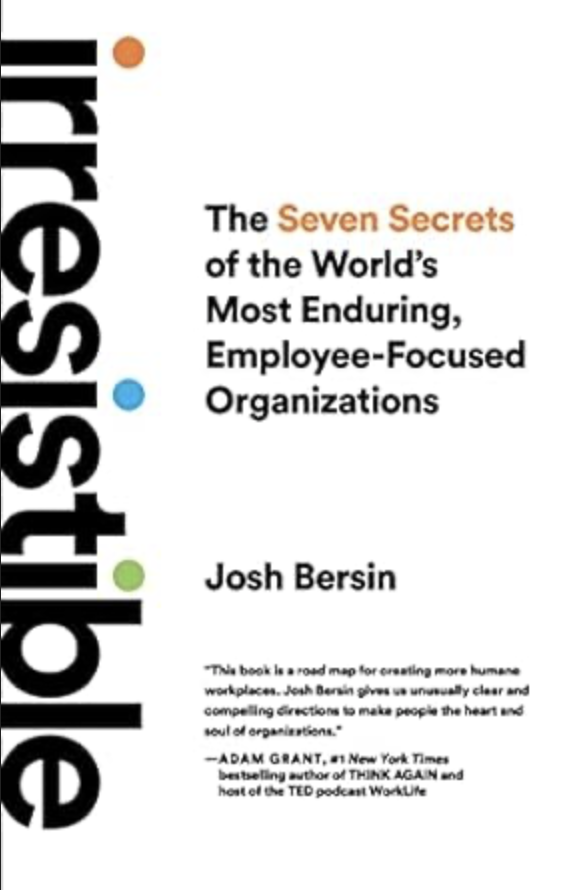
Bersin, J. (2022). Irresistable: The Seven Secrets of the World’s Most Enduring, Employee-Focused Organizations. United States: Ideapress Publishing.

“The anatomy of a team starts with a diverse, multifunctional group of individuals who depend on one another to achieve a clearly outlined mission. Teams are not institutionalized groups; they are easy to build and disband.”
“Leaders must understand the network, the business model, and have influence and followership. This is achieved by being a sponsor for employees, helping them in their day-to-day tasks, providing career advice, and sponsoring them for new opportunities. A leader knows they’ve achieved this because they “have good followers.”
“Continuous personal progress and skill acquisition are valued. This doesn’t just apply to managers and executives liking their employees increasing their skills. The number one reason an employee leaves a company is because they felt they were not learning anything at their former company.”
“Citizenship and ethical operation are essential in modern business. Companies like
Patagonia leverage the loyalty of customers by acting responsibly. For example, Patagonia
donates 100 percent of profits on Fridays to nonprofits focused on protecting the environment. Leaders need to ensure they understand that prioritizing profits over brand loyalty can harm their profits even more.”