
“By exploring other people’s concerns, we can discover whether they might be open to collaborating or changing their minds in the future. When you respect people’s intentions, their intelligence, and their fundamental liberty, your attempts to influence them will go more smoothly” (p. 141).
Key Points and Concepts
What is Influence?
Influence is our human advantage. It is passed down in our DNA and it initially allowed our species to grow and survive (p. 1).
People confuse influence with manipulation because of societal norms, sales tactics, and general greediness (p. 4).
Moving away from transactional influence to personal influence can be the key to becoming better in many areas of life (p. 5).
When you are trying to influence behavior, treat people like human beings and respect their freedom of choice for the best results (p. 11).
Chance’s approach to influence starts with connecting to the powers of persuasion we had all along and enhancing them to make life better for everyone (p. 13).
Knowing what you want comes from experiencing it. To better understand what you want to do you must experiment and take chances (p. 16).
The Human Decision-Making Process
Our brains work using two distinct systems. Chance names System 1 the Gator and System 2 the Judge (pp. 19-21).
The Gator is habitual and automatic (p. 20). It oversees quick processes that require little attention like emotions or judgments.
The Judge is conscious and rational. It is responsible for any process that needs concentration and effort (p. 21).
The Gator is always the first to respond, and the Judge only enters when the task is deemed important and demanding. The Gator can make decisions without the Judge, but the Judge cannot work without the Gator (p. 23).
The majority of the Gator’s work happens on a subconscious level. Because of this, humans deceive themselves to think they are rational (p. 23).
To be more influential, all influence efforts should be focused on the Gator since this is where decisions are truly made (p. 38).
On Saying No
The “No” challenge is saying no to any requests or invitations for 24 hours. This helps to expand our comfort zone, exercise our power, and identify what truly matters. It also shows how much of the Gator’s first reaction is based on being compliant (pp. 48-50).
By saying no more often, we become more comfortable hearing no in our own lives and build resilience to rejection (p. 55).
“No is not fatal. And as you release your fear of hearing no, you gain the freedom to ask for things” (p. 58). When you are clear about your boundaries with others it shows confidence and allows everyone to be more open to mutual influence (p. 63).
Being More Influential Means Just Asking
“Along with saying no, the easiest thing you can do to become more influential is just ask. Ask more often, ask more directly, and ask for more” (pp. 64-65).
There is a link between generosity and happiness. By asking, we can give people the opportunity to feel good about saying yes to us (p. 66).
Many people hesitate to ask because they fear rejection or are concerned about how others will perceive them (p. 65).
It is important to be more direct in our asking. Most of what we think is asking is more closely related to hinting (p. 66).
Charisma
There are three paradoxes of charisma: trying to be charismatic has the opposite effect, you attract other people’s attention by giving them yours, and to connect with many people, connect with one (pp. 70-88).
When someone is in a less powerful position, they usually focus on their own experience and use more self-referential language (p. 72).
Focusing on yourself is the opposite of being charismatic. To connect with someone turn your attention toward them, practice deep listening, and ask questions (pp. 75-77).
A good reminder to keep your attention outward is to use people’s names more often. It places the attention on them and not yourself (p. 78).
“Charisma isn’t something you are. It’s something you do, which places it within your control; you can become more charismatic by adjusting the way you interact with people” (p. 83).
The Power of Framing
“When you ask can sometimes matter more than how you ask or even what you’re asking for. Moments of truth are situations in which someone is particularly likely to be open to your influence” (p. 93).
Framing is powerful and can shape expectations and interpretations of events. It helps to shift the focus on what they are gaining instead of what they are losing (p. 101).
The three most useful frames are monumental, manageable, and mysterious (p. 106).
Monumental frames emphasize importance (p. 107).
Manageable frames make big changes feel easy (pp. 109-110).
Mysterious frames spark curiosity (pp. 114-115).
Combining multiple frames at once helps to be the most effective in achieving your desired goal (pp. 115-116). Overcoming Resistance
“The Gator is extraordinarily sensitive to danger. Even if you have the best intentions, someone you are trying to influence might feel you’re threatening to take away their time, attention, money, or other valuable resources. This is why some people will say no when it seems to make no sense. Or before they’ve even been willing to listen to your great idea” (p. 124).
Threat detection and loss aversion spark resistance to influence. This is because people weigh losses far more heavily than gains (p. 124).
When we are pressured to act in a certain way, we often respond by doing the exact opposite. This is called psychological resistance (pp. 124-125).
In Aikido, responding to an attack means redirecting the momentum while trying to protect both sides from injury. Chance uses this example to show how to redirect the resistance from other people’s objections (p. 130).
By not pushing back against resistance, you create space for the other person to say what they’re feeling and eventually be more open to influence (p. 131).
Applying Aikido in our daily lives means witnessing and exploring resistance, affirming freedom of choice, and easing resistance with a soft ask (pp. 131-137).
“By exploring other people’s concerns, we can discover whether they might be open to collaborating or changing their minds in the future. When you respect people’s intentions, their intelligence, and their fundamental liberty, your attempts to influence them will go more smoothly” (p. 141).
On Listening
In conversation, we tend to focus on our own experience or what to say next. In a disagreement, the mind amplifies these urges. This leads us to skew the views of people who disagree with us and to imagine them to be far more extreme than they are (p. 143).
People often overestimate how much members of the opposing side disagree with them which is known as the false polarization bias (p. 144).
Connecting and bridging the gaps between people begins with listening. Focus on the other person and make your listening goals specific. Listen for what they are thinking, listen for thoughts being left unsaid, and listen for the other person’s unspoken values (pp. 144-146).
“By listening skillfully, modeling openness, and letting go of our agendas in order to relate to another person’s experience, we show each other what empathy looks and feels like. By connecting in this way, we open our hearts and minds–including our own–to influence” (p. 150).
On Negotiating
Chance shares an influence strategy called the magic question. The answer to the question, “What would it take?” provides many of the ingredients we need in a negotiation and turns the conversation away from confrontation and toward collaboration (pp. 152-154).
Using the Magic Question makes it easier to see negotiations as a chance for both sides to add value and not as a win/lose scenario (p. 159).
To look for opportunities to create value before, during, or after a negotiation, ask yourself three value creation questions first then discuss them with the other party later (p. 160).
1. How could this be even better for me?
2. How could it be even better for them?
3. Who else could benefit?
When there are multiple issues to negotiate, offer multiple equivalent simultaneous offers (MESOs). This steers the conversation toward collaboration and not conflict (pp. 170-171).
People are more likely to purchase a product when it is presented with alternatives. We tend to favor middle options instead of the extremes because they seem practical and are easier to justify (pp. 170-171).
Economists Carl Shapiro and Hal Varian identified the Goldilocks Strategy knowing we favor the middle option. This involves proposing something you think will be ideal for the other person, a less appealing alternative, and another option that is far more than they need. This makes the middle option feel just right. This encourages the person to take action instead of delay (p. 171).
When negotiating with a difficult person, focus on leverage. Be prepared and know what other options you have and where you will draw the line before the negotiation begins (p. 174).
Influence as Manipulation
Mastering influence and gaining more power means there are more opportunities to be taken advantage of by sharks (pp. 187-188).
Pay attention to your instincts when someone is trying to influence you. Look out for red flags such as urgency, exclusivity, half-truths, alternating hot and cold, and a funny feeling (pp. 192-207).
Psychologist Paul Ekman has found people can detect lies with only 5% greater accuracy than random chance (p. 192).
Manipulation shifts you into Gator mode so you are in a reactive mindset instead of being able to think rationally. This shows why it is easier to spot red flags when someone else is the target (pp. 192-193).
By sharpening the skills to identify these red flags, you can protect yourself while also becoming a better influencer (p. 207).
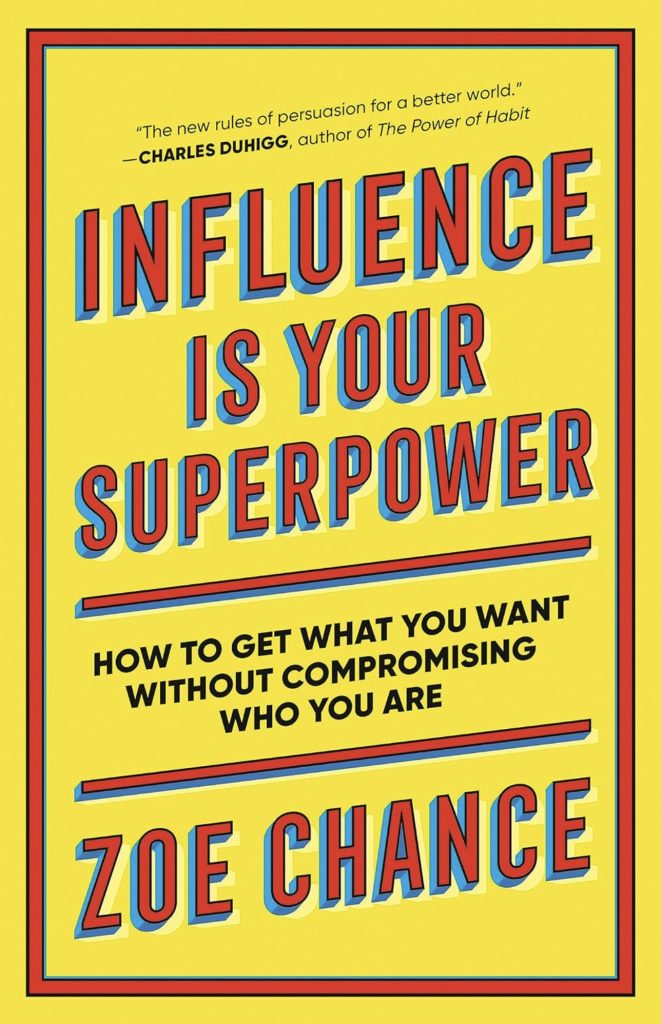
Chance, Z. (2022). Influence Is Your Superpower: How to Get What You Want Without Compromising Who You Are. New York: Random House.

“Moving away from transactional influence to personal influence can be the key to becoming better in many areas of life. When you are trying to influence behavior, treat people like human beings and respect their freedom of choice for the best results.”
“By listening skillfully, modeling openness, and letting go of our agendas in order to relate to another person’s experience, we show each other what empathy looks and feels like. By connecting in this way, we open our hearts and minds–including our own–to influence.”
“Mastering influence and gaining more power means there are more opportunities to be taken advantage of by sharks. Pay attention to your instincts when someone is trying to influence you.”