
Key Quote:
“The most valuable players are never finished. They are continually adapting, adjusting to hit the mark” (p. 132).
Key Points and Concepts
Defining An Impact Player
Wiseman divides contributors into three groups:
High Contributors (Impact Players): Those who are doing work of exceptional value and impact.
Typical Contributors: Smart, talented people who are doing solid (if not great) work.
Under-Contributors: Smart, talented people who are playing below their capability level.
Impact Players stand out because they step up in critical moments. “It’s the one who understands the gravity of the moment and will step up and get the job done” (p. xi).
Turning Challenges into Opportunities
Impact Players don’t avoid problems. Instead, they see challenges as chances to add value.
“Perhaps most fundamentally, they don’t see problems as distractions from their job; rather, they are the job—not just their job, but everyone’s job” (p. 9).
“He saw a complex problem as an opportunity. For Impact Players, problems become opportunities to serve, to find solutions, and make an impact” (p. 16).
Impact Players thrive in messy, high-pressure situations. They prepare for problems and work to solve them without burning out. As Wiseman notes, “Because they’ve anticipated and prepared for unforeseen problems, they aren’t thrown off their game when problems arise” (p. 121).
Navigating Uncertainty
Impact Players succeed in uncertain environments where others hesitate.
They take control of their work and believe they can influence outcomes. “Add to the service mindset a strong sense of agency (I can act independently and make decisions) and internal locus of control (I, not external forces, control the outcome of events in my life)” (p. 40).
“While others might build a shelter and hunker down during a storm, the Impact Player is building a windmill to create power” (p. 20).
Wiseman introduces the “completion gene,” which drives Impact Players to finish tasks without constant reminders. Impact Players complete tasks efficiently and without needing reminders because of their strong sense of ownership and responsibility.
The completion gene, powered by resilience and grit, enables Impact Players to persist through uncertainty, recover from setbacks, and maintain steady progress toward their goals.
Managers value their ability to learn quickly and stay open to new ideas. “Their managers consistently noted two behaviors that set them apart: (1) how quickly and eagerly they learned when presented with a new challenge and (2) how curious and open they were to new ideas” (pp. 137–138).
The Job That Needs to Be Done
Impact Players don’t limit themselves to their official job descriptions. They focus on solving the most important problems.
“Specifically, the tendency to ‘work outside their official job scope to solve problems or realize opportunities’ was one of the top three differences between high-impact and typical contributors” (p. 46).
They stay flexible, expanding their range when necessary. “They don’t leave their post; they play their position but expand their range” (p. 48).
Their leadership style is fluid. They step up to lead when needed and step back when the job is done. “They practice a fluid model of leadership, leading on demand rather than by command” (p. 9).
Continuous Learning and Adaptation
Impact Players are always learning. They welcome
feedback and use it to improve.
“They certainly appreciate affirmation and positive feedback, yet they actively seek corrective feedback and contrary views and use this information to recalibrate and refocus their efforts” (p. 12).
“The most valuable players are never finished. They are continually adapting, adjusting to hit the mark” (p. 132).
They also recover quickly from mistakes. “Admitting mistakes and recovering quickly is one of the top ten differentiators between Impact Players and under-contributors” (p. 153).
Making Work Easier for Others
Impact Players lighten the load for their teams and managers.
Managers appreciate employees who take action without being told. “We asked the same group of managers what employee behaviors they most appreciate. Their number one response? ‘When people do things without being asked’” (p. 39).
They show “upward empathy,” understanding their managers’ challenges and supporting them. “Impact Players learn what their leaders need and are great practitioners of what I call upward empathy” (p. 43).
Their low-drama, high-impact approach creates a positive work environment. “Our survey data indicated that Impact Players consistently demonstrate low-maintenance, low-drama behavior at rates 4.5 times higher than typical contributors and 21 times higher than under-contributors” (p. 178).
Overcoming Bias and Seeing the Invisible
Impact Players excel at navigating organizational dynamics and understanding unspoken rules.
They intuitively identify “What’s Important Now” (W.I.N.) and focus on high-value activities that align with organizational priorities. “The top contributors we studied intuit the real agenda the way a good defender reads the field and anticipates the imminent play” (p. 46).
“This incongruence suggests that employees need to decipher the real culture to be successful. Impact Players are active decoders of the culture” (pp. 40–41). They align their actions with what truly matters in the organization, enabling them to navigate dynamics effectively and contribute where it counts most.
Wiseman emphasizes that managers play a crucial role in creating an environment where everyone can contribute their best.
“Managers: to foster a culture where everyone contributes at their fullest, look behind the scenes and seek out the unsung heroes. Ensure they are seen and heard, then celebrate their work. Elevate hidden contributors and amplify the quiet voices, especially those lacking systemic power or ordinary privilege” (p. 259).
By understanding the nuances of workplace dynamics and addressing bias, Impact Players enhance their own effectiveness while fostering inclusion and collaboration within their teams.
Leadership and Communication Insights
Impact Players show leadership through action, even without formal authority.
“The most impactful players take charge even when they aren’t in charge. They show initiative and take responsibility” (p. 73).
They build trust and collaboration by creating environments where people feel both supported and challenged. “Creating an environment of both safety and stretch in which individuals feel safe to experiment and fail, yet challenged to perform at their best, is one of the fundamental tasks of managers” (p. 244).
Their approach inspires others to give their best and work toward shared goals.
From Insights to Impact
“Impact Players” is more than just a book; it serves as a guide for anyone looking to make a real difference in their workplace. Liz Wiseman’s research shows that being an exceptional contributor is not just for a select few, it is something anyone can learn and develop. The main takeaway is clear: making an impact at work is not about your job title, but rather your attitude, flexibility, and commitment to helping others succeed.
By following the ideas in this book, individuals can boost their value at work, while organizations can create environments that support growth and achievement. “Impact Players” encourages readers to rethink their potential and demonstrates that with effort, smart planning, and a desire to learn, anyone can become a key player in their team.
The insights provided are not just theoretical; they offer practical steps that can change careers and improve teamwork. As the workplace continues to change rapidly, the concept of being an impact player will guide both individuals and organizations toward lasting success and meaningful contributions.
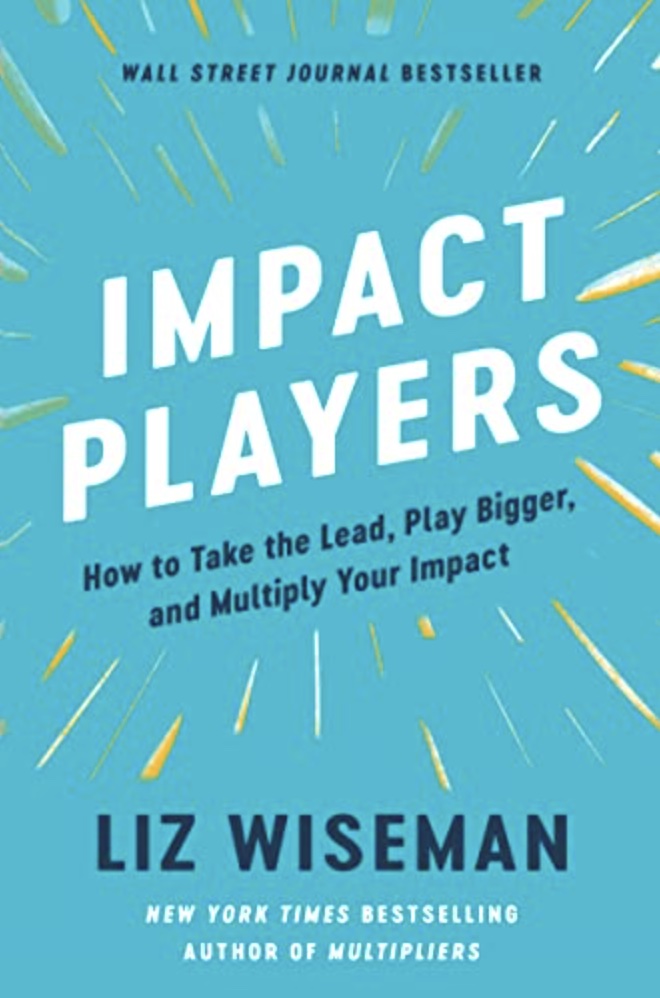
Wiseman, L. (2021). Impact Players: How to Take the Lead, Play Bigger, and Multiply Your Impact. New York: HarperCollins Publishers.

“The most valuable players are never finished. They are continually adapting, adjusting to hit the mark”.
“Impact Players stand out because they step up in critical moments. “It’s the one who understands the gravity of the moment and will step up and get the job done.”
“They certainly appreciate affirmation and positive feedback, yet they actively seek corrective feedback and contrary views and use this information to recalibrate and refocus their efforts. The most valuable players are never finished. They are continually adapting, adjusting to hit the mark.”
“‘Impact Players’ is more than just a book; it serves as a guide for anyone looking to make a real difference in their workplace. The main takeaway is clear: making an impact at work is not about your job title, but rather your attitude, flexibility, and commitment to helping others succeed.”