
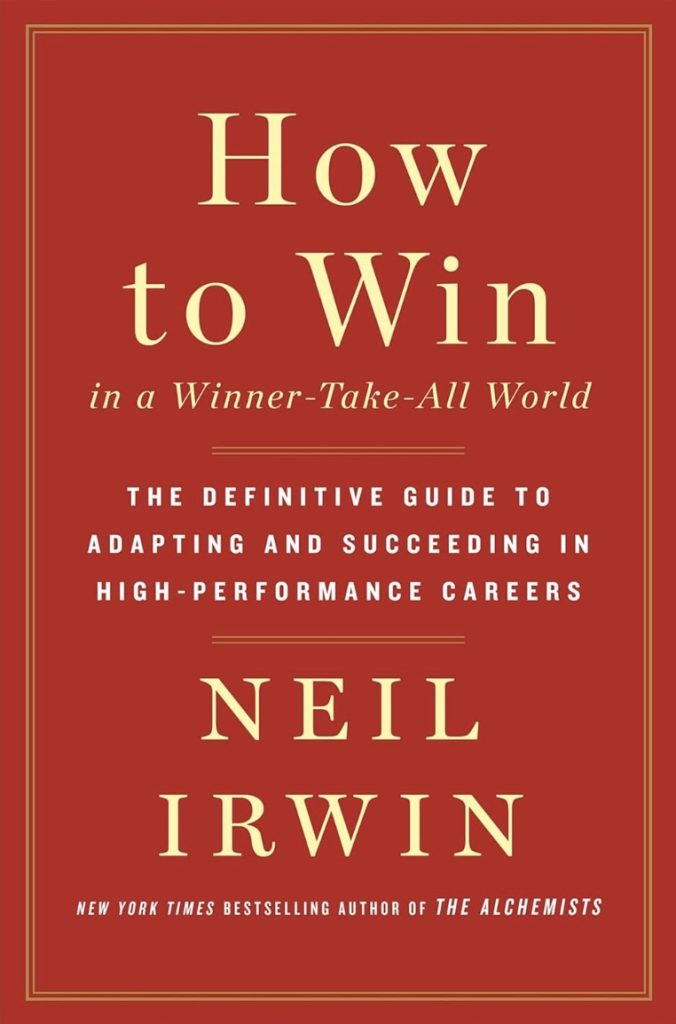
A Rule of Three Book Summary by Admired Leadership
The Book in 3 Sentences:
The author argues that the modern economy increasingly rewards large, technologically sophisticated organizations, and that the individuals best positioned to thrive within them are not narrow specialists but people who can bridge multiple disciplines and translate between different areas of expertise. Irwin introduces the idea of becoming Pareto-optimal, developing a combination of skills that is hard to find together, so that improving on one dimension of your work does not come at the cost of another. The book is a practical rethinking of how to build a career in an era when winner-take-most dynamics are reshaping every industry, and when the traditional notion of climbing a ladder has been replaced by the more complex reality of navigating a lattice
The 3 Most Important Concepts:
Pareto-Optimal is the concept Irwin borrows from economics to describe a person whose combination of skills is genuinely difficult to improve. A Pareto-optimal person cannot be made better on one dimension without becoming weaker on another, which makes them uniquely valuable in roles that require bridging different functions or communicating across specialties.
The Glue Person is Irwin’s term for someone who connects different areas of expertise within a large organization. Glue people are not necessarily the deepest experts in any single domain, but they understand enough about multiple areas to make collaboration possible, communicate strategy effectively across functions, and prevent the kind of costly miscommunication that silos produce. The distinction between a good glue person and a bad one is whether they add genuine value or merely create more process.
The Career Lattice is the authors reframing of career development away from the image of a vertical ladder and toward a more complex structure of horizontal and even downward moves that ultimately lead to a steeper ascent. Lateral moves into unfamiliar functions build the breadth of experience that makes someone Pareto-optimal, even when those moves do not come with higher titles or immediate compensation gains.
The Book’s 3 Most Essential Claims:
1) The twenty-first century economy has been restructured around large, complex, technologically advanced firms, and those firms are now the primary arena in which careers are built. Understanding how these organizations actually function, including who makes decisions, how value is measured, and where the real leverage points are, is a prerequisite for succeeding within them.
2) The skills most at risk of being displaced by automation and artificial intelligence are those built around repetitive, predictable processes. The skills most resistant to displacement are those that require improvisation, contextual judgment, and communication across disciplines. People who develop the latter category are building a career in the direction the economy is heading.
3) Good management is a form of technology, and organizations that have it enjoy a compounding advantage over those that do not. The best-run firms attract better people, produce better outcomes, and can offer better compensation, which reinforces the cycle. This is part of what makes winner-take-most dynamics so persistent and so difficult to disrupt from outside.
3 Surprising Facts or Insights:
Research on manager effectiveness cited in the book suggests that the sweet spot for weekly work hours is 40 to 45. Managers who regularly work beyond that threshold, particularly on weekends, tend to have less engaged direct reports, not more productive ones. The
correlation between hours and outcomes is weaker than most high-performers assume.
Irwin describes jobs as naturally unfolding in three one-year stages: the first year for learning the basics, the second for making real changes and achieving flow, and the third for seeing the payoff and reaching genuine comfort in the role. By the end of the third year, the discomfort needed for growth has faded, which is usually the right moment to seek a lateral move rather than a promotion.
In fields where top performers are separated by very small margins of objective quality, positioning and differentiation matter more than most people acknowledge. Research on competition, from piano competitions to job interviews, consistently shows that sequence effects, who speaks first, who is evaluated last, can be as influential as the underlying performance being judged
3 Actionable Recommendations:
Deliberately seek out lateral moves that take you into unfamiliar functional areas, even when those moves do not come with better titles or compensation. The breadth of perspective you build by working in finance, operations, product, and strategy at different points in your
career is exactly what makes you genuinely difficult to replace.
Develop the skill of helicoptering: the ability to move fluidly between high-level strategic thinking and technical detail depending on who you are talking to and what the situation requires. This capacity to match the level of abstraction to your audience is one of the traits that most reliably distinguishes effective leaders from people who can only operate in one register.
When evaluating a potential employer, look beyond compensation and title to assess what the firm actually offers in terms of varied experience, access to skilled people across different functions, and the quality of its management. The firm that builds the broadest
foundation for your career lattice is often more valuable than the one offering the highest initial paycheck.
3 Questions the Book Raises:
Irwin’s framework is most useful for people who already have the educational background and professional access to pursue Pareto-optimal careers. What does this advice look like for people who are entering the workforce with narrower starting points, less institutional access, or careers in fields where deep specialization is still the primary currency of value?
The book treats the winner-take-most dynamic as a structural reality to be navigated rather than a policy choice to be contested. But the concentration of economic gains in a small number of large firms has significant social consequences. Is the right response for individuals to adapt their career strategies, or is there a larger argument being quietly conceded here?
Irwin recommends thinking of jobs in three-year cycles and moving laterally when comfort has been achieved. How does this advice interact with the reality that many organizations reward tenure and penalize lateral movement in their compensation and promotion systems? The book identifies the goal but underestimates how hard the organizational culture often makes it to pursue.
3 Criticisms of the Book:
The book is most persuasive as a description of a particular career environment, the large, knowledge-intensive, technology-adjacent firm, and least persuasive as advice for anyone working outside that world. Irwin is a senior economics correspondent for the New York Times who covers large organizations, and the careers he describes as ideally positioned tend to look a lot like the careers of people he covers or works alongside.
The concept of becoming Pareto-optimal is genuinely useful but also easy to misapply. The book does not give readers much help distinguishing between breadth that is genuinely valuable in a specific context and breadth that is simply a collection of partially developed skills that does not add up to a coherent professional identity.
Irwin’s treatment of the gig and contracting economy is notably ambivalent. He acknowledges the risks but frames them as primarily individual, a matter of personal risk tolerance and planning. The structural reasons why so many people end up in contingent work, and what that says about the winner-take-most economy he is describing, get less scrutiny than they deserve.

“Good management is essentially like a technology that some organizations have and
others don’t.” (p. 262)
“Thinking of a career path in terms of a ladder is not as effective as thinking in terms of
a career lattice, in which sideways or even downward moves ultimately lead to a steeper ascent later in one’s career.” (p. 70)
“Your success isn’t about you and your performance. It’s about us and how we perceive your performance.” (p. 24)