
Key Quote:
“The best asset we have to offer the world is ourselves. If we underinvest in protecting our minds, bodies, and spirits, we are failing at protecting our greatest asset” (p. 98).
Key Points and Concepts
Part I: Essence
Choose: The Essentialist doesn’t just recognize the power of choice, he celebrates it. He knows that when we surrender our right to choose, we give others not just the power, but also the explicit permission to choose for us (p. 33).
We tend to over emphasize the external aspects of decision-making (options) and underemphasize the internal aspects (actions). Options can be taken away, while our ability to choose, or our free will, never can be.
Become expert at discerning the essential few from the nonessential many.
Discern: Many believe that the harder and longer we work, the more we will achieve. Once we break free of this 1:1 mindset we can begin to see that certain investments will have a greater return than others. Not all opportunities are created equally (p. 41).
Make an intentional decision to live by design and not by default.
We all know someone who is constantly trying to fit one more thing in. They know it will take them ten minutes to walk to the meeting that starts in ten minutes, but they choose to send a few more emails and are late as a result. Recognizing that we can’t have everything allows us to excel at what is important.
Trade-off: By accepting the reality of trade-offs, we can make the liberating realization that we have the power to choose which problem we want to have. These problems will exist whether or not we decide to acknowledge them. By choosing to acknowledge them, we give ourselves the ability to make strategic decisions and design our lives in a way that contributes to our greater sense of purpose (p. 52).
Trade-offs are not something to be ignored, they are something to be embraced and made deliberately, strategically, and thoughtfully.
Now that we know it’s possible to design our lives instead of living by default, we need to take a look at how to discern what deserves our attention and energy, and what can be omitted from our to-do lists. In Part II: Explore, McKeown teaches us how to discover what is essential to us.
Part II: Explore
Escape: In our overly connected world, we don’t get space by default, only by design. We need space to escape in order to discern the essential few from the trivial many.
The Essentialist sets deliberate time aside to be bored, to sit and think and explore options. You can’t evaluate and decide what is most important unless you have the time and space to ponder (p. 65).
The Essentialist spends time exploring a hundred different options in order to discover which is most meaningful to her. The non-essentialist skips this initial step and tries to continually pursue a hundred options without being fully dedicated to any of them.
Look: Essentialists are powerful observers. They have already accepted the reality of trade-offsand know that it’s impossible to pay attention to every single detail that comes their way (p. 76).
Listen to what is not said: what exists between the lines and creates the whole from the sum of its parts.
Play: McKeown defines play as “anything we do simply for the joy of doing rather than as a means to an end”. Play is an essential activity because it 1) broadens the range of options available to us, 2) helps us see possibilities we otherwise wouldn’t, and 3) stimulates the parts of the brain that are involved in careful logical reasoning and carefree, unbound exploration.
Sleep: By prioritizing sleep, we enable ourselves to be more productive. Sleep allows us to explore, make connections, and do less but achieve more throughout our waking hours.
The best asset we have to offer the world is ourselves. If we underinvest in protecting our minds, bodies, and spirits, we are failing at protecting our greatest asset (p. 98).
Select: “If the answer isn’t a definite yes, then it should be a no.” – Derek Sivers
Seek to do work you love, that taps your greatest talent and serves an important need in the world (p. 107).
After discovering our areas of greatest impact, it’s time to start going through our lives and eliminating everything that doesn’t aid in our pursuit of excellence. Part III: Eliminate shows us how to begin this process, step by step.
Part III: Eliminate
Clarify: Create an essential intent: something that guides your greater sense of purpose and allows you to commit to “one decision that makes a thousand.”
This intent needs to feel achievable and concrete so that there will be clear indicators for when you have achieved the main goal (p. 123).
Creating an essential intent takes courage, insight and foresight to see which activities and efforts will add up to your single highest point of contribution.
People thrive with high levels of clarity. We need to ask the question “How will we know when we’re done?” or “how will we know when we have succeeded?”
Dare: It takes courage to be driven by your internal instincts instead of succumbing to external pressures and actions (p. 132).
Why is it so hard to choose what is essential over what is nonessential? Most often, it is because we are unclear about what is essential to us.
When we have strong internal clarity, it fuels us with the strength to say no. It’s as though we have a force field protecting us from the nonessentials.
Uncommit: A good rule of thumb is to ask yourself, “If I didn’t already own this, how much would I pay to own it?” or “if I hadn’t already invested so much time into this opportunity, how much energy would I spend trying to attain it?” (p. 149).
Limit: When we don’t set our own boundaries, we will find ourselves limited by the boundaries that people set for us (p. 167).
Clearly define boundaries to give yourself the freedom to select and explore an entire range of options that have been deliberately set aside.
Defining the essence of essentialism, exploring our unique vital few and working to eliminate everything in our lives that doesn’t serve our greater purpose, and essential intent makes us masters in the theory of Essentialism. How do we apply this practice to our personal and professional lives? In Part IV: Execute, we learn how to execute our life’s work with seemingly minimal effort.
Part IV: Execute
Buffer and Subtract: The Essentialist practices extreme preparation and is always ready to tackle worst-case scenarios.
By planning ahead, he has the opportunity to subtract whatever might be getting in the way of his goals (p. 176).
Progress: To get essential things done, we need to start small and build momentum.
Start “early and small” and celebrate small victories instead of pursuing big, lofty goals all at once (p. 194).
Flow: Create a routine that makes working hard feel effortless. This will minimize the mental energy required to create and execute an agenda every day (p. 207).
When we perform functions over and over again, our brains create new pathways and eventually new and difficult tasks become second nature.
Focus: Essentialists live their lives focusing on what is important in the moment without getting distracted by past successes and failures (p. 219).
Make the distinction between multitasking and multifocusing. Humans can easily do more than one thing at a time, but we cannot focus on more than one thing at a time.
There is a world of difference between setting out to “do” essentialism and seeking to “be” an Essentialist. “Doing” essentialism just becomes something else to labor over. As essentialism becomes the essence of who we are, it becomes effortless. We see the philosophy of “less but better” reflected in the lives of endless notable figures, both religious and secular. The Dalai Lama, Steven Jobs, Leo Tolstoy, Michael Jordan, Mother Teresa, Henry David Thoreau, Buddha, and Jesus are just a few of these examples. By choosing to live a life full of meaning and intent, we can choose to live without regret and focus on what is truly essential.
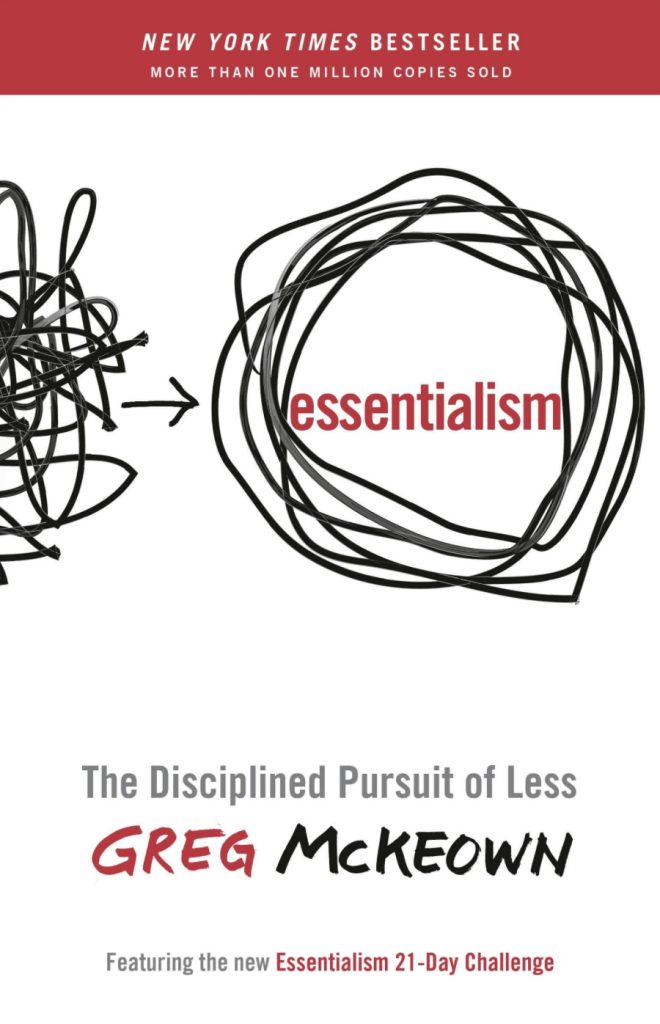
McKeown, G. (2014). Essentialism: The Disciplined Pursuit of Less. New York: Crown Publishing Group.

“We tend to over emphasize the external aspects of decision-making (options) and underemphasize the internal aspects (actions). Options can be taken away, while our ability to choose, or our free will, never can be.”
“Why is it so hard to choose what is essential over what is nonessential? Most often, it is because we are unclear about what is essential to us.”
“There is a world of difference between setting out to “do” essentialism and seeking to “be” an Essentialist. “Doing” essentialism just becomes something else to labor over. As essentialism becomes the essence of who we are, it becomes effortless.”
“We see the philosophy of “less but better” reflected in the lives of endless notable figures, both religious and secular. The Dalai Lama, Steven Jobs, Leo Tolstoy, Michael Jordan, Mother Teresa, Henry David Thoreau, Buddha, and Jesus are just a few of these examples. By choosing to live a life full of meaning and intent, we can choose to live without regret and focus on what is truly essential.”