
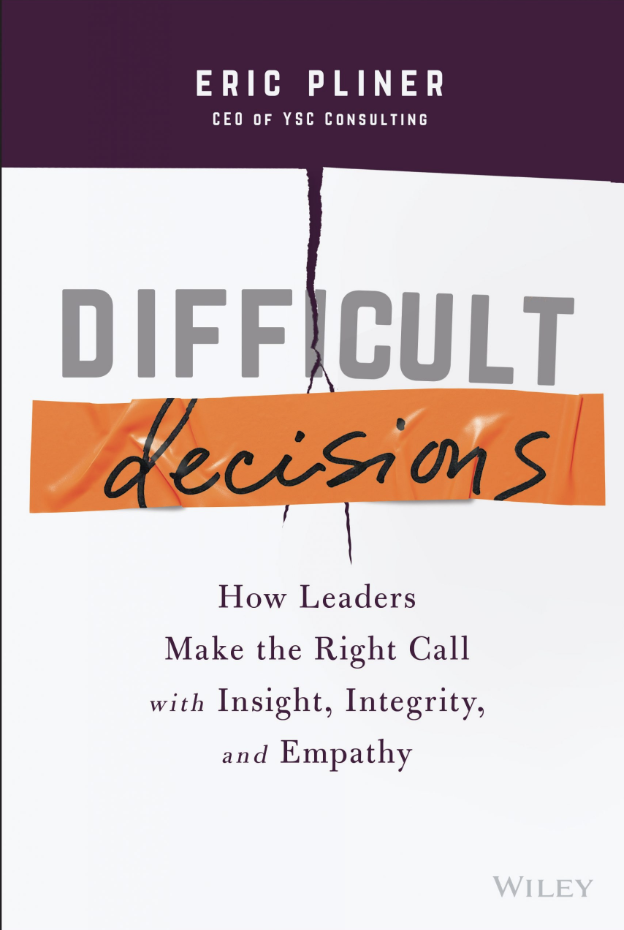
Key Quote:
“Intentional design of leadership strategies requires an understanding of where we’ve come from, who we are today, how we got here, where we want to go, and how we’d like to get there” (p. xii).
Key Points and Concepts
Preface: Intentional Design in Decision-Making
Pliner sets the stage for the importance of intentional design in decision-making. He emphasizes the need for leaders to understand their backgrounds, current positions, and opinions to design effective approaches to professional and interpersonal situations. The preface underlines the significance of interpreting the world and applying knowledge based on current circumstances, advocating for self-awareness in decision-making (pp. xii-xiv).
Introduction: Eric Pliner’s Framework for Decision-Making, Intentional Design
Pliner introduces the abundance mindset and its relevance in decision-making, prompting questions about the conflict between moral beliefs and financial stability during challenging times. He underscores that the most critical decisions cannot be made objectively and outlines three key decision-making factors: Lived Moral Belief, Explicit Ethical Framework, and Role Responsibilities (pp. 7-20). The introduction lays the foundation for intentional design in leadership, emphasizing the need for leaders to understand their personal expertise, skills, and context (p. xiv).
“Intentional Design of leadership strategies requires an understanding of where we’ve come from, who we are today, how we got here, where we want to go, and how we’d like to get there” (p. xii).
The Triangle of Morality: A Framework for Decision-Making
Pliner discusses the Triangle of Morality, emphasizing the importance of intentional design in leadership. Leaders are encouraged to consider their lived moral belief, explicit ethical framework, and role responsibilities when designing their leadership style and organizational culture. Making everyone happy is deemed unrealistic, but shaping a net positive outcome is achievable through aligning these three factors (p. 23).
While Pliner argues that the triangle of morality can help us make the most comparatively “good” decision, he notes that no truly difficult decision will ever leave everyone 100% happy. This concept was introduced earlier in the book and boils down to the idea of “trade-offs” (p. 25).
“Morals and ethics come into conflict when what we personally believe about what is right and what is wrong is ignored, disputed, or contradicted by what is considered acceptable in our organizations, societies, and cultures” (p. 23).
Case Study: Ralph Lauren Furloughs 80% of Workforce
During COVID-19 lockdowns, it became apparent to the CEO of Ralph Lauren that their most critical problem was preserving cash. They had no indication of how long this situation could last. The company wanted to remain vibrant for many years to come; however, resource restrictions threatened the loss of 24,000 jobs. Even after stopping all external cash burns and projects, the leadership team understood further measures needed to be taken. Ultimately, their responsibility was to ensure the survival of the company for their stakeholders (see pages 122-127 for definition) and adhere to their core mission and values. The CEO took direct responsibility by cutting their own compensation and furloughing 80 percent of their workforce. The CEO explained the steps taken, provided reasoning, and offered emergency resources where possible. This transparency was appreciated by the workforce; consequently, 70 percent of workers chose to return post-lockdown. The CEO and leadership team understood that there would be trade-offs and pain; they recognized it would be impossible to please everyone. Yet, in light of these challenges, they chose to preserve their core mission to align their decision-making process with stakeholder interests (pp. 35-40).
Understanding Morality and Values
Pliner distinguishes between values and morals, defining values as indicators of what one stands for and morals as what one refuses to stand for. He explores the coexistence of diverse moral notions and stresses the importance of leaders communicating their morality intentionally. Leaders should understand the sources of their morality, set boundaries, and determine relevance to their leadership context (pp. 43-49).
“Values tell us what we stand for—but morals tell us what we absolutely won’t stand for” (p. 43).
Pliner urges readers to understand where their morals come from, reflect on these sources, and understand parameters and boundaries.
He reiterates that “morals and rights are not absolutes” while referencing a case study around the National Gallery of Art’s decision not to show a piece mocking the KKK—not out of fear or adherence to racist beliefs but because Kaywin Feldman noted that “the majority of our guards—about 85 percent—are African American.” She became increasingly awareof what it would mean to ask them to stand eight hours a day guarding these images (pp. 59-65).
Kaywin Feldman and the National Gallery realized that at that time surrounding these images were different morals at play; different stakeholders had varying ideas about resolution. It was only after she asked “to which stakeholders are we most beholden?” did it become clear what was morally permissible for leadership (p. 73).
Ethics: External References and Individual Interpretations
Pliner delves into external references regarding ethics and individual interpretations thereof. He describes ethics as externally provided but internally interpreted—revolving around shared social acceptability rather than popularity (p. 75). The discussion includes acknowledging exceptions to ethical rules along with decision-making processes involving framing, envisioning, recognizing, and analytical vigor (pp. 98-101).
“Ethics are contextually dependent; therefore they are not uniform” (p. 76).
Role Responsibilities and Identity in Decision-Making
The shift in prioritizing stakeholders over shareholders raises questions about rightness or wrongness based on role responsibilities (p. 122). The threefold role—identity, expression, attribution—is discussed with Pliner advocating for authenticity while skillfully navigating these facets (p. 127).
Pliner walks through various “role titles,” such as saver vs investor; these titles highlight different personalities, responsibilities, and inevitable conflicts that can occur in leadership decision-making processes.
Applying the Triangle to Decision-Making
Pliner introduces a tissue test as a tool for evaluating responsibility in decision-making processes while emphasizing structured approaches:
1.) What am I deciding?
2.) Consider your stakeholder set.
3.) Ask: “Should I be deciding?”
4.) Ask: “By when must this decision be made?”
5.) Determine how this question should be decided.
6.) Clarify who you will engage with and how.
7.) Before discussing content decisions, discuss how decisions were made.
8.) Standardize processes focusing on decision making.
9.) Ask stakeholders for input.
10.) Thank stakeholders for input while reminding them how decisions will be made.
Power sharing in decision making involves:
• A view is simply a perspective.
• A voice elevates perspective into recommendation.
• A vote changes authority from “mine” to “ours.”
• A veto moves final authority back to an individual (pp. 181-182).
Conclusion: Acknowledging Complexity in Decision-Making
The conclusion emphasizes making decisions as a significant
accomplishment while acknowledging complexities throughout this journey (p. 186).
Afterword: Wrapping Up the Decision-Making Journey
The afterword encourages reflection on having made a decision as a noteworthy accomplishment while recognizing challenges faced throughout this process.
Tetlock, P. & Gardner, D. (2015) Superforecasting: The Art and Science of Prediction. New York: Crown Publishers.

“Intentional Design of leadership strategies requires an understanding of where we’ve come from, who we are today, how we got here, where we want to go, and how we’d like to get there.”
“Kaywin Feldman and the National Gallery realized that at that time surrounding these images were different morals at play; different stakeholders had varying ideas about resolution. It was only after she asked “to which stakeholders are we most beholden?” did it become clear what was morally permissible for leadership.”
“There is content within these pages which you are bound to disagree with. Your view isn’t necessarily right; but then, neither is mine…I still think it’s worth writing, and hopefully you think it is worth reading. Here is why…” (p. xi)