
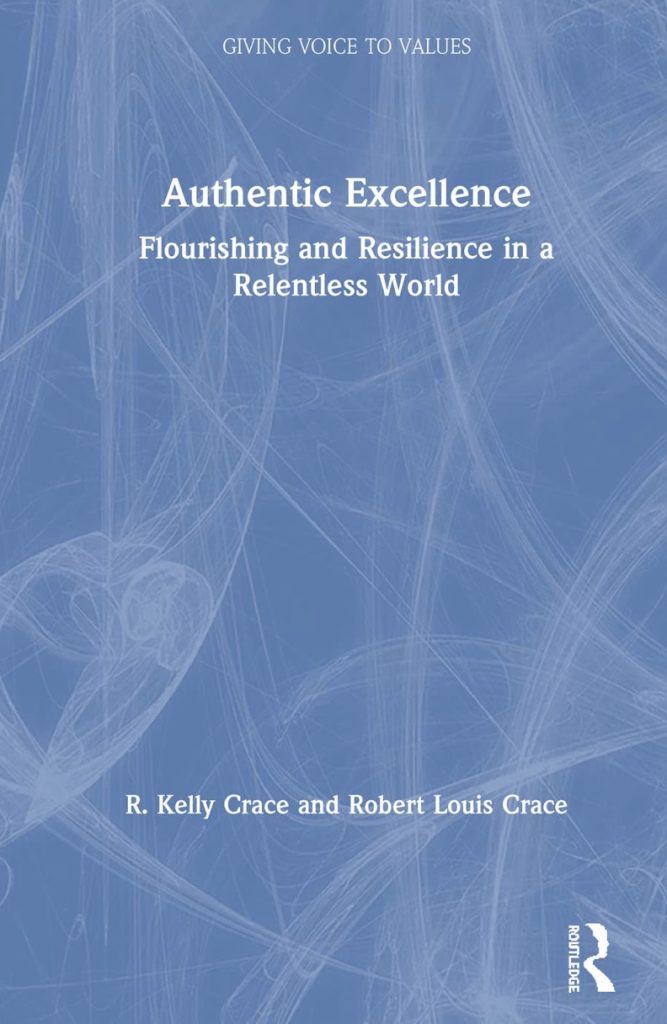
A Rule of Three Book Summary by Admired Leadership
The Book in 3 Sentences: Authors R. Kelly Crace and Robert Louis Crace argue that today’s relentless pace of change and pressure creates a unique vulnerability in young adults, causing them to plateau at “good enough” when the very values that initially led to their success become sources of fear and stagnation. Building on three decades of empirical research through the Life Values Inventory (assessing over 160,000 subjects), the book distinguishes between “living at your neurology” (using sympathetic crisis and parasympathetic regulation as motivational strategies) and authentic excellence that emerges from values-centered living. Through five paradigm shifts—from values clarification to values relationship, from equity-minded to integrity-minded, from fear reduction to holding fear well, from avoidance to confidence in managing difficult emotions, and from evaluative to expressive mindset—the book provides a framework for achieving consistent productivity, fulfillment, and resilience.
The 3 Most Important Concepts:
Living at your neurology: The authors define this as “essentially using our sympathetic (crisis) and parasympathetic (regulation) nervous system as a motivational strategy. We focus on all of our critical ‘have to’s of the day and then seek comfort by whatever soothing habits we’ve developed.” While this approach is natural and can be effective, it is a coping mechanism that gradually erodes resilience, performance, and health. The shift to a relentless world where “fear is now exceeding trust” has made this neurological pattern the default for many young adults.
The plateau effect and its four vulnerabilities: Young adults who achieve initial success through their values paradoxically become vulnerable to plateauing when that success becomes tied to self-worth. The four key vulnerabilities that emerge are: (1) fear of failure manifesting as perfectionism (over-control) or procrastination (avoidance), (2) need for equity and fairness causing resentment when effort doesn’t yield expected returns, (3) chronically evaluative mindset creating guilt toward self and judgment toward others, and (4) competing values leading to over-commitment or indecisiveness. These vulnerabilities represent “the very same reasons that lead emerging adults to excel through adolescence will start to work against them.”
Fear-based excellence versus authentic excellence: The book establishes that “there is a difference between being outcome-driven and outcome-desperate.” When an outcome is a “want to” it works positively, but when it becomes a “need to” attached to self-worth, it interferes with performance. Authentic Excellence redefines success as “the courage to act on your values” rather than outcomes achieved, shifting motivation from fear-centered to values-centered, resulting in “a deeper level of productivity, fulfillment, and resilience.”
The Book’s 3 Most Essential Claims:
1. Values require relationship, not just clarification: The authors assert that “in order for values to serve as a consistent influence on our behavior and a strong source of motivation, we must move from values clarification to a deeper, relational understanding of our values.” This involves annual reflection, story connection, and understanding that values are “a double-edged sword because they are our highest source of fulfillment, but they are also a high source of stress.”
2. Integrity must replace equity as the measure of worth: “One of the cornerstones of adult self-esteem is a personal sense of integrity, of how well our behavior is aligned with our values.” The paradigm shift requires deriving worth “primarily from the expression of your values rather than the outcomes of the day.” While outcomes affect mood, “they shouldn’t be so personalized that they affect our self-worth.”
3. Fear and difficult emotions must be held well, not eliminated: The book argues we must shift “from reducing fear through control and avoidance to holding fear well” and develop “confidence in managing difficult emotions” rather than avoiding them. This involves keeping fear in its “sweet spot” where it provides information without driving behavior. Recognizing that “vulnerability which leads to trust” is essential for authentic excellence.
3 Surprising Facts or Insights:
The 14 empirically stable values: From an initial list of almost 200 values from previous research, only 14 values emerged as empirically stable through rigorous factor analysis: Achievement, Belonging, Concern for the Environment, Concern for Others, Creativity, Financial Prosperity, Health and Activity, Humility, Independence, Interdependence, Objective Analysis, Privacy, Responsibility, and Spirituality. This suggests that human values are more universal and limited than commonly believed.
Cognitive strain versus cognitive ease: The book reveals that “managing our fear of failure through over-control or avoidance is a form of cognitive ease because it is what our neurological system is designed to do.” Moving to values-based responses requires temporary cognitive strain—deliberate effort to break automatic patterns—before new behaviors can become natural, explaining why change feels so difficult even when we know what we should do.
The paradox of striving: The authors argue that striving for passion, happiness, potential, and balance actually works against us. Instead, we should strive for purpose (not passion), meaning (not happiness), expression (not potential), and harmony (not balance). “Paradoxically, the more you strive for purpose, meaning, expression, and harmony, the more you experience passion, happiness, balance and optimal performance. It’s attaining these experiences by effect instead of intention.”
3 Actionable Recommendations:
Conduct annual values meetings: “Commit to reflecting 1-2 times a year on what matters most to them and how those values are demonstrated in their behavior.” Use the Life Values Inventory to categorize values as High Priority, Over-Attention, Under-Attention, and Medium/Low Priority. Create stories about your values relationships and share them with others, as “when you organize your thoughts into a conversational story that others understand, you move into another level of understanding.”
Practice Dynamic Blueprinting: Define what healthy versus unhealthy expression looks like for each value in concrete behavioral terms. “If we have a clear understanding of what unhealthy expressions of our values look like, we can recognize when the world pulls us in that direction. Similarly, if we define what healthy expressions of our values look like, we have a better idea of where to go when we drift.” Focus on behavior rather than outcomes when blueprinting.
Implement the four daily verbs: “You can limit your focus to just four verbs each day: learning, expressing what you’ve learned, relating, and taking care of yourself.” Study to learn (not for grades), test to express learning (not for evaluation), focus on relating (not relationships as outcomes), and prioritize self-care. This verb exercise focuses on maintaining attention on controllable actions rather than uncontrollable outcomes.
3 Questions the Book Raises:
Can authentic excellence truly be sustained in environments that structurally reward fear-based excellence, particularly when “we can’t ignore the reality of outcomes and the importance that they play in our world?”
Is the plateau effect an inevitable developmental stage, given that “the very same reasons that lead emerging adults to excel through adolescence will start to work against them,” or can early intervention prevent it?
How do we reconcile individual values expression with systemic constraints, when the book acknowledges that “the pressures of life do not foster flourishing; they drift us from it?”
3 Criticisms of the Book:
While claiming broad applicability to young adults, the book’s case studies and examples predominantly feature college students and those transitioning through traditional educational and career paths, potentially limiting relevance for young adults in non-traditional situations.
The five paradigm shifts, though conceptually rich, sometimes lack concrete implementation strategies for those facing severe external constraints. The book acknowledges that flourishing requires “catching and recovering” from unhealthy patterns but doesn’t fully address how to do this when basic needs aren’t met.
The authors’ institutional backgrounds (college mental health centers) and the book’s foundation in positive psychology may create assumptions about available resources and support systems, making some recommendations feel inaccessible to those without institutional support or facing systemic barriers.
3 Quotations Worth Remembering:
“‘Living at your neurology’ means we are essentially using our sympathetic (crisis) and parasympathetic (regulation) nervous system as a motivational strategy. We focus on all of our critical ‘have to’s’ of the day and then seek comfort by whatever soothing habits we’ve developed.” (p. 4)
“There is a difference between being outcome-driven and outcome-desperate. Essentially, when an outcome is a ‘want to’ it tends to work positively for us; but when an outcome is a ‘need to’ where it is attached to our self-worth, it tends to interfere with our performance.” (p. 5)
“One of the cornerstones of adult self-esteem is a personal sense of integrity, of how well our behavior is aligned with our values. They are never perfectly aligned but when our behavior reflects what is important to us, we feel good about ourselves and manage stress in a resilient manner.” (p. 58)
