
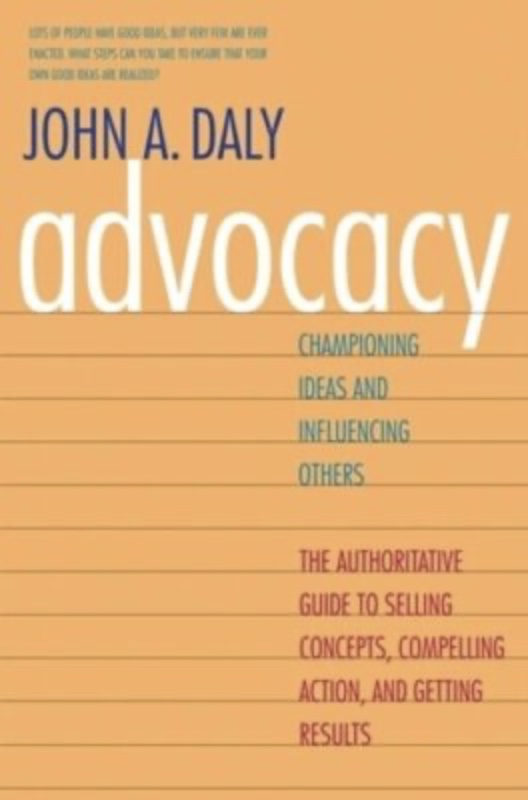
A Rule of Three Book Summary by Admired Leadership
The Book in 3 Sentences:
The author argues that advocacy is a learnable, structured skill that goes well beyond simply having a good idea, requiring clear communication, deliberate relationship-building, and strategic influence. Daly outlines a practical five-part framework showing how successful advocates build credibility, presell their ideas to the right people, and shape how problems are defined before solutions are ever proposed. The central insight is that how you champion an idea almost always determines its fate more than the quality of the idea itself.
The 3 Most Important Concepts:
The Advocacy Framework is the author’s five-part model for effective advocacy, which includes communicating clearly and memorably, building credibility and affinity with the right people, cultivating relationships that allow ideas to gain traction, preselling ideas before the formal pitch, and influencing the decision makers who ultimately matter most.
Useful Redundancy is the practice of reinforcing your core message across multiple formats (stories, visuals, examples, and varied media) so that key points stick with the audience without becoming repetitive or predictable. The goal is repetition of substance, not repetition of form.
Problem Definition is the principle, central to Daly’s thinking, that whoever frames the problem controls the solution. Successful advocates invest real time in reshaping how a challenge is understood, because a well-defined problem points naturally toward the advocate’s preferred answer before any debate begins.
The Book’s 3 Most Essential Claims:
1) Advocacy is a systematic, teachable discipline and not an innate talent. Anyone willing to study and practice a clear set of communication and influence skills can become a more effective champion of ideas.
2) The questions your audience asks during a presentation reveal far more about their priorities than anything they volunteer on their own. Skilled advocates treat every question as a signal worth decoding and a chance to reframe their case around what the audience actually cares about.
3) Strategic relationship-building before a formal pitch is often the decisive factor in whether an idea gains traction. Identifying allies early, pre-selling to key influencers, and symbolically including stakeholders in the process can matter more than the pitch itself.
3 Surprising Facts or Insights:
A converted opponent is among the most valuable advocates you can have. When a former skeptic champions your idea, the credibility that person carries with other doubters far exceeds what you could ever say on your own behalf. This makes it worth the effort to bring critics around rather than simply route around them.
Symbolic inclusion is remarkably cheap and remarkably effective. Simply inviting people to participate in a process, even in a limited or ceremonial way, generates a sense of ownership that can turn passive bystanders into genuine supporters. Most advocates underestimate how much goodwill this costs them nothing to create.
The hotel elevator problem is one of the book’s most instructive examples. When guests complained about slow elevators, the real problem turned out not to be speed or capacity but perceived wait time. Installing mirrors in the lobby solved the complaint without touching the elevators at all, a reminder that redefining a problem often does more work than solving the original one.
3 Actionable Recommendations:
Pay close attention to the questions others ask during meetings and presentations. Those questions are rarely random. They surface what the audience finds most important, and a skilled advocate uses them as an invitation to pivot toward those concerns rather than sticking to a prepared script.
Name the weaknesses in your own idea before critics have a chance to. Openly acknowledging a flaw signals confidence and intellectual honesty, and it significantly reduces the impact of an opponent who tries to raise the same point later as if it were a revelation.
Presell your ideas by surfacing them early and allowing key decision makers to arrive at your conclusion on their own. People who believe a good idea originated with them tend to champion it with far more energy and persistence than people who were simply persuaded by someone else.
3 Questions the Book Raises:
At what point does strategic advocacy cross the line from legitimate influence into manipulation? The book is notably quiet on this, but the tactics Daly describes, including planting ideas and engineering social pressure through surrogates, raise real ethical questions worth sitting with.
How should an advocate handle a situation where the idea being championed is genuinely inferior to a competing option? The framework assumes you are advocating for something worth advocating for, but does not reckon seriously with what to do when that assumption does not hold.
If problem definition is as powerful as Daly argues, how do organizations build the discipline to slow down and interrogate how a problem is being framed before rushing toward solutions? The book makes the case compellingly but offers less guidance on the culture change required.
3 Criticisms of the Book:
The book presents influence tactics without drawing clear ethical boundaries. Planting ideas so that others believe they originated them, or leveraging social networks to engineer pressure on decision makers, can easily slide into manipulation. Daly acknowledges the risk in passing but does not engage with it seriously enough to give readers a principled framework for where to stop.
The examples lean heavily on corporate and political settings, which can make the framework feel less applicable to people working in environments where relationships and hierarchies behave differently. Advocates in nonprofits, academic institutions, or highly regulated industries may find themselves doing extra translation work throughout.
The framework is genuinely comprehensive, but comprehensiveness comes at a cost. With five major components and dozens of supporting tactics, readers looking for a simple, memorable model may find the book more useful as a reference to consult than as a roadmap to follow. It teaches a lot but may leave some readers uncertain about where to actually start.
3 Quotations Worth Remembering:
“Whoever defines the problem wins.” (p. 51)
“A converted naysayer is a compelling advocate.” (p. 98)
“It is amazing what you can get done when you let others take the credit for it.” — George Marshall (p. 104)
